
Editor’s Note: This story includes mention of sexual violence. Resources are available here. All opinions, columns and letters reflect the views of the individual writer and not necessarily those of the IDS or its staffers.
As students settle in for the new academic year, they’ll be putting the final touches on their dorms, searching for their classes and, of course, completing the dreaded New Student Orientation modules.
While shoving my own array of cleaning supplies into a storage cubby, I overheard the modules playing from my roommate’s phone. More specifically, I caught the following line, which is a subset of Indiana University’s official definition of consent:
“Consent can be withdrawn at any time, as long as it is clearly communicated.”
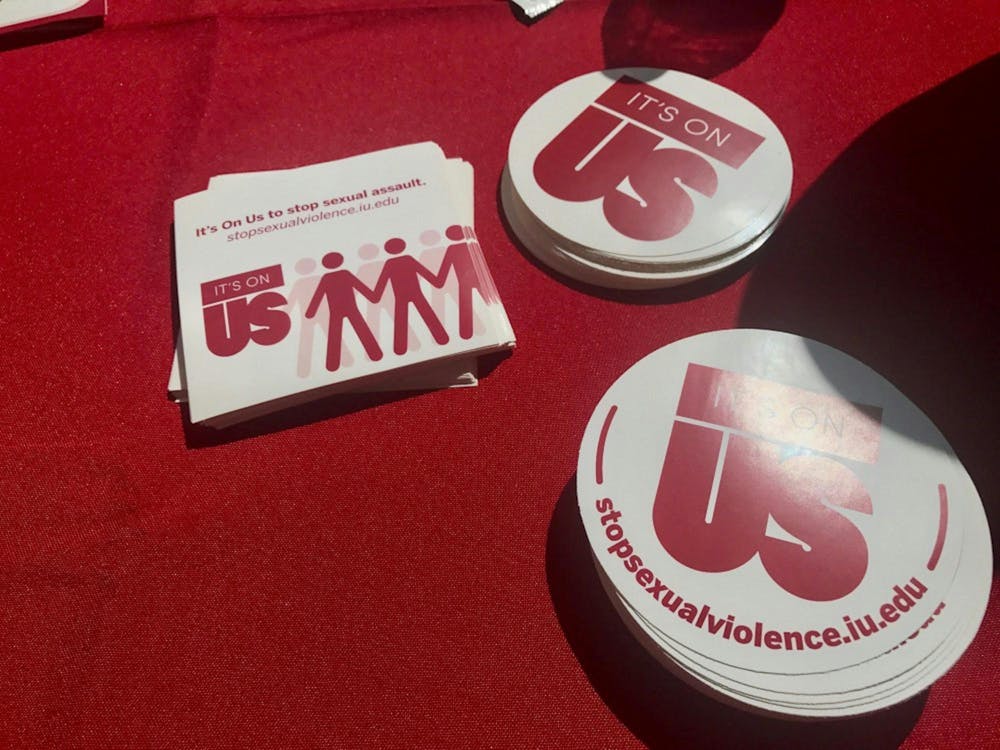
I first came across this line a year ago. It was written on one of the anti-sexual assault, “It’s On Us” signs around campus. Faced with this portion of the definition, I began to question a recent experience I had of my own, wondering if I had clearly communicated my discomfort. However, I soon noticed other students had begun to adjust the signs by crossing out the second half of the sentence, sometimes even replacing it with more unconditional alternatives.
“Consent can be withdrawn at any time, for any reason or no reason at all,” one read.
Inspired by the sense of relief these changes brought me, last semester, I included the original line and its student-edited alternatives as a part of a broader column about victim-blaming language in media. Yet, IU continues to spread this harmful narrative.
Campus policy officially defines consent as an “agreement or permission expressed through affirmative, voluntary words or actions that are mutually understandable to all parties involved, to engage in a specific sexual act at a specific time.”
Incorporated are multiple bullet points underneath that initial definition, including that consent “cannot be assumed based on silence, the absence of ‘no’ or ‘stop,’” and, in seeming contradiction to this, that consent “can be withdrawn at any time, as long as it is clearly communicated.”
As far as I’ve seen, campus signage and orientation modules only present the latter.
The line regarding “clear communication” of a withdrawal indicates there is a correct or incorrect way to retract consent when the reality is that it’s never that simple. Situations vary, and clear communication is not always possible. But when so many students are taught this definition — by official university sources, no less — they will begin to apply it to their own varying situations. No student facing the aftermath of sexual assault or harassment should have to second-guess their experience.
Unfortunately, victim blaming ideology is not only prevalent in our campus policy, but in our culture at large.
Victim blaming is a social phenomenon in which individuals are held responsible for their own harmful experiences, disregarding any further contributing context. In the case of sexual assault victims, around 75% have encountered victim blaming in some way. Not only does this mindset produce mental distress in survivors, but it strongly correlates with the underreporting of cases. According to the American Psychological Association, it is estimated around 90% of assault cases on college campuses go unreported.
As the Red Zone begins, this topic is more pertinent than ever.
The Red Zone refers to the time between the beginning of the fall semester and Thanksgiving break. According to the Dallas Rape Crisis Center, this is when over 50% of campus assaults occur nationwide. New students are particularly at risk. During this time, it is more important than ever that universities provide the proper support for their students. IU is no exception.
During the Red Zone, it is more than likely that increasing numbers of students will become victims of sexual assault over the course of the semester. That means more students may be witness to the school’s current terminology surrounding consent and apply it to their own experiences.
However, IU has a chance to make real change for students this fall.
I am no expert in the field of social work. That acknowledged, my prior column garnered responses from students who are studying those topics, and they were open to giving suggestions on how IU’s current written policies could be amended:
“These posters could even highlight examples of when someone withdraws consent,” social work student Emily Knight and Indiana Daily Student guest writer wrote. These examples would expand “one’s perspective on how withdrawal of consent and rejection look in many different ways.”
In addition to consulting social work and mental health professionals, IU could benefit from looking at other universities as examples.
Purdue University’s policy states, "Although Consent may be given initially, it may be withdrawn at any point without regard to activity preceding the withdrawal of Consent.”
Similarly, the University of Notre Dame’s policy acknowledges the complexity around withdrawal: “A person who is the object of sexual aggression is not required to physically or otherwise resist the aggressor.”
Neither of the above statements dictate that survivors must provide affirmative communication when retracting consent like IU’s policy does. As the university continues to boast an inclusive and supportive environment for students, the implication that victims are somehow responsible for their experiences remains prevalent through the narrative told by “It’s On Us” signs and other forms of consent education. We deserve a better narrative.
Emma Howard (she/her) is a junior studying journalism.
A list of resources is available here if you or someone you know has experienced sexual harassment or abuse.



