
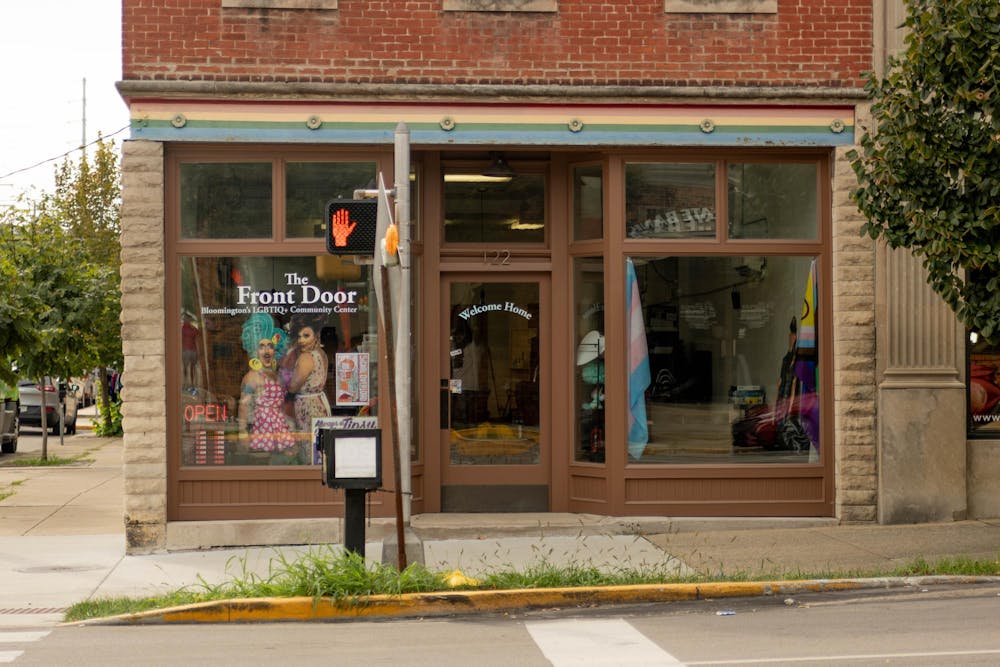
The Front Door Community Center had its soft opening on Aug. 22 , but for board president Melanie Davis, creating a safe environment for the LGBTQ+ community has been years in the making.
After moving to Bloomington 17 years ago, Davis noticed an interest amongst the local LGBTQ+ community for a designated space. She said she knew bars were a common gathering spot for community members, but it made sense for there to be a spot for younger people and people who don’t want to go bars. Now, The Front Door is open at 122 S. College Ave., and it plans to have a grand opening event later this month.
Davis mentioned that Rachael’s Cafe, formerly located at 300 E. Third St., was a notable gathering spot for the community, but the restaurant closed in 2015 for financial reasons.
As a friend of café owner Rachael Jones, Davis began collecting items like silverware and cups from the restaurant, hoping to one day open a similar location. In 2019, Davis was finally ready to create a new center but was delayed by factors like the COVID-19 pandemic.
In 2023, Davis said she was approached by Amy Jackson and Ryne Shadday, current member and former chairman of the Bloomington/Monroe County Human Rights Commission, renewing conversations about creating a local center.
“It needed to happen,” Davis said. “I figured the right people would come together at the right time if we got things started, and they did.”
Davis brings over 20 years of experience volunteering with LGBTQ+ centers in Indiana, including the Indiana University LGBTQ+ Culture Center. She also founded Protect Our People in 2023, a nonprofit formed to provide gender-affirming care for transgender, nonbinary and other gender-expansive individuals within Indiana.
According to Davis, Protect Our People has merged with The Front Door. The center is home to a gender-affirming closet, a free resource where people can find clothing that suits their identity. The clothing is sourced from donations, Davis said.
The Front Door center is also a venue for events like “GayRage” garage sales, self-defense lessons and bring-your-own craft sessions. But most importantly, Davis said, it is a community gathering space that welcomes anyone.
“Somebody came in and they went directly to the coloring pages,” Davis said. “It helped them kind of decompress from where they were, and they left happier than they came in, and they had this piece of work with them. It’s those little things that's what's been happening already, and I just hope it continues on a larger scale.
Davis said The Front Door looks to the community for input when planning events. In July, the center had a “Come Dream with Us” event, where people could share their ideas for future programs.
In the upcoming year, Davis hopes to have recurring self-defense lessons and is planning a joint celebration with the university for the Transgender Day of Remembrance on Nov. 20. She said the best way for people to stay updated on The Front Door is connecting with its Instagram and Facebook.
She said The Front Door wants to work with the greater Bloomington community, and they have already partnered with several organizations, such as Women Writing for (a) Change.
Board member Minassa Gabon said the center already received an overwhelming response after putting out a call for volunteers.
Gabon, a minister at Unity of Bloomington, said she learned about The Front Door through participating in Pride celebrations around Bloomington and Spencer, Indiana.
“We all wear masks; we all put on a front,” Gabon said. “That's just basic humanity, but to be able to come to a place where everybody knows your name and you're safe, that is just so important to me, and that's why I decided to get involved.”
Gabon said The Front Door is a space where older members of the LGBTQ+ community can connect with younger people, who may have greater access to LGBTQ+ resources than previous generations.
"That wasn't always the case, and you had to be secretive about it,” Gabon said. “And so, a place where you can come and have fun, where you can just sit and relax, and where you can meet like-minded people, to me, that's the best activity or the best way for this sacred space to serve.”
Gabon acknowledged the LGBTQ+ Culture Center at IU but said the space can be prone to changes in the state’s political climate. The Front Door, however, is independent from the university’s decisions.
The university’s six cultural centers operate under the Office of Student Life, which works with students, staff, alumni and donors. The LGBTQ+ Culture Center is supported by a combination of funds, including university funding and private donations.
IU senior Alexis Donnowitz has gone to events hosted by the university’s LGBTQ+ Culture Center but said it is important to have spaces away from campus too.
“The only LGBTQ+ experiences I've had off campus have kind of been nightlife-wise, but coming here, I think I think it's really good for Bloomington to have a space that's for all ages,” she said. “It seems to be really welcoming for all age groups or identities and backgrounds.”
When board members were brainstorming names for the community center, Davis said the idea was that people are “welcome through the front door.” She said it was a “secondary realization” that the name was similar to The Back Door, a queer night club in Bloomington.
But for Gabon, the center’s name holds a deeper meaning.
“As an African American, there are times I couldn't walk in the front door,” Gabon said. “To be able to do that as an African American, as an LGBTQ person, no one should be shut out.”
Looking forward, Gabon said one day she hopes there will not be a need for LGBTQ+ centers to exist, with the idea that every place would be a safe one.
“On the front door of The Front Door, I put the words ‘welcome home,’” Davis said. “Because a lot of us have unfortunately felt like we didn't have one, and I want people to feel like they have one.”
Natalie Chan covers issues of diversity for the Indiana Daily Student. Her work is supported by a donation to IDS Black Voices, a fund fostering coverage of and perspectives from Black and other historically underrepresented communities.



