
Editor's note: This story includes mention of sexual violence. Resources are available here. All opinions, columns and letters reflect the views of the individual writer and not necessarily those of the IDS or its staffers.
“Consent can be withdrawn at any time as long as it is clearly communicated.”
These words are featured on the anti-sexual assault “It’s On Us” signs in almost every bathroom on Indiana University’s campus. The quote really bothered me upon first notice. It felt so cut and dry. In an actual sexual situation, psychological factors like fear and confusion often prevent such clear communication. When a poster tasked with providing support for sexual assault victims fails to acknowledge the complexity of trying to withdraw consent, it’s easy to feel like not saying “no” means an attack was these victims’ fault. It wasn’t.
Fortunately, Sharpie-wielding students have sought to correct these posters’ problematic narrative. Many flyers see the “as long as” portion of the sentence crossed out. One sign I saw even offered its own maxim:
“Consent can be withdrawn at any time for any reason at all.”
That sounds much better. Students who have survived sexual assault don’t need an extra source of doubt about their experience, wondering if they “clearly communicated” their discomfort.
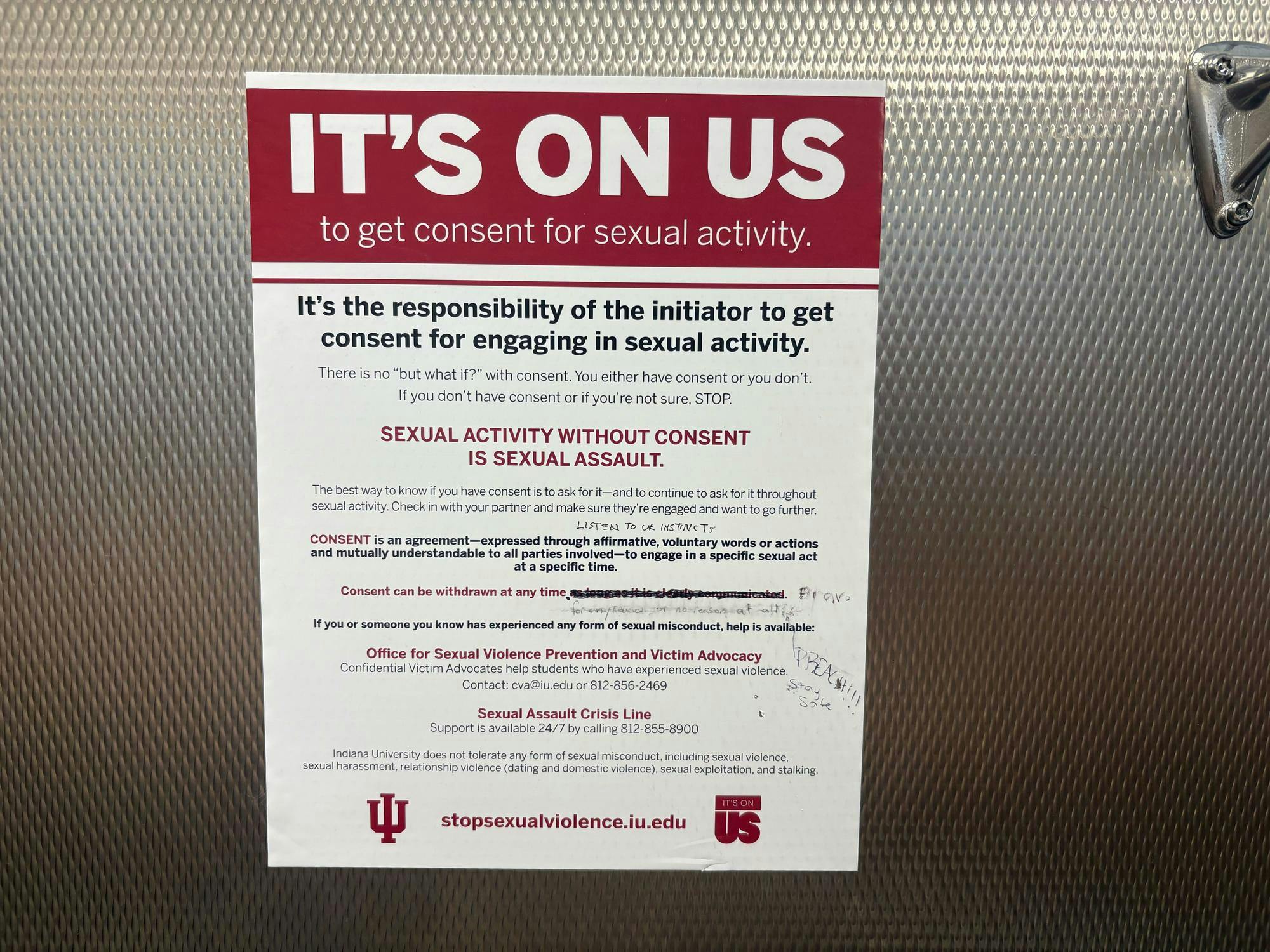
An It's On Us sign is seen on a wall April 13, 2026, in the Indiana Memorial Union. People crossed out part of a sentence that said consent can be withdrawn at any time "as long as it is clearly communicated."
The language we use to discuss sexual violence molds our culture around it. Our media often falls short, shifting the blame from perpetrator to victim. In response, groups like The Right Words Project are setting out to change how we portray abuse cases in the media.
When I found out about the project via Instagram, it reminded me of our campus’s own student sign-changers. The Right Words is a UK-based nonprofit that prompts journalists to use an active voice when reporting on abuse. According to the organization’s manifesto, too many media organizations use a passive voice when reporting cases of sexual assault, abuse and violence. By omitting perpetrators from headlines, culpability falls on the victim. Take the following BBC headline from March, for example:
“Woman raped on university campus after night out.”
Here, the victim — and her activities leading up to her assault — is the subject of the sentence, while the perpetrator is completely unacknowledged. By using passive wording, this headline fails to place responsibility on the proper party. Furthermore, by emphasizing the woman’s behavior, the headline hints to the reader that her trauma may be the product of her own actions. The archaic narrative that women should regulate their habits to avoid violence perpetuates a culture of victim blaming. Now take The Right Words’ rewrite of the same headline, and notice the use of active language:
“Man rapes woman on university campus.”
In this correction, the perpetrator is the subject of the sentence, rather than the victim. He is framed as directly responsible for the action, and unnecessary details on the woman’s conduct are eliminated. Like the corrections made to IU’s bathroom signage, The Right Words places responsibility squarely on the perpetrator’s shoulders.
According to a 2001 study published by the British Journal of Social Psychology, a direct relationship links the language we use around sexual violence and victim-blaming ideology. Researchers tasked a group of university students with writing short descriptions of two different video segments of rape from fiction film and television, one containing few details that perpetuate common rape myths, and the other with many.
In one clip, strangers attack an “inconspicuously” dressed woman in an alleyway. When describing this clip, participants were more likely to use an active voice, placing more blame on the perpetrator. In the other, featuring common stereotypes about rape, the attacker and the woman show mutual interest in one another at a bar before he rapes her. Students shown this video were more likely to describe the events using passive language, showing a positive correlation between passive voice and perceived responsibility of the victim.
Passive wording isn’t the only linguistic issue with how sexual violence is framed in the media. A guideline created by the Virginia Sexual and Domestic Action Alliance lists several terms journalists should avoid using when discussing sexual assault. For example, the Alliance advises against using words and phrases like “sex,” “intercourse,” “perform” and “engage in” to describe criminal behaviors like rape, as they imply mutual consent between two parties. By employing terminology that would typically describe a consensual experience, the violence of sexual assault is minimized.
Similarly, Clare McGlynn, a law professor and expert on gender-based violence at the UK’s Durham University, has developed the phrase “image-based sexual abuse” to replace the more sensationalized term “revenge porn.” By focusing on the aspect of a “vengeful” ex-partner, McGlynn claims that the phrase does not account for all cases of sharing explicit images without consent. Using a broader term, like “image-based abuse,” prompts media and lawmakers to take such cases more seriously.
In addition, Advocates for Youth, a youth activist organization primarily focused on sexual and reproductive health, urges journalists to respect survivors’ narratives by avoiding the word “allegedly” or “alleged.” However, publications typically require these terms for reporting on any crime until an official verdict has been reached, due to the risk of libel and defamation lawsuits. That said, it is essential that the validity of a victim’s account does not come into question unnecessarily. For more ethical journalism, Advocates for Youth suggests using direct quotes as much as possible, allowing survivors more control over their stories. Letting survivors speak for themselves gives them the ability to include the details they feel are most important, that paraphrasing, for example, might omit.
Despite the work of academics and activists to curb harmful language around sexual violence, the poorly worded headlines are still pouring in.
In January, CBS News reported “Florida Memorial University student raped on campus, suspect still at large,” using a passive voice rather than an active one.
A local news outlet in Louisiana following the trial of Misty Roberts, who was found guilty of raping a 16 year old, ran the headline, “Former DeRidder mayor Misty Roberts’ underage sex sentencing delayed,” implying the consent of a victim who could not legally give it.
Just last week, the BBC wrote, “Woman’s ordeal after abduction and rape by fake taxi driver,” placing the victim as the subject, letting the perpetrator fade into the background.
Words are powerful. When you’re discussing sexual violence, remember to be mindful of the language you’re using. Describing traumatic crimes with the wrong phrasing can invalidate victims’ experiences. This Sexual Assault Awareness Month, find the right words.
Emma Howard (she/her) is a sophomore studying journalism.