
Indiana University Bloomington is proposing an overhaul of its general education curriculum, simplifying requirements and restructuring how students fulfill foundational coursework.
The IUB General Education Redesign Committee released a revised proposal in March 2026 after receiving faculty feedback. If approved, the framework would take effect in fall 2026 with full implementation expected for incoming students in fall 2027.
Danielle DeSawal, a co-chair of the redesign committee, presented the proposed changes to faculty at a town hall Thursday, with some professors saying the changes could impact existing courses, world languages and study abroad programs.
What are the proposed changes?
The revised program proposal establishes a 29-30 credit hour GenEd curriculum using a distributive model, meaning students would take courses across multiple areas of knowledge foundations.
The biggest change is the removal of the five Shared Goals requirements. Currently, Shared Goals include classes on intensive writing, information literacy, diversity in the United States, sustainability literacy and enriching educational experiences. The goals vary for each student by school and degree program.
There are six Common Ground requirements, which are the same for all students. They include foundational skills in English composition, mathematical modeling, arts and humanities, social and historical studies, natural and mathematical sciences and world languages and cultures.
Three Common Ground categories would change under the proposal. All mathematical modeling courses would be renamed to mathematical reasoning, with two precalculus courses now counting toward the requirement.
Arts and humanities and social and historical studies would each require at least one course carrying a new world culture credit, totaling six world culture credits across the two categories.
The world languages requirement would move from a range of zero to 14 credits, which varies depending on a student’s placement, exemptions and degree programs, to a flat six credits for all students. Students could fulfill the requirement either by completing a two-semester sequence in one language or by taking introductory courses in two different languages.
Courses completed through an approved education abroad program would count toward the GenEd requirements based on whatever category attribute the course carries at the time it is taken.
The proposed changes are set for a phased implementation. If approved, the framework would take effect in fall 2026 — but the only immediate change for that incoming class would be the removal of the Shared Goals. The full restructured 30-credit curriculum would likely not be in place until fall 2027, DeSawal said.
What did faculty have to say?
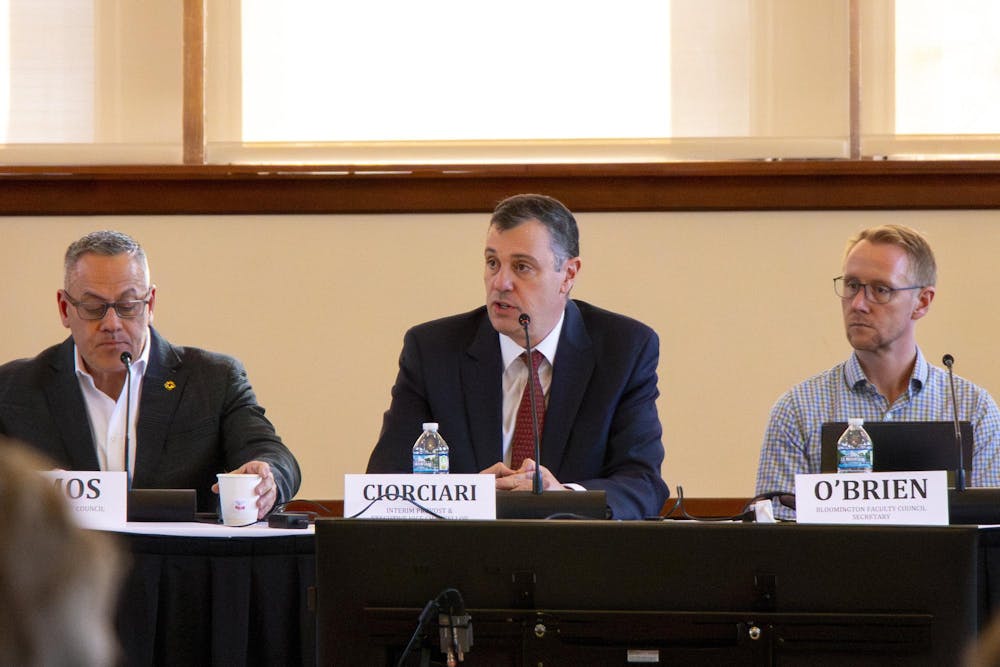
About 15 faculty members attended Thursday’s session, where Interim IUB Provost John Ciorciari and DeSawal presented the proposal.
“This is a very important juncture in the process,” Ciorciari said. “Faculty expertise is obviously vital to having a successful general education curriculum.”
Faculty questions centered largely on world languages, study abroad and how the new requirements would interact with existing programs. French and Italian professor Nicolas Valazza questioned the committee’s decision to allow two introductory language courses instead of a sequential series.
French and Italian teaching professor and committee member Karolina Serafin said the flexibility has broader academic benefits for students.
“Blending languages and seeing the difference between different languages, even at a basic level, has a huge impact on learning development,” Serafin said. “Students become better speakers of English by even learning the basics of foreign arts.”
As part of implementation, all existing GenEd courses would need to be reviewed under updated learning outcomes. Lecturer in music Gabriel Lubell raised concerns about whether the recertification process would shrink the range of GenEd-approved courses available to students.
Education associate professor and committee member Meredith Park Rogers said the reduction would largely reflect courses that are no longer being taught and that the process would shrink the range of GenEd-approved courses available to students.
“A little bit of that decline is going to be just cleaning house,” Park Rogers said. “That might allow for more courses to be developed and come in that are more up to date.”
Why is IU reviewing the GenEd curriculum?
First implemented in 2009, the GenEd Program is a mandatory, campus-wide curriculum for all IU undergraduate students. The curriculum consists of six Common Ground requirements and five Shared Goals, which must be completed before earning a bachelor’s degree.
The GenEd Program is managed by the General Education Committee, a body formed by the Bloomington Faculty Council in 2006 and co-chaired by Vice Provost for Undergraduate Education Vasti Torres for the 2024-2025 academic year. In 2019, the BFC established the Task Force on the Future of General Education to review the Bloomington campus’s GenEd curriculum.
Following a three-year review, the task force presented its findings to the BFC on Dec. 6, 2022. The report cited widespread student and faculty confusion, recommending structural reforms to the curriculum.
In response, the BFC created the Long Range Planning Committee in fall 2024 to develop recommendations for redefining the GenEd curriculum with input from IUB campus faculty.
The recommendations were passed to the General Education Redesign Committee in September 2025. The committee was then charged with proposing a revised, simplified curriculum structure for GenEd through continued conversations with faculty.
By March 4, 2026, the Redesign Committee shared a proposed curriculum update and invited feedback from the faculty. After reviewing campus input, the committee released a revised draft later in March 2026.
The final faculty town hall is scheduled for 1-2:30 p.m. April 1 in Presidents Hall within Franklin Hall.


