
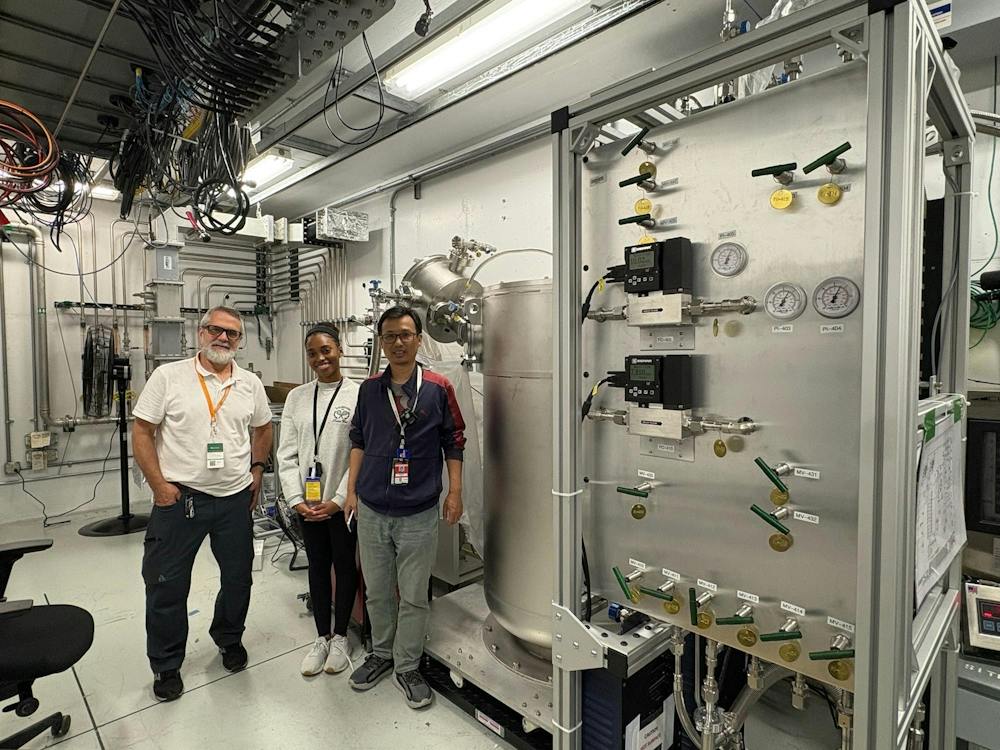
Indiana University researchers are leading the development of a new detector utilizing over 1,600 pounds of liquid argon that will operate alongside the world’s most powerful pulsed proton beam at Oak Ridge National Laboratory in Oak Ridge, Tennessee.
The detector, referred to as COH-Ar-750, will look for tiny fundamental particles called neutrinos interacting with atomic nuclei in a hard-to-detect process called coherent elastic neutrino-nucleus scattering, or CEvNS.
The construction of the detector not only pushes the boundaries of new detector technology, but it also allows interested students to get involved and gain research experience. Undergraduates, graduate students, postdoctoral researchers and professors are all working on different aspects of the detector, from testing components at the Multidisciplinary Engineering and Sciences Hall to handling the data it will collect.
Researchers first theorized CEvNS was possible 52 years ago, but it was first experimentally confirmed in 2017. Measuring the process with greater precision, though, can test predictions of the Standard Model of particle physics.
The Standard Model, a theory developed by physicists throughout the 20th century, is able to successfully describe the fundamental building blocks of the universe and how they interact, but it also leaves many questions unanswered.
Rex Tayloe, IU physics professor, said the university is leading the liquid argon detector development as a member of a 29-institution collaboration focused on observing the CEvNS process.
IU senior Elias Graf, a physics, math and computer science major who has contributed to the detector development, said the CEvNS process works like two billiard balls. The smaller neutrino and the larger argon nucleus bounce off each other, and when they collide, a tiny amount of light is released through a process called scintillation. Graf said the light from this collision is what the detector is searching for.
Neutrinos rarely interact with matter, often passing right through it. To increase the chance of neutrino interactions, there needs to be a large target mass and an intense neutrino source. For this detector, the large target mass is liquid argon, and the intense neutrino source is Oak Ridge National Laboratory’s Spallation Neutron Source.
The Spallation Neutron Source is primarily used for neutron research and produces neutrons, a different, larger particle, by aiming its 1.7-megawatt proton beam at a liquid mercury target.
This process creates an immense amount of neutrinos. The neutrinos, upon creation, are able to permeate matter. This means they can go through walls and into the detector, where they interact with the liquid argon.
Jeremy Lu, a postdoctoral researcher with IU working on the detector, said that one major challenge during the construction process was maintaining cleanliness. Any impurities in the liquid argon would significantly impair the scintillation process. This means that any work done on the detector components needs to be done in a clean room, a room where the air quality is closely monitored.
“You could imagine how challenging it is working in the clean room with gloves and masks, and how well you’d be able to handle tiny screws with those gloves,” Lu said.
Lu said another challenge with the detector construction is handling fragile components such as photomultiplier tubes. PMTs are highly sensitive devices that detect and amplify low levels of light.
The detector utilizes PMTs to see the scintillation light produced during the CEvNS process. However, when the light is first produced, it is in the ultraviolet range of the light spectrum. It has to be changed to a less energetic wavelength that the PMTs can detect.
This is done with Tetraphenyl-butadiene, a powdery wavelength shifter that has to be uniformly applied with great care.
To apply TPB, the powder is heated to 392 degrees Fahrenheit in a vacuum and then applied to the PMT surface, Lu said.
“If it’s not a good vacuum, then a lot of the TPB particles will get scattered off,” Lu said. “Once you have the coating there, then you need to be very careful to not scratch or drop liquid on it.”
Tayloe said they hope to have the detector running by December.
“We are working feverishly to do that,” Tayloe said. “You have to have all your procedures worked out, and it has to be a really rock-solid and safe detector. That took a little bit of time, and now we are doing the last steps.”
Tayloe said once the detector begins running, the data it collects will be used to precisely test if what they see agrees with what the Standard Model predicts. If it doesn’t, that means something else scientists don’t currently understand is happening, which would reveal flaws in the Standard Model.
Tayloe said working on the detector has been rewarding.
“It's a challenge, and then once you meet that challenge by building a fairly complex device, the data is beautiful,” Tayloe said. “That's the product of many years of work. Goes on a little longer than we want. But boy, getting those data sets makes it worthwhile.”


