
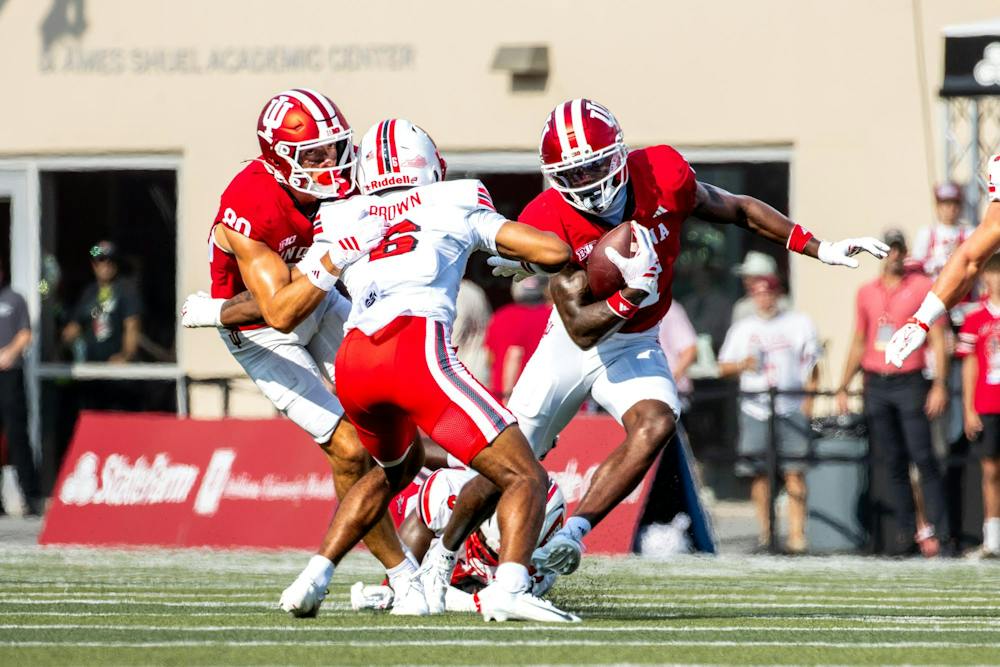
Indiana football faced a third-and-1 from the Northwestern 48-yard line. The Hoosiers’ defense had given up an 8-yard touchdown pass on the Wildcat’s previous possession, bringing the score to 15-13.
Seeking a response in Week 4, the Hoosiers leaned on the run game. Their offensive line created a gap allowing redshirt senior running back Lee Beebe Jr. to burst through the front and cut toward the sideline.
Northwestern defenders chased him to limit the damage, while sixth-year defensive back Ore Adeyi positioned in the secondary, ready to slow Beebe.
But Indiana redshirt senior wide receiver Shazz Preston was with Adeyi downfield.
Preston pushed Adeyi away from the sideline, clearing space for Beebe to gain extra yards and finish a 39-yard run.
Later in the fourth quarter, Indiana sent Preston in action. Starting from the left side of the formation, he ran across the middle of the field. Preston’s motion created chaos in Northwestern’s defense as he brought the outside defensive back with him and then crack-blocked a safety who crept up to stop the run after the ball was snapped.
Preston’s block paved the way for a 70-yard rush from Beebe and set up Indiana for a game-sealing touchdown.
Beebe rushed for 203 yards against the Wildcats — the most by a Hoosier in a game since 2018. The receiving core played a key role in reaching that yardage total.
On Sept. 7, Indiana head coach Curt Cignetti said his team did not block “very well at receiver the first two openers” in 2024 and 2025. Now in his third season with the program, Cignetti stressed the importance of receiver blocking before the Hoosiers’ 2026 opener against the University of North Texas.
This point of emphasis is not unfamiliar to Cignetti.
Prior to building a national championship roster and winning 20 consecutive games at Indiana, Cignetti spent 2007-10 as the University of Alabama’s receiving coach.
“That’s something we emphasize,” Cignetti said during a press conference Monday. “Mike (Shanahan) does and me being an ex-receiver coach at Alabama where all we do was block when I was there, you know, I kind of drive that point home hard to the receivers as we get close to game day.”
While Preston made key blocks during Beebe’s two longest runs against Northwestern, the Hoosiers’ top two pass catchers through four games, juniors Nick Marsh and Charlie Becker, have made significant contributions in the run game.
Marsh transferred to Indiana after two seasons at Michigan State. He caught the attention of Indiana fans in his debut against North Texas with a leaping one-handed touchdown catch. Despite not starting in Indiana’s Week 2 victory over Howard University, Marsh ranks second on the team with 16 catches and 221 receiving yards.
“He’s (Marsh’s) a threat in the passing game and he’s also an excellent blocker,” Cignetti said Monday.
Marsh’ blocking abilities are consistently utilized on split-zone run designs, where he motions behind an offensive tackle and crack blocks the defensive edge. This helps open a larger running lane up the middle.
“My job is to do the best I can for my teammates,” Marsh said Sept. 25. “Downfield blocking is one of the things I’m good at. So, you know, I just try to elevate that in my game.”
While capable of laying important blocks, Marsh did not anticipate playing such a versatile role with the Hoosiers.
“It’s been a process coming here to Indiana,” Marsh said Sept. 25. “I thought I would probably be in one spot here on the offense, but you know, they wanted to move me around a bit. With the blocking skills and everything, just to be able to move around and help out the offense the best way I can.”
Becker has made headlines for his pass-catching ability. He sits tied for fourth in the nation with six receiving touchdowns this season, while his 370 yards through the air rank 19th in the country.
Becker tallied five receptions for 127 receiving yards and a touchdown against Western Kentucky University on Sept. 19. But his first question postgame to offensive coordinator Mike Shanahan did not revolve around his ability to catch the ball.
“I mean the first question I asked coach Shanny (Shanahan) when we got into the locker room was ‘How did my blocking look?’ and ‘Did I improve at all?’” Becker said.
Despite losing both of its top rushers last season — Roman Hemby and Kaelon Black— Indiana owns a top 20 ground attack in the nation. The Hoosiers average 233.5 rushing yards per game behind the efforts of their receiving core.
“I give them credit,” Cignetti said, “They’ve responded.”
Follow reporters Conor Banks (@Conorbanks06 and conbanks@iu.edu) and Nathan Shriberg (@NShriberg and naashri@iu.edu) and columnist Elakai Anela (@elakai_anela and eanela@iu.edu) for updates throughout the Indiana football season.


