
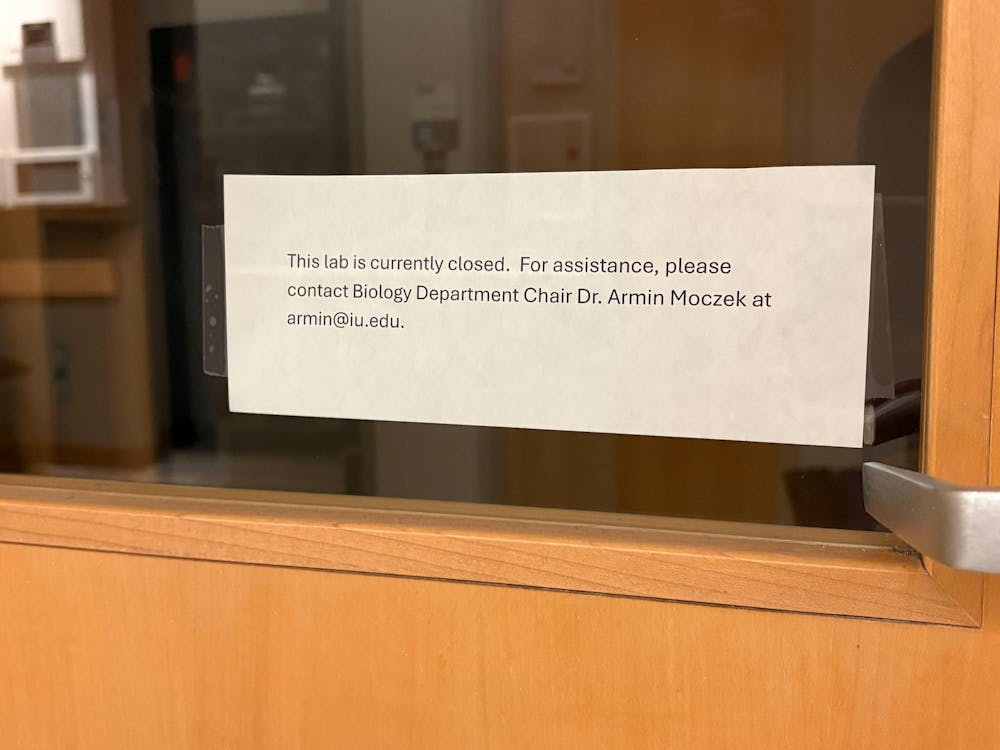
When Roger Innes, a distinguished professor of biology, received a phone call at home the evening of May 7, he said he thought the FBI had returned to his laboratory.
According to Innes, a postdoctoral researcher in his lab called to report that three unidentified men were inside the laboratory in Myers Hall and ordered her to leave. The researcher was allowed to retrieve her backpack and apartment keys, Innes said, but was not told why the lab was being closed or who the men were.
“I just couldn't believe that they were back because the FBI had searched my lab back in December,” Innes said. “It was shocking to me because I didn't think they would have a reason to search again.”
Within the hour, Innes said he learned the men were not FBI agents. Instead, the closure was connected to an anticipated U.S. Department of Agriculture review of biological materials, permits and research records in his laboratory following months of federal scrutiny .
The FBI's search of Innes' lab in December 2025 followed the previous month's arrest of his former postdoctoral researcher, Youhuang Xiang, who was charged with conspiracy, smuggling and making false statements.
Federal authorities alleged Xiang imported plasmid DNA derived from E. coli into the United States in a package labeled as women's clothing. Xiang later pleaded guilty to one count of smuggling and was sentenced to time served and a $500 fine before being deported to China.
Innes said he has questioned whether Xiang's arrest and an October court letter he wrote in the case of University of Michigan researcher Yunqing Jian contributed to increased scrutiny of his laboratory.
Jian was charged with smuggling biological material related to Fusarium graminearum, a fungus that can infect wheat and maizecrops. In his letter, Innes argued the fungal strains posed no risk to U.S. farmers.
Innes said the timing of the events was one reason he believes the cases are connected, noting federal investigators first contacted him shortly after his expert letter was filed in federal court in November 2025.
"The fact that they arrested my postdoc five days after my letter was read in court, that's not a coincidence," Innes said.
Innes said the USDA informed him in February his lab was in compliance with federal regulations following the FBI’s search. However, in late April, he received another notice that the compliance determination was issued in error and that his lab remained under review.
Less than two weeks later, USDA-related activity in Myers Hall led to the closure of Innes' laboratory and several adjacent research spaces.
“There was no explanation of what the USDA was planning at that point,” Innes said. “The USDA never reached out to me directly.”
During the shutdown, researchers were required to inventory biological materials stored in affected laboratories and provide documentation showing where those materials came from. Innes said USDA also directed researchers to identify materials requiring federal permits and materials whose origins could not be independently verified.
Researchers were also barred from entering affected lab spaces while federal officials reviewed permits, records and biological materials. Innes said some fungi were destroyed because permits had expired, while other biological materials were discarded because researchers could not provide documentation verifying their origin.
“The biggest thing they found is that we had several plant pathogens for which we previously had permits to work with, but the permits had expired,” Innes said.
The closure extended beyond Innes' lab because multiple laboratories shared interconnected research space. Innes estimated the shutdown affected about 40 researchers and disrupted ongoing research projects.
“Some experiments were probably delayed as much as three months,” Innes said. “The most common delay was about six weeks.”
Federal officials completed their review May 19, allowing researchers to return to the affected laboratories. Innes said that while the USDA found that some biological materials had expired permits and that documentation for other materials was incomplete, the agency did not identify any federal violations.
Even before the review concluded, the shutdown drew criticism from the Indiana University Bloomington chapter of the American Association of University Professors and Concerned Scientists at Indiana University Bloomington.
In a joint May 18 statement shared with the Indiana Daily Student, the two organizations questioned the university's decision to close the laboratories and criticized administrators for failing to consult faculty members before the shutdown.
“We expect transparency from our administration: who ordered this lockout and why was it conducted in this manner?” they wrote. “Why weren’t the affected faculty and departmental leadership consulted prior to the closure to discuss alternative, less damaging approaches to meet the written USDA directive?”
IU spokesperson Mark Bode shared a May 19 email with the Indiana Daily Student that IU Vice President for Research Russell Mumper sent to Biology Department Chair Armin Moczek regarding the shutdown.
In the email, Mumper said the university worked to minimize the impact on researchers while meeting federal compliance obligations.
“By working together with you and your colleagues, we did our best to navigate this disruption and minimize the impact on researchers, while meeting our federal compliance obligations,” Mumper wrote.
Despite the reopening, Innes said questions remain about how the shutdown was handled by university officials and the USDA and whether the disruption could have been reduced.
“I think they overreacted by so quickly locking down my lab and not discussing it with me at all,” Innes said. “Maybe we could have reduced this lockdown to like three days rather than 12 days.”
Innes said he hopes university officials take steps to improve communication with faculty members during future federal reviews.
“A lot of the problems that arose with the shutdown could have been avoided if we just had more open communication between upper IU administration and faculty,” Innes said.


