
Editor's note: All opinions, columns and letters reflect the views of the individual writer and not necessarily those of the IDS or its staffers.
“What-about-me-ism” has been on the rise over the past decade. Subtly, it has taken hold of our culture and requested we lower the monkey bars for all to reach.
The phrase frequently rears its ugly head in some of the most desired and exclusive places on the planet. What-about-me-ism, to me, is when someone hijacks a situation to center themselves as the missing piece that should have been included in the original puzzle.
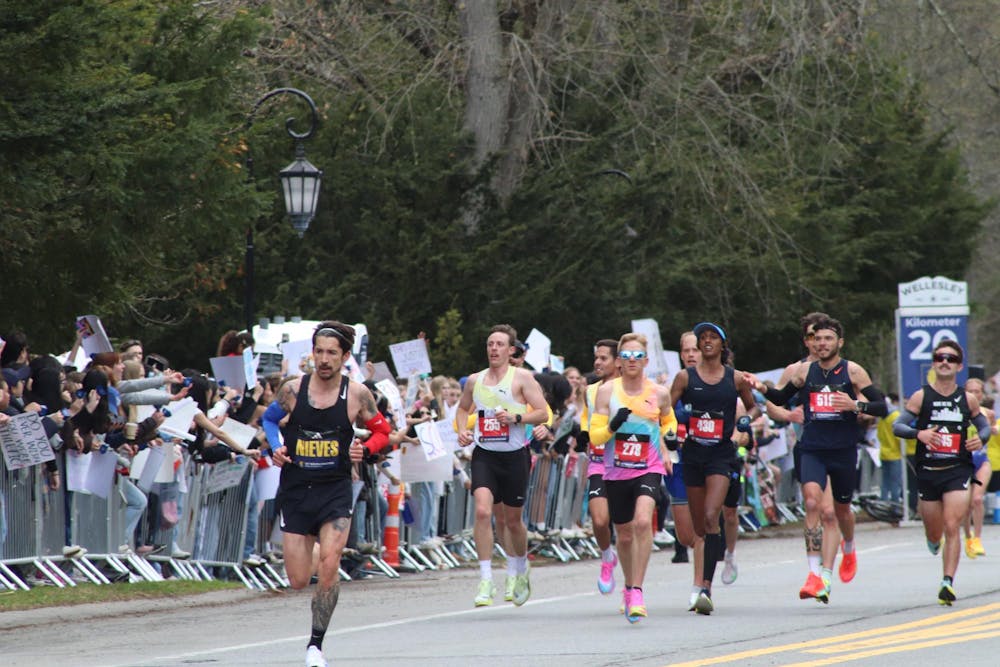
This past April, we witnessed what-about-me-ism come to life at the Boston Marathon.
Nike’s advertisement at this year’s race read “Runners Welcome, Walkers Tolerated.” Public response to the slogan epitomized what-about-me-ism. Some interpreted the ad as an attack on walkers in the fitness community, believing they too should fit into Nike’s vision for an ad aimed at those participating in an elite marathon.
One main criticism of the advertisement was that runners and walkers should be equally welcome. Those who took offense from the ad believed it spread the wrong message that only certain movement counts. Some critics even went as far to call it “pace-shaming,” the act of making people feel inferior based on the speed they move at. But in an elite athletic event like the Boston Marathon, where top runners from around the world gather to race, the standards of competition are different. Maybe not every athlete belongs at the Boston Marathon — and maybe that’s OK.
According to the Boston Athletic Association website, for runners aged 18 to 54, the qualifying time needed for the marathon was between two hours and 55 minutes for men and to three hours and 50 minutes for women. For perspective, an adult moving at the average walking speed of 3 mph would take eight hours and 45 minutes to walk a marathon.
Just by looking at these numbers, one can see those who walk an entire marathon are inherently excluded from participating in Boston. To be classified as an official finisher, you only have approximately six hours to complete the race.
The advertisement should have offered gutsy motivation to racers even when the finish line seemed light-years away. Instead, the ad got ripped to pieces by those who felt it didn’t apply to the lay-Boston Marathon racer — who, by the way, doesn’t exist.
Nike, under pressure to placate the ghost walkers, took the ad down. The company protected its pocketbook from the potential backlash that swelling anger against the ad threatened. It replaced the original advertisement with a shell of the celebration of elite performance it once was: “Boston will always remind you, movement is what matters.”
Nike transformed an ad that aligned with its brand image of pushing yourself to be at your best into a universalist message that no longer offered motivation to those actually running the marathon.
At a marathon as elite as Boston, the level of performance is simply more competitive. That’s not to diminish the accomplishment of just qualifying for the race, or to say athletes who walked its 26.2 miles should feel ashamed. But exclusivity has to exist in some places.
If you were already in every room, there wouldn’t be any doors left to open.
This what-about-me moment at the Boston Marathon doesn’t mean that every door of exclusivity should be sealed shut, though. Because truthfully, there should sometimes not be a barrier to such exclusivity. Exclusivity can be manufactured in areas where it has no place. Some notable examples are the film industry, or even politics, with small circles of decision-makers. In these cases, advocating for the bar of exclusivity to be lowered, or for the wall to fall completely, can be justified.
There is no doubt that people who have advocated for more inclusivity have made monumental, positive changes to our society. Martin Luther King Jr. and Helen Keller are just two examples of people who have changed the world by promoting inclusivity, asserting that all people belong regardless of skin color or disability.
The difference with what-about-me-ism, though, is when people attempt to mold things that are bound by nature to be exclusive, into a shoe that fits all.
Beyond the runners and walkers, social media has made it all too common to artificially lower the ceiling for everyone to touch.
In an interview on “The Tonight Show,” actor Gabriel Basso said he deleted his Instagram account after seeing a photo from the view of the top of Mount Everest. He said it bothered him that to get to that mountain top, people had to step over bodies to get there, but that he was just able to see it from his couch. This represents a counter to the what-about-me-ism movement; he knows it would be unfair to see such a breath-taking view that should be exclusive to the dare-devils who reach it.
When social media reveals places meant to be exclusive, it can become easy to believe the world revolves on your axis. So when you come across something that isn’t tailored to you, it’s easy to say, “what about me?”
In a world where there are so many different platforms to voice thought, it’s inevitable you will come across a perspective that doesn’t take your unique life experience into consideration. We have to find self-assurance and learn to be OK with not belonging everywhere.
Derek Marshall is a freshman studying Media Advertising.



