Editor's note: All opinions, columns and letters reflect the views of the individual writer and not necessarily those of the IDS or its staffers.
Happy birthday, Little 500.
You’re 75 years old. That’s a ripe age for a bike race.
How many people are attending your party? It’s the greatest college bash in America, after all. Hardly a student at Indiana University, this country’s 19th best party school, according to Niche, should miss it. Though, I suspect many will.
The school won’t tell you that.
An IU press release last month claimed the “Little 500 is the nation’s largest collegiate bike race, drawing a record number of 30,000 spectators.” Drawing a record number? When? Which year? The university’s phrase is oddly atemporal for a race that’s well-known to occur at a specific time — two days in April — as all races must.
The strangeness of IU’s statement mounts at the word “record.” Typically, a record is awarded for a particular instance of something. Did the 2025 races hit 30,000 spectators? Are the races this year supposed to hit that number? IU does not specify.
In fact, for the Little 500, 30,000 spectators is not a record. If anything, the evidence suggests we’ve observed a record decline in spectatorship over the last several decades.
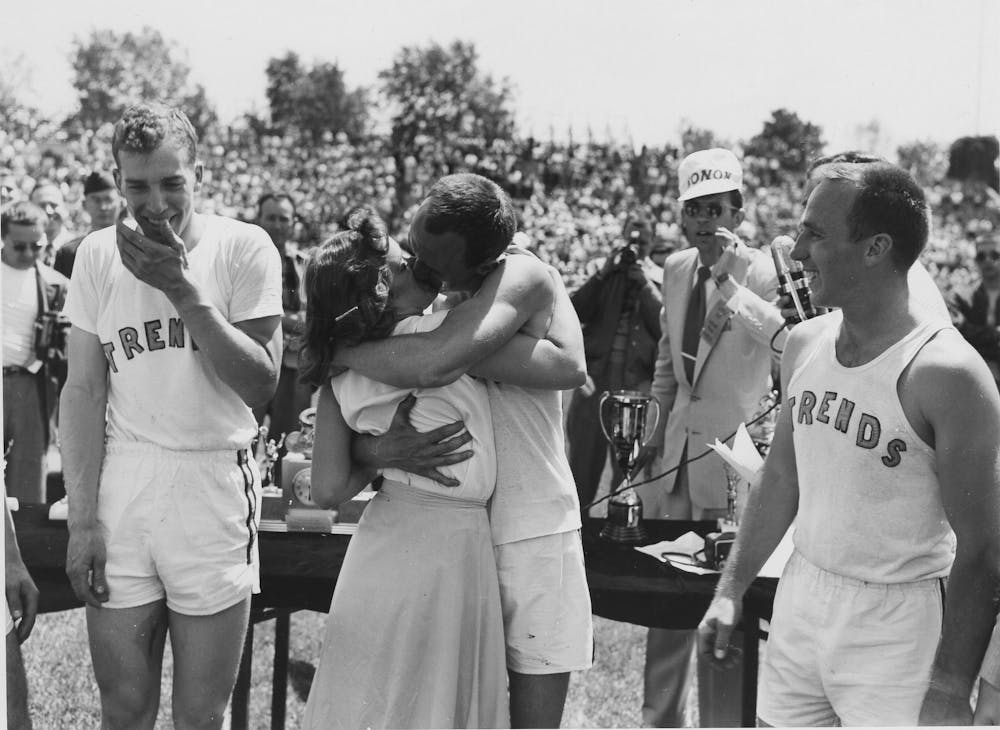
Archives sourced from the IU Student Foundation state that, by the mid-1960s — roughly 15 years into the race’s history — the Little 500 drew crowds of 60,000 people. At the time, that number was more than triple IU Bloomington’s student body. Indeed, it was more than triple the student population of the whole IU system at the time.
Per Indiana Daily Student reporting in its 1981 Little 500 guide, the first-ever race in 1951 courted a crowd of 7,000. It seems attendance must have been record-breaking year after year for 1960s crowds to reach the numbers IUSF said they did.
Now don’t ask me how Bill Armstrong Stadium is supposed to fit a “record” 30,000 spectators, let alone how Tenth Street Stadium, which hosted the race until its demise in the early ‘80s, could have accommodated a comparatively mythical 60,000. Armstrong Stadium’s capacity is just above a sixth of 30,000. Tenth Street Stadium’s was a third of 60,000.
But do ask me why the Little 500 has ceased to attract the same magnitude of crowds. I have my hypotheses. And if one of them proves even a smidge right, it may be key to the Little 500’s survival. If the Little 500 is not growing proportionally with the student body, what is it doing? Dying?
Dying, I find, nearly blasphemous to suggest of so blest a Hoosier hand-me-down, but traditions like the Little 500 should rarely be taken for granted. The ’50s and ’60s marked a peak of countless other student institutions that are now relegated to practical or absolute obscurity for the better, like panty raids, or for the worse, like student government.
When explaining why the Little 500 has a shrunken place in students’ hearts, the easy answer is to propose that the party ate the race. The traditions surrounding any mainstream holiday — Fourth of July, Halloween, Christmas, New Year’s — all eventually give way to non-specific festivities, like drinking and reveling, though some, like Linus from “Peanuts,” claim to hold onto the day’s original, and true, meaning, come what may.
At IU, that Linus-like remnant is, supposedly, 30,000.
Another answer suggests that the race itself ate the race. In 1988, an all-freshmen team from Willkie Hall, Willkie Sprint, won the first women’s Little 500. That outcome would be unthinkable today, when practice for the following year begins as soon as the race ends. As the Little 500 becomes more competitive, it also winds up more removed from the average student.
The days when a dorm’s team had a fair chance at winning are long gone. The Little 500 is no longer won by the team that has, in the words of Carl Stockholm, a member of the 1920 U.S. Olympics team who spoke at the first race in 1951, “the most good, old-fashioned American guts.” The team, for better or worse, that dedicates the most time to training, wins.
The previous answer is, in many ways, a modern rendition of the “Breaking Away” problem. In 1979, when the movie is set, fraternities dominated the race. Its plot follows Bloomington townies, underdogs who found an independent team, the Cutters, and manage to eke out a victory. But nowadays, independent teams, like CUTTERS, have dedicated coaches, beating out fraternity teams most years, while dorm teams, which won the first races, have long since been shut out.
A third explanation for the Little 500’s downward trend in attendance is complex, connecting to other developments that involve indoor climate control, popular clothing styles and generational comfort.
Generation Z may simply be less attracted to sitting in the early summer heat for the duration of 50 miles to watch the men’s race than generations past. The air-conditioned house offers countless more amenities. By contrast, this generation’s grandparents, with far less home entertainment, may have been happier to endure the heat and time in long pants and thicker fabrics.
Whatever the causes of plummeting attendance, I expect the Little 500 is guaranteed a 150th anniversary, 75 years from now, simply because of the inertia of the IU Student Foundation’s mission. But if the current trends continue, I expect an even smaller portion of IU students will be present for the race’s sesquicentennial.
And a race without a cheering crowd would be an awfully sad thing.
Eric Cannon (he/him) is a sophomore studying philosophy and political science and currently serves as a member of IU Student Government.