Editor's note: All opinions, columns and letters reflect the views of the individual writer and not necessarily those of the IDS or its staffers.
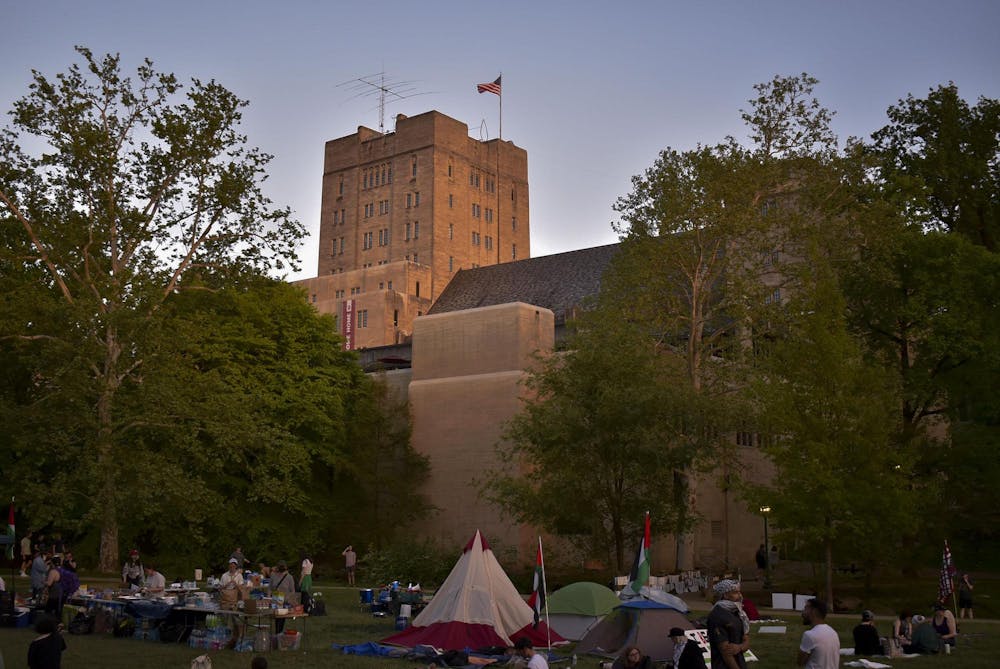
My most vivid memory of my time at IU, the one I’m most certain I’ll carry with me the rest of my life, was on April 25, 2024, when the encampment in Dunn Meadow protesting the actions of Israel in the Palestinian territories was first broken up by state police.
I remember sitting in the Monroe County Public Library downtown, watching a livestream of the arrests; I remember the visceral reaction it prompted in me, how I was physically sick to my stomach; I remember feeling an intense desire to be there, to throw myself in the middle of the hurricane; I remember not going because before I even had the chance to leave it was over; and I remember immediately understanding that I needed to write about this, that I had no other choice.
And I did write about it, as I wrote about several of the tumultuous events that happened over the course of my four years at this university. At times, it feels like my time here was punctuated by these consequential episodes, a series of political crises in which my education was simply a background element. Perhaps it’s felt this way because of my connection with student journalism, or perhaps it would’ve felt this way regardless. In any case, the personal and the political of my college experience have been too intimately and brazenly connected to ever divorce.
I write today, as I work on my final essay and prepare to turn my tassel at graduation, with little sense of sentimentality. I’m not sure any joyous celebration, any hymn of thanksgiving, would be appropriate for the reality of the past four years: I’ve certainly had some of the best moments of my life here, met most of my closest friends, but I’ve also directly experienced the most severe failures of the system — failures that, if they haven’t plainly affected me, have affected people I care about as well as people I don’t know.
That, in keeping with all those other columns I’ve written, seems to me the most important thing to talk about.
Of course, not a single thing that has happened at IU has been singular to it: these things exist within a larger political situation, and to say that the past four years here have been erratic is to say the last four years of American history have been erratic. The encampment in Dunn Meadow was only in April that year: lest we forget, the protests happening across the country were happening in the context of a presidential election, and a particularly fraught one at that.
It was also in the context of a much longer attempt to establish the Indiana Graduate Workers Coalition and to get the university to recognize it as legitimate. Though the encampment wasn’t particularly about labor, and the graduate workers’ strikes weren’t ever particularly about Palestine, the two movements had significant overlap and demonstrated the interconnectedness of the political issues we collectively face every day.
Universities have long been a hot bed of political debate, protest and change: it’s one of the things that makes the university so essential, what makes them, in theory, these paramount demonstrations of democracy. Comparing our moment to the 1960s is in vogue right now, and one thing those comparisons do inevitably point to is the steadfastness of student protest. The 2024 pro-Palestine encampments weren’t the first time students occupied Dunn Meadow for a political cause: a “shantytown” protesting South African apartheid lasted a little while longer, from April 1986 through December of the same year.
It would be disingenuous to center history around either of these student movements, but it is appropriate to say they were instrumental in exposing the deep connections our public institutions have in upholding abominable systems: just prior to the anti-apartheid encampment, the IU Board of Trustees voted against total divestment from South African companies, and a key demand of the pro-Palestine protesters just a few years ago was a divestment from Israeli companies.
In both instances, students unveiled the role we all play — through our paying tuition, our tax dollars, our willingness to remain ignorant — in legitimizing horror across the world. That in itself is significant, whether the protests were immediately “successful” in their goals or not.
But this simplifies things a bit, doesn’t it? Bad things do happen, and people do protest them, but to reduce all the political machinations constantly turning, constantly shifting, to such a basic equation ignores all the uncertainty that lingers in the air. The university still does not recognize the IGWC. It’s unclear when, or if they ever, will. Public opinion on Israel has been declining over the past year, to its lowest point in decades, yet the U.S. government still provides it with unwavering support as violence moves into Iran.
The concept of higher education itself remains under scrutiny, the tenets supposed to make them a petri dish for democracy being treated as political inconveniences. And, of course, the stark increase in Immigration and Customs Enforcement raids, which have plagued Bloomington and, under the current federal administration, will almost certainly continue to.
It’s impossible not to think, too, of the current economic situation, of how so many of us are about to be thrown into a world of financial ambiguity. The job market has been in a “low hire, low fire” stasis for more than a year, but reports point to the War in Iran as damaging a workforce that’s only just now starting to show the slightest signs of recovery. It’s a scary thing to graduate college, unsure whether your degree is going to have any sort of value, meet any sort of demand, but that’s unfortunately simply the current order of things.
But, if there’s any one thing that defines my political philosophy, it’s that people are resilient and I am still confident we will continue fighting for a better world. I spent my freshman year at Ball State University, and when I made the decision to transfer to IU, one of the things I so admired about it was its long tradition of student and faculty resistance. My four years here have been tumultuous, to say the absolute least, but there’s little reason to believe that tradition is going to die any time soon.
Joey Sills (he/him) is a senior studying English and political science.