
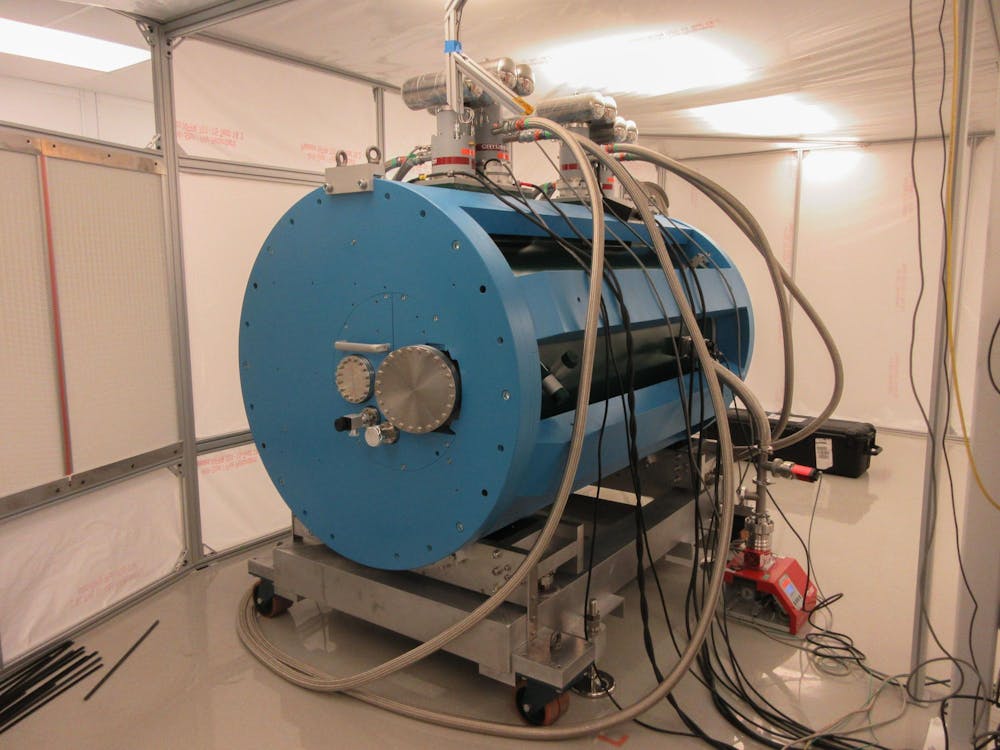
A new superconducting magnet that will help scientists solve a puzzling nuclear physics discrepancy is currently undergoing functionality tests at Indiana University’s Swain Hall West.
The magnet, which is 7 feet tall and 4 feet wide, will be used in the under-construction Beam Lifetime 3 experiment, a successor to two previous experiments designed to explore a mystery still puzzling nuclear physicists: the neutron lifetime, or the amount of time the neutron can exist without being inside an atom.
The experiment collaboration spans across seven institutions.
Fred Wietfeldt, physics professor at Tulane University and principal investigator of the National Science Foundation grant funding the project, said the sub-basement in Swain Hall West serves as the central integration site for the experiment, where other parts will soon arrive.
Historically, the Swain Hall West sub-basement housed the university’s first cyclotron, a particle accelerator that propels charged particles along a spiral to study nuclear reactions. The cyclotron was used for experiments related to the Manhattan Project, a top-secret program during World War II responsible for the first atomic bombs, before its shutdown in 1968.
Wietfeldt said IU physics professor Mike Snow, part of the experiment collaboration, was able to secure the unutilized sub-basement area as the central integration site. Since then, the sub-basement had a contaminant-controlled environment installed for the experiment integration.
“The IU physics department upgraded it. Plus, Indiana has a nice central location,” Wietfeldt said. “It’s not easy to get a nice lab space like that just at some random university.”
Wietfeldt said IU is also responsible for the proton detector, a device that can count protons, assembled at the Multidisciplinary Engineering and Sciences Hall.
“We've been designing and machining parts, we've been coming up with different solutions for things, finding different parts here and there to make this work,” IU junior Garrett Willis, a physics major who assisted with the proton detector construction, said. “And that has been a really cool, humbling, but cool experience.”
Atoms are composed of three particles: protons, neutrons and electrons. But isolating those three particles can lead to peculiar results. While the proton and electron are both stable outside an atom, the neutron cannot exist for long by itself, breaking into pieces after a duration between 877.8 seconds and 888.1 seconds.
The lifetime of a neutron outside of an atom has been measured by two experimental methods, but the results of these methods have a 10-second discrepancy, meaning another factor is at play. The goal of the BL3 experiment is to find out what this factor is.
Wietfeldt said that the discrepancy may arise from consistent measurement errors going unaccounted for, which can be difficult to isolate in complex experiments.
He also suggested a more intriguing possibility: that the discrepancy could be attributed to dark matter produced during the neutron’s decay.
Scientists have known about the existence of dark matter, a mysterious substance all around, for years, but they have not been able to observe it directly.
The experiment starts with a focused beam of neutrons sent through a trap designed to store charged particles. While the neutron itself has no charge, one of the pieces it breaks into upon decaying, a proton, has charge.
The trap retains these charged particles and then releases them into the large magnet’s magnetic field. The magnetic field guides the protons to the detectors, which count them. The neutron lifetime is measured by counting how and when neutrons enter and protons exit.
Kyle Steffen, a postdoctoral researcher at Tulane on the BL3 experiment, said the real limitation on the previous iterations, BL1 and BL2, was the proton detector.
“In the last decade, there have been advancements in detector technologies where we’re able to make large, multi-segmented silicon detectors,” Steffen said. “I think the proton detector is a really critical upgrade that allowed BL3 to separate itself from the previous iterations. Because of that, everything else has to change to get bigger.”
Steffen said that in BL1 and BL2, the proton detector could only accurately count one proton at a time. If too many neutrons enter the experiment and decay, then the detector gets overwhelmed, making it hard to discern individual protons. The new detector is larger and can count more protons without overlap.
Wietfeldt said other universities involved in the experiment collaboration and construction include Tulane, which oversees the project, the University of Illinois Urbana-Champaign, University of Kentucky, Eastern Kentucky University, Drexel University and Hamilton College.
Wietfeldt said once the hardware is tested and proved to be working correctly, all parts of the experiment will be transported to the National Institute of Standards and Technology Center for Neutron Research in Gaithersburg, Maryland, and the experiment will begin.
Steffen said it was rare to have the opportunity to build an experiment with so many interesting elements.
“Not only is it interesting physics that we're trying to learn with it, but it's interesting physics just building it in the first place,” Steffen said. “It's an opportunity to teach students. It's an opportunity to get people involved in a nuclear science experiment that trains a next generation of workforce.”


