Editor's note: All opinions, columns and letters reflect the views of the individual writer and not necessarily those of the IDS or its staffers.
In a lonely patch of ocean in the Gulf of Mexico, a shadowy colossus rises over the churning sea. The hulking figure bobs with surprising elegance at the swelling surface — as comfortable there as in the deep, where it exclusively feeds. Listen closely, and its bassy hums can be heard echoing miles below the depths. This gentle giant needs no introduction — as you probably guessed, I’m talking about the ultra-deepwater dynamically positioned semi-submersible offshore drilling rig.
While most are aware of their awesomeness, few know the imminent danger to their survival. Decades of ruthless predation by dastardly environmental conservation groups have left “Petroleus drilliatus” teetering on the brink of extinction.
Luckily, our ever-vigilant secretary of war, Pete Hegseth, has swooped in to cut the long-suffering multi-billion-dollar oil conglomerates free from a tangled net of environmental conservation lawsuits. Another win for the plucky underdog!
All jokes aside, it happened last Tuesday, when the United States Endangered Species Committee — or “God Squad,” so named for its ability to decide a species’ fate — convened for the first time in over 30 years. The committee only meets to consider exemptions from the Endangered Species Act, which ordinarily forbids any action that threatens an endangered species with extinction.
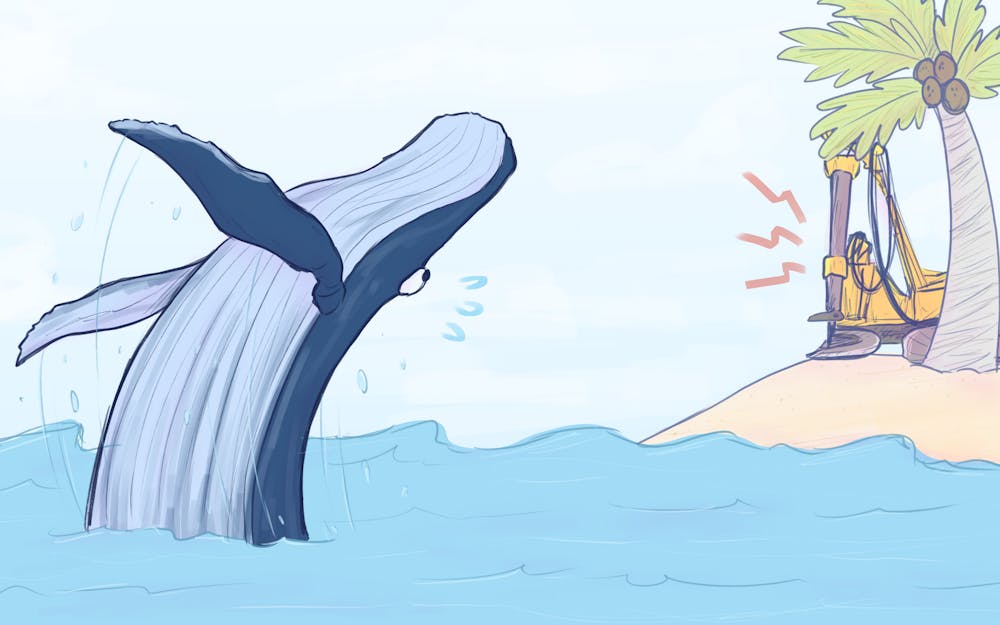
This time, the committee was summoned to consider oil and gas drilling operations in the Gulf of Mexico. The gulf serves as the year-round home of Rice’s whale, a critically endangered species with an estimated population of 51. Byproducts of drilling in the gulf, including oil spills, boat strikes and excessive underwater noise, pose a significant threat to the whales’ survival.
The “God Squad” has only convened three times prior. All three were announced months ahead of time, preempted by public hearings and made open to attend. Two of the three committees took more than a month to arrive at a decision.
Tuesday’s meeting lasted a little less than 16 minutes. The Department of the Interior provided two weeks prior notice, and in lieu of a public hearing or in-person attendance, the American people were offered a livestream. The committee’s verdict was predictable: Oil and gas drilling activities in the Gulf of Mexico would be exempt from the Endangered Species Act. The fate of an entire species may have been decided in the time it takes to walk from Wells Library to the Indiana Memorial Union.
In the committee’s defense, they didn’t have much to discuss. Technically, they didn’t even have a say. Thanks to a special provision in the ESA, if the Secretary of War determines an exemption is necessary for national security, an exemption must be granted. After Hegseth made his decision, the committee’s vote was just for show.
Don’t be fooled — this had nothing to do with national security. This was about getting pesky regulation out of the way of sweet, lucrative oil.
The threat, according to Hegseth, is domestic: environmental conservation groups suing to challenge the existing — and in their opinion, insufficient — regulations put in place to protect Rice’s whale and other marine life. If a judge agrees the protections are too lax, Hegseth worries in his letter to the interior secretary, then oil and gas drilling operations would have to grind to a halt or continue illegally until new regulations can be developed.
But when Hegseth’s worst fears were realized two years ago, the fossil fuels kept flowing. A Maryland court sided with the Sierra Club in 2024 and ordered the regulations to be vacated but provided a nine-month grace period before its order went into effect. The National Marine Fisheries Service created new regulations in this time, and an energy crisis never materialized.
For Hegseth, our national security depends on more than a functional oil and gas drilling operation in the gulf — it depends on a maximally productive one. Anything short of “realizing the Gulf’s full developmental potential,” as he wrote, constitutes a national security threat, too.
If you’re like me, you’re wondering when exactly unbridled fossil fuel extraction became considered a national emergency. Look no further than Executive Order 14156 on “Declaring a National Energy Emergency.” President Donald Trump signed it the day he was inaugurated, mere hours after promising in his inauguration speech to “drill, baby, drill.”
When it comes to maximizing energy production at the expense of the environment, convening the God Squad is one of many extreme tactics recently employed by the Trump administration.
In February, the EPA rescinded its 2009 finding which labeled certain greenhouse gases as threats to public health. If the move survives legal challenges, it would severely limit government regulators from enforcing greenhouse gas standards — giving power plants, oil and gas facilities and car manufacturers free rein over their emissions.
Last Friday, the Department of the Interior announced plans to merge the Bureau of Ocean Energy Management and the Bureau of Safety and Environmental Enforcement, the agencies responsible for managing ocean energy resources. The two were previously one agency, called the Minerals Management Service, which was disbanded due to safety concerns after the 2011 Deepwater Horizon oil spill. With the two together again, oil and gas operations will be far more streamlined with far less oversight.
We’re trading our oversight for efficiency, diminishing our safety in the name of opportunity. As we cut costs and minimize delays for the agencies and companies overseeing our natural resources, we risk losing control of their impact on our environment. Efficiency, speed and profitability are not worth the cost of ungovernable oil and gas drilling in the gulf — and the deregulation of these operations is not life or death for the U.S.
So, the graceful form of Petroleus drilliatus rises again above the crashing waves, finally free from the uneconomic bounds of accountability. A flare of natural gas bellows triumphantly into the salty air: this creature is no longer in danger. Whether the same is true for Rice’s whale, or for the rest of the gulf, only time will tell.
Spencer Schaberg (he/him) is a sophomore studying microbiology.