Busy students, faculty and visitors often walk through Indiana University’s campus with the goal of getting to their next location. But the art that surrounds them, whether it’s lining the walls of the Indiana Memorial Union or displayed in exhibits on campus, can get overlooked.
“You walk the halls of the union, you see these paintings all the time, and I think oftentimes as busy people we’re walking by, we’re not really looking, right?” Katie Chattin, director of public art and cultural heritage at University Collections, said. “So we see them everyday, but we don’t see them everyday.”
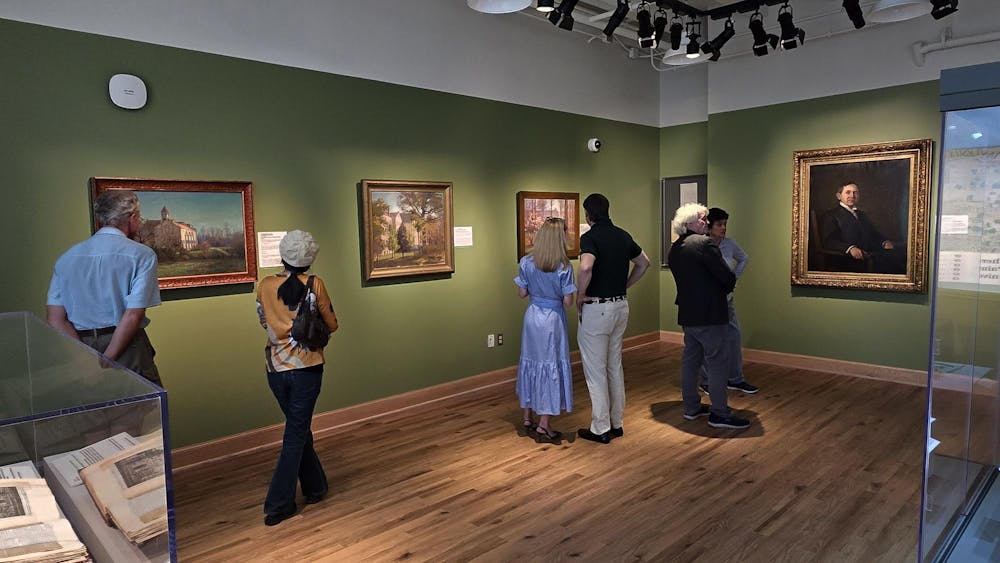
“Capturing the Campus: T.C. Steele,” a collaborative exhibit between the IU Public Art and Cultural Heritage Collection and Indiana State Museum and Historic Sites, opened April 17 at University Collections at McCalla. The exhibit brings together many of Steele’s paintings for the first time in decades.
Steele was a Hoosier artist and IU’s first artist in residence from 1922 until his death in 1926. Steele studied art in Munich from 1880-85 but eventually returned to his home state of Indiana. From portraits of IU presidents and faculty to depictions of campus, Steele’s works are integral to IU’s art history and offer a valuable perspective of what the campus used to look like.
Shannon Conway, a historical interpreter at the T.C. Steele State Historic Site in Nashville, Indiana, said some of Steele’s paintings featured in the exhibit have not been displayed frequently in the past.
“A lot of things brought me to the exhibit,” Conway said. “One is being able to see paintings that haven’t been on display very often or have not been on display beside each other in order to be able to see what the campus looked like in 1926 versus what it looks like in 2026, and what’s changed and what hasn’t changed.”
From the old Bur Oak tree outside the IMU to Dunn’s Woods and parts of campus’s Old Crescent, many of the places depicted in Steele’s work are recognizable today.
Steele depicts familiar spaces in an impressionist style that was a signature of his landscape paintings in his later years. The works feature common sights still seen today as well as views of campus that no longer exist after being transformed through construction.
For example, the open pastures or the old power plant that once stood where the Biddle Hotel reflect what Steele, and IU’s students from 100 years ago, would have seen on their daily walks to class. Some of these can be seen in paintings of his such as “God’s Acre on Campus (1926) or “The Bridge Over the Jordan” (1926).
Brian Woodman, director of McCalla and associate director of University Collections, said the exhibit has been years in the making. He said the undertaking involved compiling works that had remained at IU and going through the vast collections of paintings kept by the Indiana State Museum.
“The early parts were always brainstorming, where you sort of get together, see what’s possible,” Woodman said. “We had to process through what would be the best way to represent him, and we realized — wait, there are enough campus images at both institutions to put those together to put on this show.”
"Capturing the Campus” features two rooms, with paintings sorted according to the campus locations depicted. Jeremy Hackerd, assistant director for special projects at McCalla, was one of the curators who worked on historical research and connecting paintings with locations on campus.
“If you go through the galleries you can see all the stuff that is in the Old Crescent is in the first room. All the stuff that goes along the Campus River and that was the east side of the campus are over there,” Hackerd said. “So, it’s kind of like you're walking through the campus in a reasonable order, geographically speaking.”
The exhibit also features a map of campus from around 1930, with markings of the locations Steele painted. Steele is also commemorated through displays of letters, belongings, documentaries and 3D renderings. "House of the Singing Winds” is a multichannel video exhibit inspired by Steele’s Indiana home and studio.
“We knew we had the paintings with just the two institutions, but then we realized there were all these other opportunities,” Woodman said. “We can have the 3D renderings that the advanced visualization lab did, we have the documentary from WTIU and we have the Arthur Liou piece.”
Letters between Steele and faculty and other clippings from after his death demonstrate his importance to and influence on the campus. Steele’s studio was located in Franklin Hall, where he would often encourage students and faculty to come and talk to him about his work. A memo from the Office of the Secretary of the University signed by IU President William Lowe Bryan on July 26, 1926, is on display alongside other such documents, detailing the cancellation of classes during Steele’s funeral.
“The students dedicated the Arbutus (yearbook) the year he died to T.C Steele, there were a whole bunch of faculty letters that went out,” Hackerd said. “So it’s interesting to connect all that together to tell one sort of story about a very important artist.”
The Sidney and Lois Eskenazi Museum of Art also features Steele’s work in a different style from that of his impressionistic landscapes. Steele painted “Boat Man” while he was studying at the Royal Academy in Munich and won first prize for it in 1884. He had it sent to Indiana instead of leaving it in Germany.
“Capturing the Campus: T.C. Steele” will be open at McCalla for the following year where visitors will be able to walk through and be mesmerized by the works and memory of Hoosier artist T.C. Steele. A companion exhibit at the T.C. Steele historic site has more on the life of Steele.