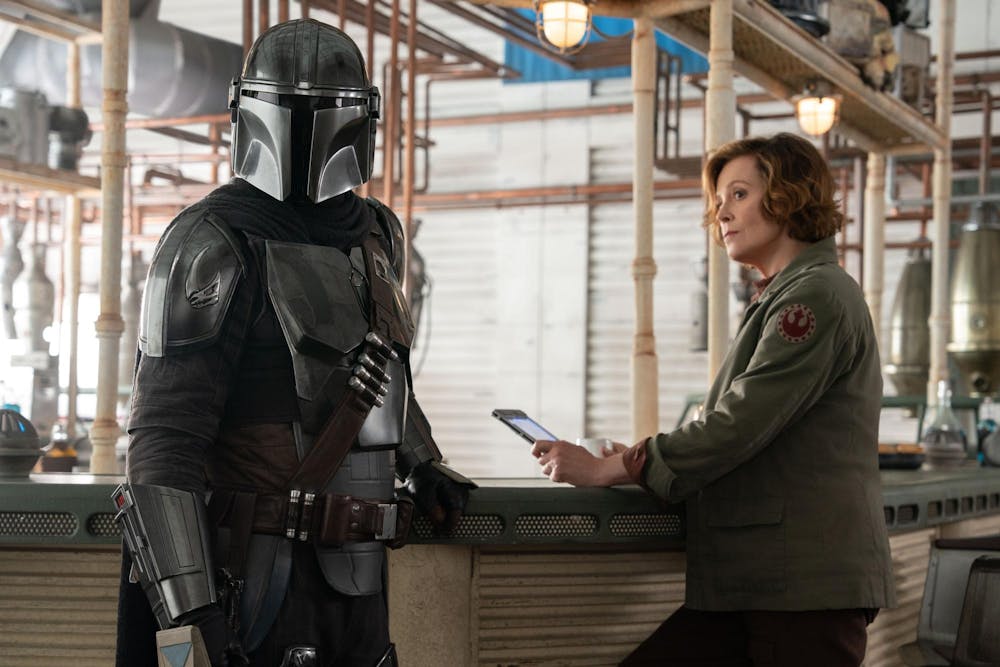
When “Star Wars: The Mandalorian and Grogu” premiered May 22, it ended the nearly seven-year theatrical hiatus for the franchise. Bringing the magic of the historic franchise back to the big screen is no small feat, and I was eager to experience it.
I’ll admit I had low expectations for this new installment in the “Star Wars” universe. After a disappointing third season, “The Mandalorian” making the jump to film wasn't as enticing as it once would’ve been.
Since the 2019 release of “Star Wars: Episode IX - The Rise of Skywalker,” fans have been patiently waiting for the next blockbuster set in a galaxy far, far away.
Continuing the story of Mandalorian bounty hunter turned New Republic contractor, Din Djarin (Pedro Pascal), and his little green apprentice Grogu, “Star Wars: The Mandalorian and Grogu” might not be another franchise-altering juggernaut. Rather, it’s a delightful adventure separate from the franchise’s main story.
Part of what makes the film so enjoyable is the prevalence of different creatures impacting the story.
For example, the Hutts, a giant slug-like species of crime lords last seen in “The Book of Boba Fett,” released in 2021, join the cast of characters in this film.
Jabba the Hutt’s cousins, The Twins, served as the film’s main antagonists while Jabba’s son, Rotta the Hutt (Jeremy Allen White), joined Djarin, Grogu and Zeb Orrelios (Steve Blum). With Jabba gone, the Twins seek to lead the family’s criminal enterprise. However, disillusioned with his father’s ways, Rotta chooses to forge a new path.
When he wasn’t reminding us that he’s his “own man,” Rotta’s muscular stature and soft personality became one of my favorite elements of the film. Additionally, the Hutt’s movements and fighting style was a hilarious addition to the Star Wars canon — I’m a big fan of his belly flop finishing move.
Rotta’s stint as a gladiator delivered an incredible fight scene. With Djarin and Rotta trapped in the arena, Imperial warlord Janu Coin (Jonny Coyne) unleashed a salvo of beasts to create his own life-size dejarik game.
The scene, based on the game played by Chewbacca and R2-D2 aboard the Millennium Falcon in the original 1977 film, brought to life each of the holo-creatures as they dueled for their freedom, with one even utilizing the same move as shown by George Lucas in the original game.
With a payoff 49 years in the making, the spectacle didn’t miss. It delivered stunning graphics and explosive action that spotlighted Rotta’s lumbering physicality.
Another memorable species, the Anzellans, were originally introduced in “The Rise of Skywalker.” These tiny expert mechanics now serve as Djarin’s local repairmen and Grogu’s friends. While Babu Frik, the most famous Anzellan, is absent from the film, Anzellans Minch, Bai, Keeto and Clang (Shirley Henderson) add a comedic and chaotic charm to the adventure.
In addition to allies such as Ardennian street vendor Hugo Durant (Martin Scorsese) and swamp fisherman Gatori (Stephen McKinley Henderson), the film also was chock full of fun creatures for Djarin to take on. Beneath the Twins’ trap door, he battled the eel-like Amani and a giant venomous dragon snake.
Embracing the galaxy’s diversity made the film quintessentially Star Wars.
The film’s fight sequences were undoubtably the highlight of my viewing experience. Within the opening scene, Djarin and Grogu infiltrate an imperial base, race down a mountain on a two-legged AT-RT and take down AT-AT walkers filled with snowtroopers as they hunt imperial warlord Commander Barro (Hemky Madera).
Each time the pair are faced with a threat, I was treated to a fight scene that features the abilities of a highly skilled Mandalorian warrior and a force-sensitive being. The contrasting styles made for a highly entertaining watch.
Despite being the first “Star Wars” film without any lightsabers, the combat doesn’t suffer.
From the fighting pits on Sakari to the aerial assault on Nal Hutta, the film’s abundance of weapons does the Mandalorians’ warrior religion justice.
Elevated by an enthralling score from composer Ludwig Göransson, the large-scale battles heighten the dynamic duo to a level only appropriate for the big screen.
Despite my praise, I’m well aware this film isn’t a home run nor what fans have come to expect after nearly 50 years of the Skywalker Saga.
Many were expecting grandiose implications regarding the fight against the Imperial remnants that will be featured in the upcoming second season of “Ahsoka.” But that wasn’t writers Jon Favreau and Dave Filoni’s goal.
They set out to take the audience on an exciting adventure with Djarin and Grogu without any prerequisites. And that’s exactly what they did.
“Star Wars” fans have become predisposed to dislike anything Disney releases. They’ve been traumatized by failed recent releases to the point that it’s all they’ve come to expect. As a result, many seem quick to criticize the film for its lack of stakes and impact.
But I see no reason to flood it with hate when all it did was provide a fun escape into the universe we all claim to love. It’s okay to watch a “Star Wars” movie simply for a good time.
I have spoken.