Editor's note: All opinions, columns and letters reflect the views of the individual writer and not necessarily those of the IDS or its staffers.
There was a time when less than a quarter of Americans exercised.
That fact may surprise in an era when athleisure dominates the United States’ clothing industry.
Then, something changed. In 1978, a year before the coining of the term “athleisure,” New York Magazine declared the country had entered a new age, the epoch of working out. A new kind of American emerged who exercised — “a little, a moderate amount, or in staggering gulps.”
By the end of the 1980s, nearly 70% of Americans claimed to exercise regularly.
This rise in athletic culture corresponded with a decline in American agricultural and manufacturing jobs and the automization of physically straining work.
When technologies arose to replace the strenuous labor that used to characterize daily life, it was necessary for Americans to exert themselves elsewhere. At gyms. On a run.
People are creatures with bodies — to work or wither. Hence, the end of American manufacturing coincided with the American exercise revolution that began in the ‘70s. Over the same decade, Americans took up en masse the office job, which filled the ‘80s and ‘90s imagination through films like “9 to 5,” “Ferris Bueller’s Day Off” and “American Psycho.” All showcased an American lifestyle increasingly defined around a sedentary place.
Today, a new replacement is burgeoning, this time targeting the mind instead of the body, taking hold with alarming speed: Artificial intelligence is performing the tasks that used to require human intellect.
In 2023, Pew Research Center found 13% of high school students used ChatGPT for schoolwork. The next year, that number doubled. By May 2025, a College Board survey showed 69% of high schoolers relied on ChatGPT — a more than five-fold increase from 2023. Usership of ChatGPT among college students jumped from a reported 23% to 78% in the same period.
The young aren’t alone in automating mental tasks and avoiding brain strain. Baby Boomers spend more time than ever scrolling on social media platforms, to their children’s chagrin and concern. Apps like Facebook and Instagram do not replace humans in the generation of creative material like ChatGPT does, but their never-ending feeds plug the vacuum that boredom is supposed to establish, leaving no space for a thought to arise where it otherwise might have.
The prospects for having a genuine human life look bleak if thinking is no longer in demand and our creativity is bridled.
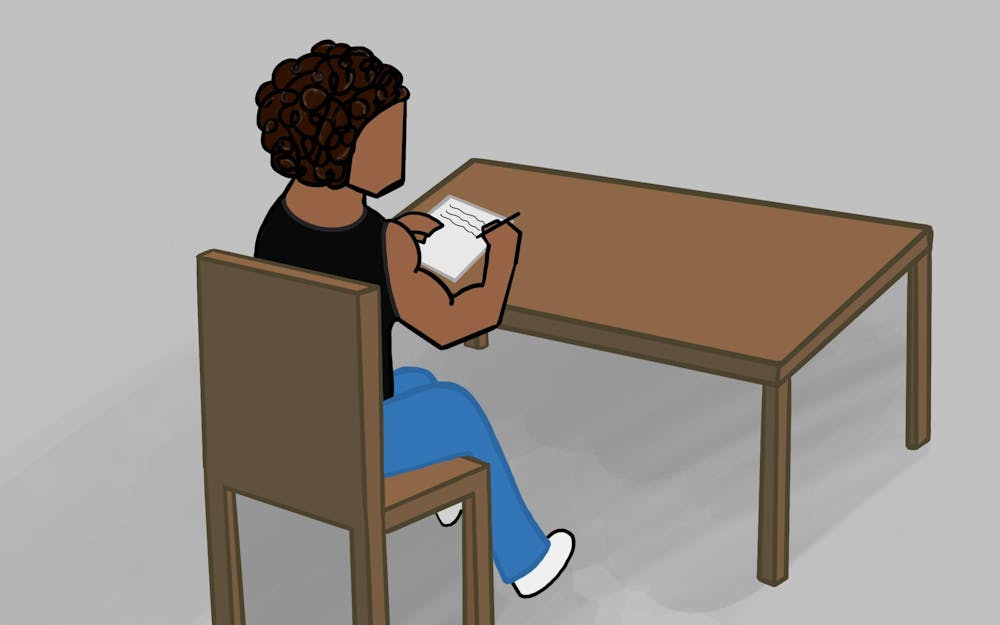
We need a gym renaissance of the mind, an avenue for Americans to exert themselves intellectually as generative AI renders such exertion obsolete in the workforce. The future, then, must be in journaling.
At present, only one in six Americans keep a journaling routine. That number is comparable to, even smaller than, the share of Americans who exercised before the collapse of hard labor jobs and their replacement with less strenuous work. But AI is replacing our intelligence at a much quicker pace. The technologies have entrenched themselves after only a few years and are sure to become exponentially more sophisticated soon.
Given the approaching risk of rapid mental atrophy, we should be concerned that a spike in journaling, or adjacent mindful activities, is not yet observable, as a corresponding exercise boom occurred relatively early into the post-manual labor age.
Reclaiming our minds might be easier than it seems. I have been restricting how much time I spend on social media per day — initially to an hour a day, and breaking the habit, I find I don’t want to use it more than 15 minutes a day — for only a week and have already seen fantastic results. I finished two — admittedly, short — books in a few days, “Tuesdays with Morrie” and “Le fin de la Chrétienté.” Give them a read.
It is unrealistic for most of us to fully abandon contemporary technology like Generation Z’s flip-phone converts. AI will, most certainly, be part of the future workforce. In light of this fact, perhaps it is inevitable that we cannot live a life thinking wholly for ourselves. Still, the mental workout of journaling — in the morning, in the evening, during a break — could help us think independently as much as possible even in the unfavorable waters to come.
Laying down whatever comes to mind, drawing connections and tiring the hand as we put pen to blank page could help us keep our brains sharp and would offer us an important reminder: We have brains that can, and should, think, just as we have bodies that can, and should, be exerted.
Mirroring the benefits of exercise, journaling also counters many of the ills wrought on us by too much technology use. In a variety of studies, researchers tied daily journaling, even for as much time as 15 minutes, to reduced anxiety toward things to come and brooding over the past. It also improved people’s ability to retain information and their work ethic, lessened blood pressure and boosted their immune systems and sleep quality.
Although I would like to see a general, Luddite restoration of the human mind’s primacy, in our world’s circumstances, consider just adding journaling to your gym routine.
Eric Cannon (he/him) is a sophomore studying philosophy and political science and currently serves as a member of IU Student Government.