
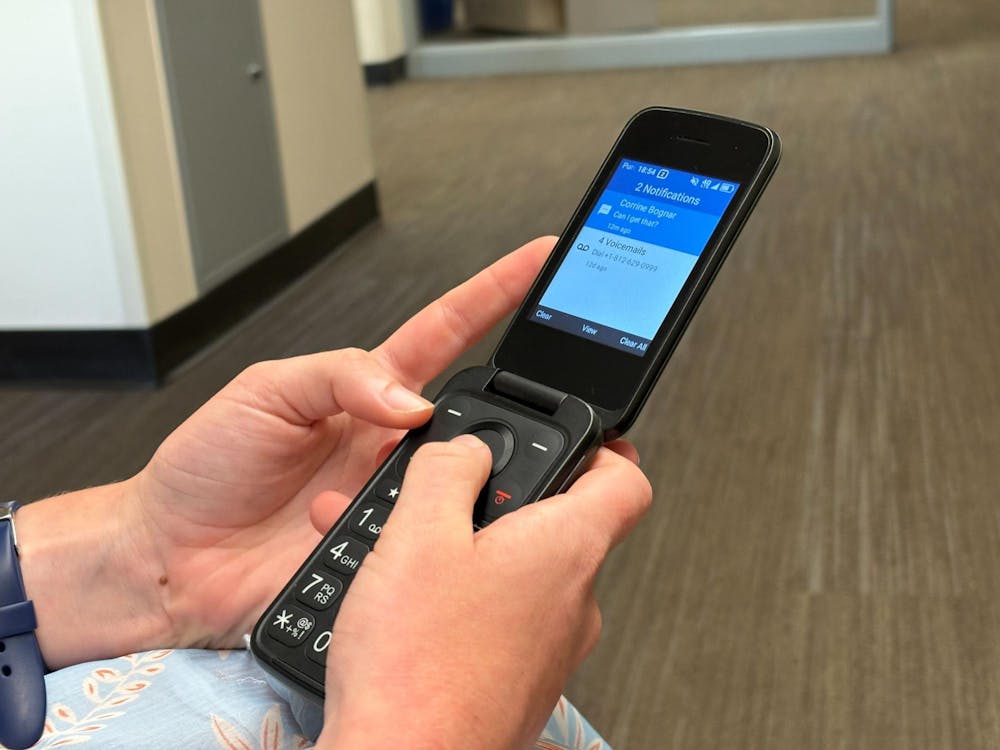
It was a slow day dishwashing at a Greek’s Pizzeria around two years ago. IU junior Maxwell Woehler took a look around at his coworkers, all on their phones, as is typical for an idle shift. But it wasn’t just here and there; it was the whole time. Still glued to their phones.
And Woehler realized something: their memories of their lives at that point, of their 20s, would be of staring down at their phones instead of being in the world.
He switched to a flip phone last Thanksgiving break.
“Now I think about my memories,” Woehler said, “and I feel like they are more material.”
He’s not alone. It’s not a large percentage, or easy to estimate, but some students at Indiana University and young people across the country are dropping their phones for cheaper, dumber ones.
Woehler lost his flip phone before his interview with the Indiana Daily Student. His, he said, cost about $45 — almost nothing compared to a smartphone. He regards the device as less important now, but he still tries to look at it as a courtesy for people trying to reach him.
“I don't know if I'll find it this time, genuinely,” he said. “But like, 45 bucks, I don't know.”
***
Everyone has a different reason for switching. Junior Gretchen Forcum also got a flip phone last Thanksgiving break after realizing how much time she was spending on social media and hitting a tipping point.
“I just noticed how little time I had to do the things I actually like to do,” she said.
Forcum had experimented with dropping social media before but found herself slipping whenever she reintroduced the apps. Because it was always so accessible, she said, she could pull up social media any time she felt awkward out in public.
After Russia’s invasion of Ukraine began in 2022, senior Wesley Kopis got caught in a feedback loop of news and doomscrolling.
“My brain was so far in the left field, like, ‘World War III is gonna happen,’” he said.
The loop caused his mental health to spiral, he said. He had to do something and started by deleting the news apps, then uninstalling social media. That helped.
Kopis kept putting in roadblocks to keep himself from looking at social media but would reinstall them every now and again. Around a year ago, he started seriously considering getting a flip phone to forever relegate social media to his computer. His three main reasons, he said, were his time, health and privacy.
Around three months ago, Kopis got a flip phone, but still had his smartphone on him. When his smartphone broke, the change became permanent.
For Woehler, another reason for the switch came from his beliefs about technology’s interaction with human society. Some things, he said, need to be hard to mean something.
“A person who is as integrated with technology as we are, I feel, is prone to becoming weak in areas of their life that they don't know they need to be struggling,” Woehler said.
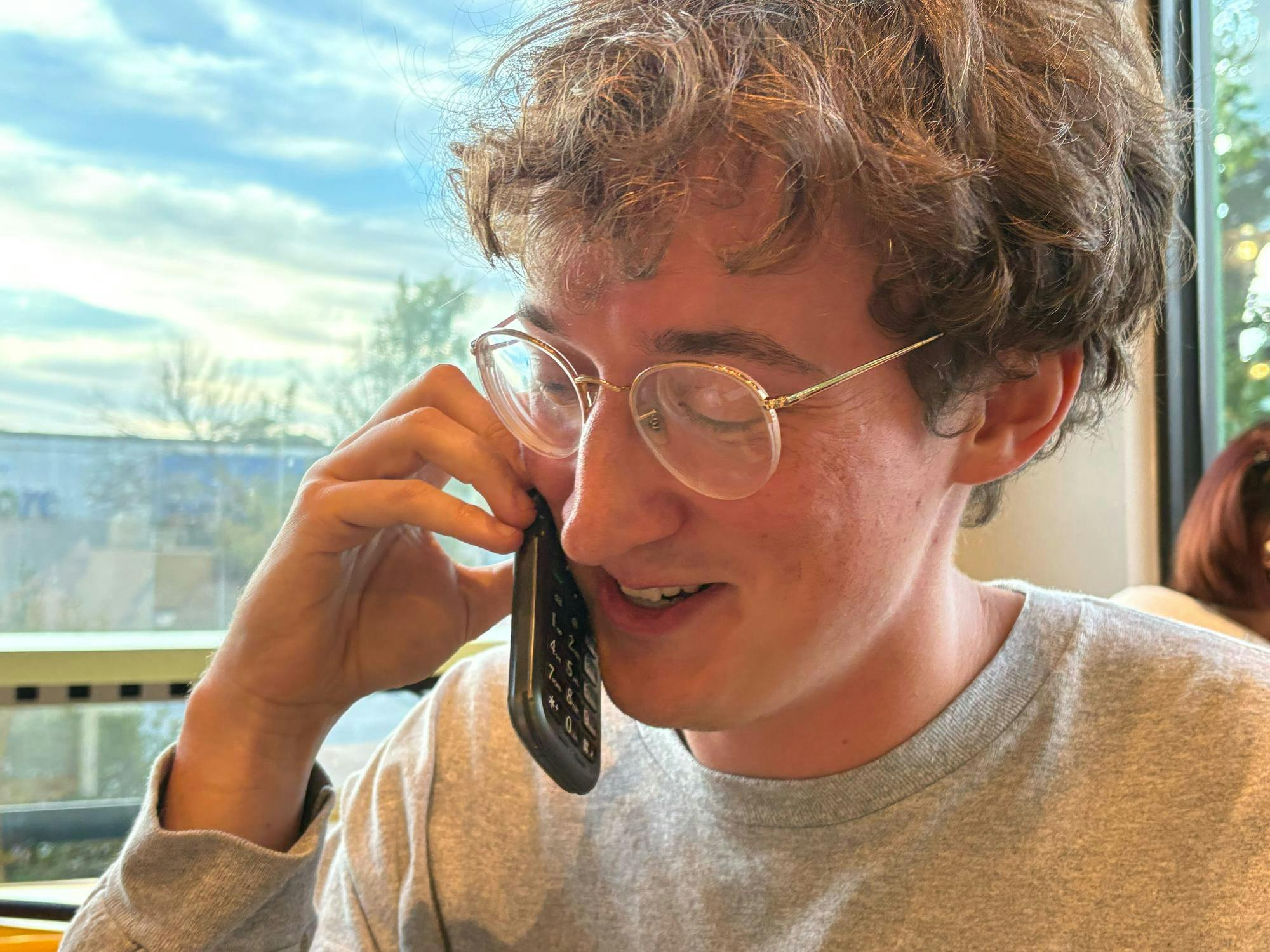
IU senior Wesley Kopis calls his girlfriend on his flip phone Oct. 1, 2025, at Morgenstern Books & Café in Bloomington. Kopis switched to a flip phone about three months ago.
The three’s switches to flip phones are predicated on a decline in social media screen time worldwide. The only outlier in that data? North America, which a more than 50-country GWI study commissioned by the Financial Times measured an increase in despite declines in Europe and the Asia-Pacific.
That study also found the reasons people report for using social media have become less social. Filling spare time and following celebrities have risen since 2014, while meeting new people and keeping up with friends have fallen.
Pew Research Center found last year that nearly half of 13- to 17-year-olds said they are “online almost constantly.” That stat jumped from 24% a decade prior.
Basic models of phones with limited features are also not selling much in North America — around 1.7 million last year, researcher Yang Wang told CNN in September. Further data from Pew last year indicate that around 98% of Americans own a cellphone, and more than 90% own a smartphone.
***
So, what’s changed? Woehler, Forcum and Kopis said their lives have improved, from their attention spans to their overall perception.
That doesn’t mean there aren’t challenges. Forcum said navigation became much harder. She tries her best to get places without GPS but uses her iPad to download maps before heading out if she needs them.
Kopis also found navigation to be the only continuing difficulty for him, though his phone does have a “not very good” GPS. Before switching, he was concerned about having access to the music he liked. But he was able to solve that with his CD collection, building his own catalog.
Kopis will also have to buy a smartphone when he goes to teach English in Germany next semester, as he caps off his degree in social studies education. But he said he’s going to go for a simpler model.
For Woehler, the main difficulty was scanning homework into PDFs for submission — until he figured out the campus printers can do that.
Other obstacles are also easy to bypass. Duo Mobile, the authentication app IU students use for university logins, can be replaced by a curious little keychain that pops up codes on an analog display. Social media they deem necessary can be accessed on laptops or iPads.
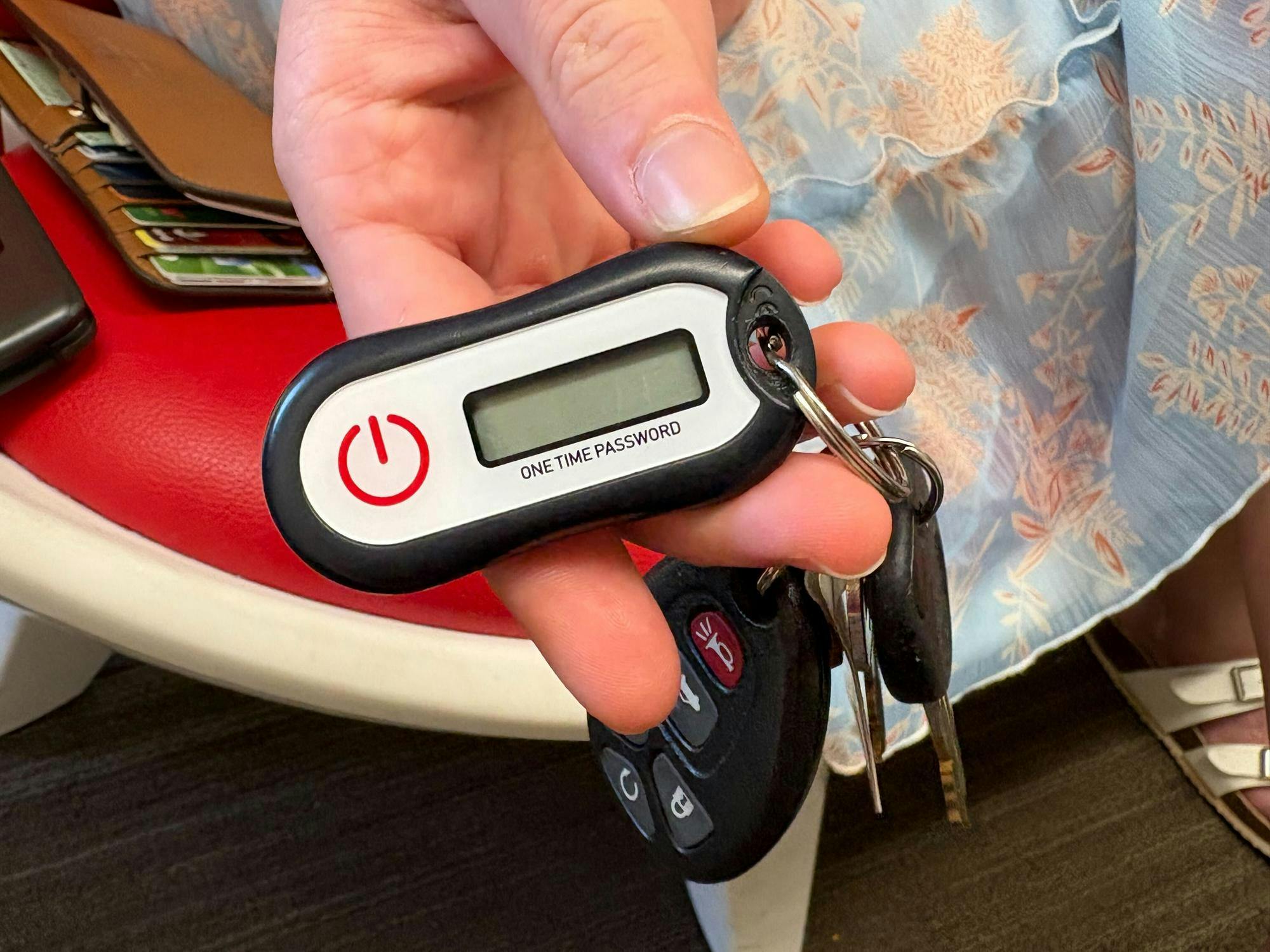
IU junior Gretchen Forcum shows the authentication device she uses in place of Duo Mobile on Oct. 2, 2025, in Franklin Hall in Bloomington. Forcum said the analog display shows a six-digit code for 30 seconds.
The difficulties each student described ended about there. The positives have been transformative.
“I've been able to be so present in what I do and intentional in my day-to-day life,” Kopis said.
Kopis has also seen his grades improve, and his ability to go above and beyond in school. After deleting all social media last fall, he locked in on a history project that ultimately won the Sam Burgess Undergraduate Research Award. He also said his program in Germany is “basically” paid for through scholarships.
He’s found more focus in other hobbies too — electronic music production, to be exact. He intends to perform in various German venues when he gets there.
Forcum found herself having more time to do what she wanted to do, rather than scrolling. That’s meant reading more books (lots of Jane Austen lately), solving more puzzles and watching more TV.
“My biggest takeaway is just having, like, finding more time for silence and finding peacefulness in silence,” Forcum said.
Woehler’s noticed that his attention span has increased. He’s found more time for music, more time for reading, more time for everything. Right now, he’s reading the perhaps-apt “Infinite Jest” by David Foster Wallace.
He knows other people who made the switch to flip phones but doesn’t know exactly where the trend will lead — he does think it is a trend that will simmer down eventually. But for the people considering making the switch, Woehler said it’s “much easier than anyone thinks.”
“Genuinely, like, I think most people could do it,” Woehler said. “Yeah, I do, and I encourage them.”


