
Editor's note: All opinions, columns and letters reflect the views of the individual writer and not necessarily those of the IDS or its staffers.
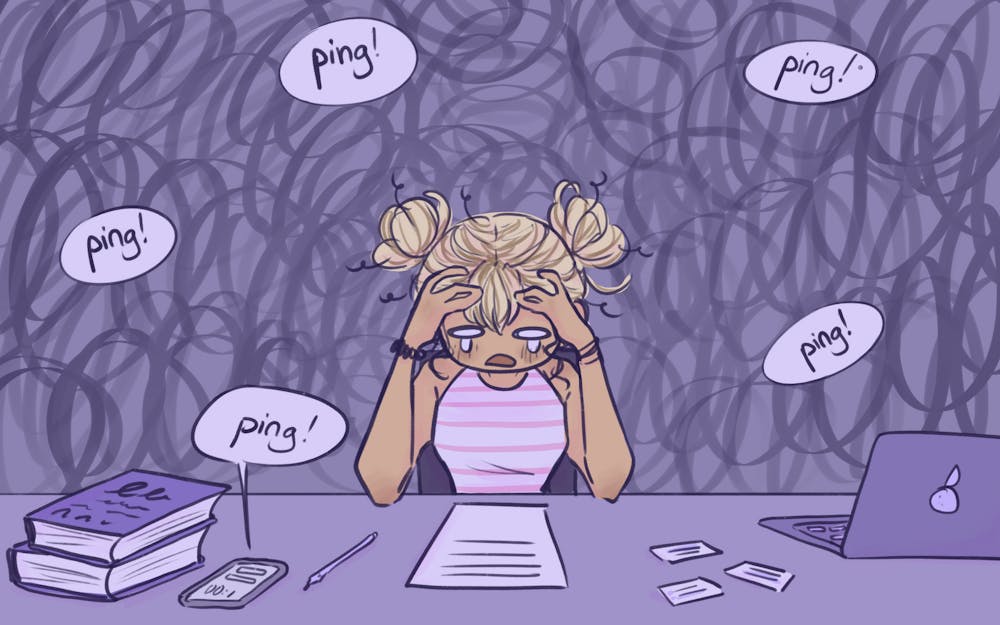
Finals week has a way of changing everything.
Sleep becomes optional. Meals become irregular. Coffee and energy drinks become your fuel. Feeling stressed becomes your default.
I’ve felt it myself. The late nights where my eyelids were heavy, but I kept telling myself, “Just one more chapter.” The constant pressure on my chest when considering everything I still had to do. The way my mind could never fully rest, even when I was sleeping. I kept having these dreams where I would feel I was feeling chased or have extreme despair even when I didn’t know why. Later, I found out these dreams were called stress dreams.
During finals, being overwhelmed feels like the norm.
But even if great stress is a natural part of finals, we shouldn’t treat it like a requirement.
For many students, stress during finals is a foregone conclusion, not something to manage but something to endure. It even turns competitive. Who slept less? Who studied more hours? Who is the most exhausted? Somewhere along the way, burnout stopped being a warning sign and became a badge of honor.
It is true that a certain level of stress can be motivating. Stress can activate the fight-or-flight response, where we release hormones that increase adrenaline. This can help us to perform better in times of school or projects. However, constant stress is anything but productive.
MentalHelp’s 2016 research showed 89% of college students were stressed two to four times per semester in the academic year, while 30% said they were stressed for almost the entire semester. For students, final exams are one of the main sources of stress the semester presents.
At first, that might not seem surprising. Finals are designed to be challenging. They represent the culmination of months of work, and the pressure to perform well on them can be overwhelming. The amount of material covered, the fear of failure and students’ pressure to meet their own expectations — even when those expectations aren’t realistic — contribute to the rising levels of anxiety around the end of the semester.
But stress doesn’t just stay in your head; it affects your entire body.
High levels of stress have been linked to physiological problems like sleep disruption and difficulty concentrating. Even if anxiety is meant to be a productive biological response, the more stressed students become, the harder it is to perform well academically. Excessive stress can interfere with memory, focus and overall cognitive function. During high-stress periods, the memory of a student can decrease around 15% compared to low-stress conditions, making it more difficult to retain information and succeed during exams.
The very force we deem necessary to our success is the one that’s holding us back from accomplishing our goals.
Still, we continue to normalize stress.
Part of the reason is time. Finals week compresses everything into a short period, accelerating the pace of life. It feels like between classes, studying and our personal lives, there’s no chance to slow down. Breaks start to feel like setbacks, and rest feels like wasted time.
Finals also suck us into unhelpful comparison. When everyone around you looks busy and stressed, you start to associate those feelings with productivity and wonder if you should emulate them. If others are pushing themselves to the limit, it feels like you should do it too. Otherwise, are you actually doing enough?
The mindset is hard to escape; I’ve caught myself in it more than once. I would start studying weeks before finals, but the extra time couldn’t keep stress at bay. I would push through exhaustion because I thought that was the only way.
But pushing through stress isn’t the same as managing it.
There are consequences to ignoring stress. According to a 2023 study from the American Psychological Association, ongoing stress in college students can lead not only to physical health issues like headaches or upset stomach, but also mental health struggles, like anxiety or depression. When our bodies and minds aren’t at their best, everyday tasks become struggles.
While avoiding stress at the end of the year might seem unrealistic, stress management doesn’t mean eliminating the feeling completely. It means learning how to respond to it in a way that doesn’t drain you.
Sometimes, it means stepping away from books for ten minutes instead of forcing yourself to keep going when you can’t focus anymore. At other times, it means choosing another hour of sleep over studying. Your brain needs to rest around seven to nine hours in order to function. Without them, the extra studying hours don’t mean much.
I’m not saying you should stop caring. I’m telling you to be realistic. Finals week is not a reflection of your entire academic ability, and one exam doesn’t define your worth. Holding impossible standards adds unneeded pressure to a situation that is already overwhelming.
We have accepted the idea that success requires stress. But if stress is affecting our ability to think, sleep and function properly in every sense, then it’s not helping at all.
We joke about being stressed. We normalize it in conversations, in group chats and in passing comments between classes. When we’re asked how we are, “I’m so stressed” becomes a default response, something we say without thinking twice about it.
But, what if we did? What if we stop treating stress as something we just have to survive, and started seeing it as something we have some control over?
Finals week will always be difficult, and work will always be there. But we can change the way we approach these challenges. We can recognize our limits instead of trying to push past them. We can take care of ourselves and stop feeling guilty about doing so. Doing well on exams doesn’t have to come at the cost of your well-being.
Stressed? Me too. Let’s do something about it.
Astrid Alomia (she/her) is a freshman studying journalism with a concentration in public relations and a minor in marketing.



