Editor's note: All opinions, columns and letters reflect the views of the individual writer and not necessarily those of the IDS or its staffers.
I used to base my gym routines on videos I watched on social media. It was helpful at first, because I learned which exercises worked which muscles. However, with time, I started feeling bad about the way I looked. Because the people I followed on social media had such “idealized” looks, I thought I was doing something wrong. There were even times where I ended up feeling physically unwell because I wasn’t eating enough to maintain my health.
Many turned to social media as a go-to for fitness advice during the COVID-19 pandemic. The trend doesn’t show any sign of stopping. For many students, fitness no longer starts with a plan or a coach, but with a swipe.
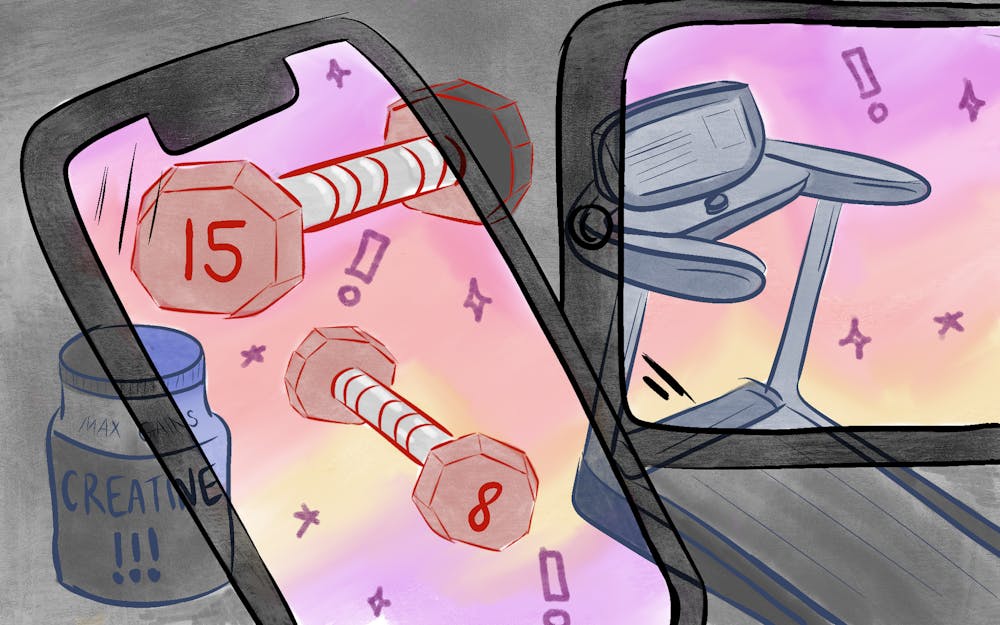
Platforms like TikTok and Instagram have transformed how we think about our health. My feed is crawling with “what I eat in a day” videos, making me think constantly about my usual diet. Videos with viral workouts promising fast results, like the walking regimen of 12-3-3on the treadmill, have also become pervasive.
I am not saying online advice about diet and exercise doesn’t work. It does, at least sometimes. Trends like increasing your protein intake to support muscle growth or following a structured strength training workout split may be genuinely helpful. Even mixing up some exercises like weightlifting and swimming or running. But others, like the ketogenic diet or dry-scooping pre-workout, often take things too far and promote habits that are not sustainable or necessary for most college students.
But when you are early in your fitness journey and trying to build health and self-esteem with new habits, social media can turn into a minefield of unhelpful fitness “shoulds” and “shouldn’ts.”
At first glance, wellness content seems like a positive force. Social media can encourage movement, introduce us to new exercises and build a sense of community between fitness-minded people. Online content can also make the fitness world more accessible to those who can’t afford personal trainers or nutritionists, or who don’t know where to start with diet and exercise. For students juggling classes, jobs and social lives, this fast-track to the “perfect” workout is a tempting offer.
However, the fact that fitness content is easy to access doesn’t mean it will also be accurate or sustainable.
Social media makes it easy to prioritize appearance over health. Creators promoting certain eating or workout regimens often curate their content with optimized lighting and angles, suggesting these regimens are a certain path to a particular body type. The message becomes less about strength, endurance or well-being, and more the achievement a certain look, like the “snatched waist.”
Studies on college-aged Instagram users have found that users frequently compare themselves to others and feel the pressure to meet unrealistic beauty and fitness standards. Over time, that comparison leads to students’ dissatisfaction with their own bodies. The Boston Children’s Digital Wellness Lab reported 46% of American teens feel worse about their body because of the constant comparison with social media.
Social media can transform our perception of exercise. Instead of an opportunity to better our lives and meet our needs, exercise becomes pressured and another area where we don’t measure up. Watching someone complete a demanding workout or follow a perfect diet can make a quick walk or a skipped gym session feel like failure, even when it isn’t.
When I started going to the gym, I would save posts with workouts or meal ideas, fully intending to implement them in my life. However, I always ended up feeling frustrated when keeping up with those who are full-time fitness content creators was impossible. I didn’t lack discipline.
Instead, the routines I wanted to follow weren’t built for my schedule and the stress my body was already handling because of school. Even knowing social media’s expectations didn’t fit my life, I internalized that if I didn’t go to the gym, walk 10,000 steps a day or eat 30 grams of protein in each meal, I was failing at “health.”
But social media rarely shows reality.
The “ideal” fitness lifestyle pushes people toward unhealthy extremes, including obsessive clean-eating behaviors or restrictive calorie counting. The exposure increases risks of falling into a state where the problem becomes dangerous for ourselves, such as food restriction or excessive exercise.
We begin to trust social media and its empty promises of “results” over what our diverse bodies need and want. If we see a creator doing pilates, for instance, we might assume we’ll achieve that person’s physique if we do pilates, too. I once told myself pilates were my thing because I saw online it “doesn’t make you bulky.” But the regimen wasn’t for me. Exercise became stress, rather than stress relief, because I felt pressure to follow the perfect position and achieve the “perfect physique.”
You don’t have to follow a fitness routine you see online just because a creator promised you the same results. Your bodies and lives are not the same.
Pilates aren’t “bad,” but they weren’t right for me. Following fitness creators isn’t misguided, but we can consider their advice as a way, not “the” way.
College is a time to learn how to be an adult. We have to balance jobs, meetings, classes, exams, finances and more. Social media can be a helpful tool in fitting changes like joining a gym and eating healthier into your busy life. But remember to take online advice with a grain of salt.
Being healthy doesn’t have to mean eating 30 grams of protein in every meal, doing the StairMaster for 30 minutes a day or doing pilates every morning. Health should be about the activities that bring you comfort and make you feel accomplished every time you finish, no matter if that’s walking, dancing or swimming.
Personally, I love weightlifting and running. How about you?
Astrid Alomia (she/her) is a freshman studying journalism with a concentration in public relations and a minor in marketing.