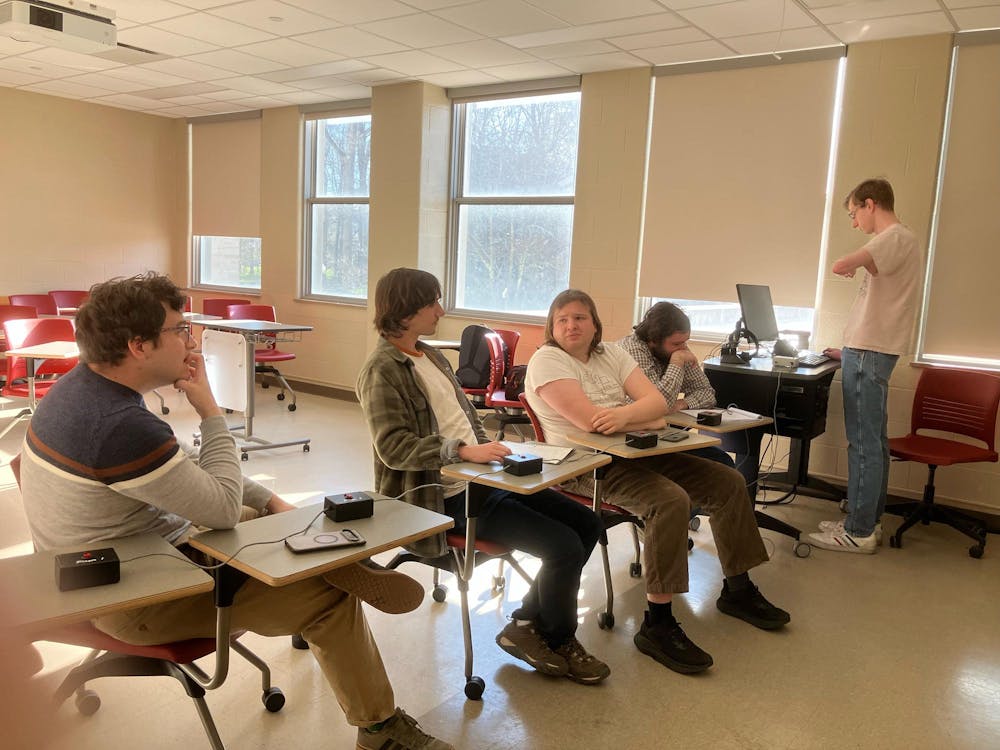
Sun pours into Ballantine Hall 216. The building is starting to empty out after a long day of classes at 5:30 p.m.
It’s time for quiz bowl.
Indiana University’s quiz bowl team sits in a row of red chairs, answering questions about anything from poetry to the World Cup. A team member fires question after question with the speed of an auctioneer.
This is the team’s sixth year qualifying for the Intercollegiate Championship Tournament, an annual quiz bowl tournament hosted by the National Academic Quiz Tournaments in North America and the United Kingdom.
After qualifying at a sectional tournament at the University of Illinois Urbana-Champaign on Feb. 7, the team will compete at the tournament starting Friday.
Club president Justin Hawkins said the team will also compete April 18-19 at the Academic Competition Federation Nationals.
Quiz bowl is a buzzer-based trivia game where one-to-four players per team try to answer questions first on topics like literature, science, music, religion and current events. Hawkins said the questions are designed to get easier as they go on, with more points awarded for early answers.
Games typically consist of sets of 20 questions, according to NAQT scoring rules. Teams that get questions correct earn a chance to answer bonus questions.
“We hope that our questions reward the players' knowledge and encourage the players to learn new things about the world around them,” NAQT Vice President for Communications Jeff Hoppes said in an email.
The chance to learn about a wide variety of subjects is exactly what attracts players like Hawkins and Jakob Myers to the game.
Both have done quiz bowl since high school, and now, as doctoral candidates at IU studying history, continued their passion.
It’s common for team members to specialize in certain categories. Hawkins' specialty is history, while Myers prefers literature.
Hawkins' study strategy focuses on breadth over depth. He looks over a database of old questions, and when he finds a concept he doesn’t know, he briefly researches it and takes notes. His notes document is over 100 pages.
“I do believe that anyone can become a pretty good quiz bowler,” Hawkins said. “You don't have to become an expert in any of the subjects that we do. You just try to have like, a Wikipedia of knowledge.”
Myers said another important part of the tournament strategy is managing caffeine levels to keep focus.
“If you under-caffeinate, you'll start zoning out during questions,” Myers said. “You overdo it and you start getting a tad twitchy on the buzzer, start getting more wrong, which is obviously sub-ideal.”
The team is sending four players to the NAQT tournament consisting of Alex Akridge, Hawkins and teammates Trenton Burgess and Daniil Kabotyanski. Myers will compete in the ACF tournament, but not the NAQT tournament.
While at the tournament, Hoppes wrote, 32 teams from universities across the country will compete in seven rounds playing against each team at least once. Then, after a tiebreaker round, there will be another six rounds of playoffs with a potential championship match after, depending on the records of the teams.
Last year, in 2025, the IU team was unranked, finishing in 25th place with a record of seven losses and seven wins, including a tie-breaker round.
Hawkins said he expects the team to perform better at the ACF tournament. He believes the team’s strengths is its wide breadth of specialties, from music to physics.
To track the team’s progress, scores will be updated on NAQT’s website.