
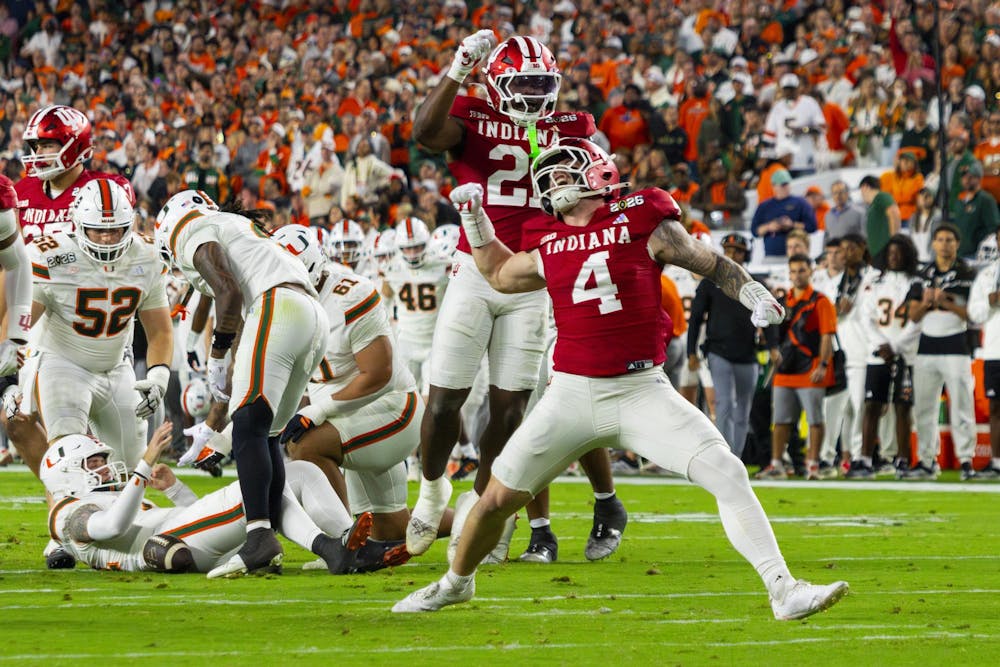
On Jan. 19, 2026, decades of despair for Indiana football were lifted. The Hoosiers walked out of Hard Rock Stadium in Miami Gardens, Florida, with the College Football Playoff National Championship trophy, a sentence that still sounds a little strange no matter how many times you say it. Indiana football, which isn’t exactly known for moments like this, had finally reached the top of the sport.
Not all seasons are created equal. Some are forgettable — six wins, a mid-tier bowl, a quiet offseason you barely remember by spring. Some are good — nine or 10 wins, a ranked finish, something that makes you think next year might be the one.
And then there are the rare ones that don’t fit anything that came before. So improbable, so out of nowhere and so disconnected from expectation that even weeks later you’re still asking yourself if it actually happened.
Indiana’s 2026 season was that kind of season: a stop-you-in-your-tracks run that didn’t just end in a championship, but reshaped what felt possible for an entire program. The kind of year where every Saturday raised the stakes, every win felt a little less believable than the last, and by the time it was over, reality had already started to blur into something closer to myth.
Months later it is still hard to believe. Five years from now, it may feel more like a dream.
So, how will we remember Indiana football's 2025-26 national championship run?
January 2031: Five years since the title
The situation:
Memorial Stadium in Bloomington has been renovated once since that night in 2026, trying to capture the energy of what fans now simply call “The Run.” Indiana football is a consistent Big Ten contender, running through the regular season with ease, occasionally losing to the other top teams in the Big Ten, but none of the seasons hit the same.
Former Indiana quarterback Fernando Mendoza is in his fifth season with the Las Vegas Raiders, who he’s led to three playoff appearances and an AFC championship appearance. He still gets introduced on broadcasts as “the guy who changed Indiana football.”
Indiana head coach Curt Cignetti has turned down multiple blue-blood offers and even though he’s still coaching, murmurs of a statue outside the Memorial Stadium have started.
Every big win is compared to 2026. Every close loss is framed as “they would’ve finished that back then.”
How we remember the season:
Reverently, but realistically. It’s the greatest season in program history, the one that proved it could be done. College football fans still argue about where it ranks nationally, but in Bloomington, it’s untouchable.
January 2036: 10 Years since the title
The situation:
College football looks different. The playoff has expanded to 24 teams, conferences have realigned twice and name, image and likeness collectives operate like Fortune 500 companies. Indiana is still good — occasionally great — but no longer surprising. It won another national championship during the 2033 season.
That 2026 team, though, is aging into legend. Stories start to stretch. Mendoza's game winning touchdown run in the national championship is continuously in top sports moment montages. People start to say, "The defense didn’t allow a touchdown for a month,” which is not technically true but feels true.
How we remember the season:
The details are getting fuzzy, but the mythology is sharpening. It’s no longer just a championship — it’s the moment Indiana football “arrived.”
January 2051: 25 years since the title
The situation:
Most Indiana football players from 2026 are now in their late 40s, making reunion appearances that draw bigger crowds than some current games. A “30-for-30" documentary called “The run that made no sense” wins multiple Emmys and introduces the story to a new generation of football fans.
Memorial Stadium now has a holographic pregame show that recreates key moments from that 2026 season.
Mendoza stayed with the Raiders through another relocation — because of course they did — as the franchise once again changed cities in search of something permanent in an increasingly unstable league. He retired 10 years ago after winning two Super Bowls and three MVPs and was immediately inducted into the Hall of Fame.
Mendoza became one of the defining quarterbacks of his era, the kind of player kids grow up arguing about, comparing across highlight reels and distorted memory, never quite able to agree on where he belongs in history.
Cignetti retired years ago and was succeeded by current Indiana defensive coordinator Bryant Haines, who helped architect the identity of that 2026 team in ways that only became fully appreciated in hindsight. His system became the foundation for Indiana’s continued rise, copied across the sport in the years that followed and never to the same success.
How we remember the season:
As something bigger than a national title. It’s folklore now. The year everything changed. The standard every era gets measured against, even unfairly.
January 2076: 50 years since the title
The situation:
College football barely resembles its former self. Games are now streamed directly into implants, and the sport’s power structure has shifted so many times it no longer has a clear center. Conferences have dissolved into something closer to corporate alliances than regional identities, and the idea of a “traditional rivalry” survives mostly as marketing language.
Indiana football is still around — still relevant — but fewer people can say they remember that season firsthand. Outside Memorial Stadium stands different holograms of the 2026 team: multiple players, Cignetti and that immortal Mendoza run, forever caught in the uncertainty of disbelief.
Sports historians still argue about whether that was the most improbable championship in the sport’s history. Old clips circulate every January, grainy and endlessly reanalyzed, as each generation attempts to reverse-engineer how it actually happened without fully believing the answers they find.
How we remember the season:
We remember it like a sports miracle that somehow made sense and no sense at the time. The kind of story that feels too perfect to be real — except it was.


