
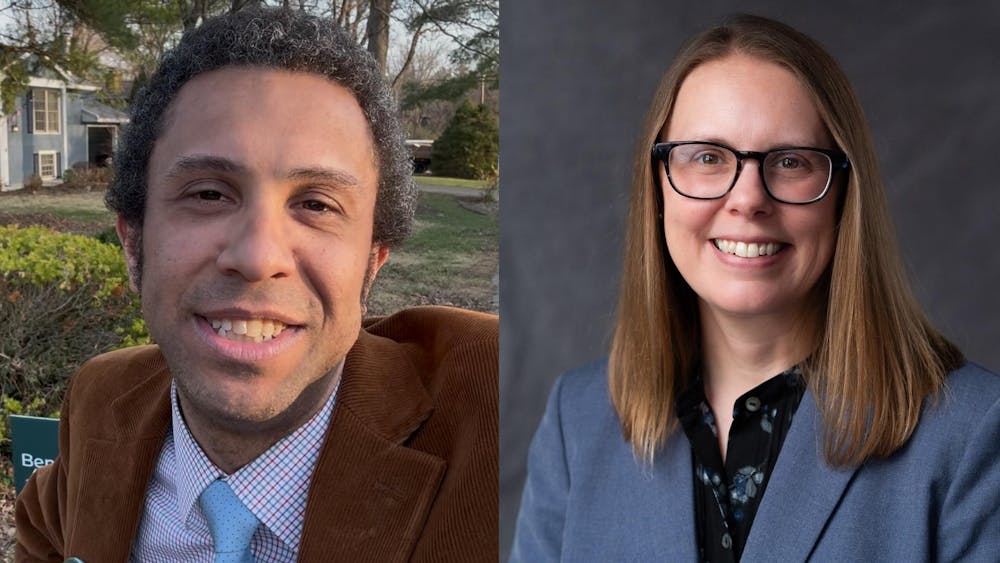
Incumbent Monroe County prosecutor Erika Oliphant and challenger Benjamin T. Arrington are both seeking the Democratic nomination for the position in the 2026 primary. With no Republican challengers filing for the general election, the Democratic primary will likely decide the race come November.
Prosecutors play a central role in the local criminal justice system. They review cases submitted by law enforcement, determine what charges to file and represent the state in criminal proceedings. The office works with multiple local policing agencies and the Monroe County Public Defender's Office.
Prosecutors in Indiana have broad discretion in how cases are handled by deciding whether to file charges, offer diversion programs or dismiss cases.
Who are the candidates?
Arrington is a Bloomington resident and first-time candidate for Monroe County prosecutor. He moved to Bloomington in 2013 to attend law school after growing up in San Antonio and studying political science at Northeastern Illinois University in Chicago.
Arrington described himself as a nontraditional student, as he earned his GED diploma before attending college in his early 20s. He said growing up in poverty and in a biracial family informs his perspective on the justice system, which he describes as compassionate and understanding. He has worked as a staff attorney at Pro Bono Indiana Inc.’s District 10 office since 2024.
Oliphant is the incumbent prosecutor running for her third term, and has lived in Monroe County for 27 years. She graduated from the Indiana University Maurer School of Law in 2009 and began working in the county prosecutor’s office as deputy prosecutor shortly after.
She was first elected to the prosecutor’s office in 2018 and has been in office for more than 7 years.
Why are they running?
Arrington said he is running to offer voters an alternative approach to the office, and said he is disappointed in the current office’s performance. He said as prosecutor, he would take inspiration from Marion County Prosecutor Ryan Mears, who stopped the criminal prosecution of one ounce or less of marijuana in 2019.
“I want to give voters the choice of a true progressive candidate, a candidate that's willing to take a stand for what's right,” Arrington said.
Oliphant said she is seeking reelection to continue initiatives focused on data collection to help reduce demographic disparities she has seen in the local justice system.
“I believe that I have the experience, temperament and leadership skills to ensure justice in Monroe County,” she said. “To make sure that the system is fair for everyone and that we have a community that is safe for everyone.”
What issues define their platforms?
Arrington’s platform focuses on changes to how certain low-level and nonviolent offenses are handled, as well as broader social issues.
He said he would make low-level marijuana offenses the lowest priority for prosecution. Arrington said he feels that marijuana prosecution in Monroe County is overemphasized, lessening law enforcement’s focus on violent crime. Oliphant said that when someone is convicted of marijuana possession in Monroe County, it is often because of a concurrent charge like driving under the influence.
Arrington has said that despite the low level of convictions, the county should still work to not charge people when not needed with possession.
“We're surrounded by states all around Illinois, Michigan, now Ohio, with legal cannabis that a friend of yours might leave in the car, and now you're accidentally facing a criminal misdemeanor,” Arrington said. “We can be better than that. We need to stop that.”
Indiana Gov. Mike Braun signed SEA 285 into law March 5, which criminalized public sleeping and camping. Arrington pledged to limit prosecution related to the act partially because of he used to be homeless.
Arrington also pledged to limit prosecution in abortion-related cases and in trespass and public sleeping cases, usually involving homeless people.
“The time is now critical that we need a prosecutor like myself that's going to have that unique lens when it comes to prosecution,” he said.
Oliphant highlighted a research partnership with Indiana University and the Monroe County NAACP examining racial and ethnic disparities in the justice system that Oliphant expects will be published in June. The project is expected to include a public-facing data dashboard with information on case trends and outcomes, which she said would help hold the justice system accountable and conscious of systemic biases.
Oliphant said she hopes to continue the work she’s been doing as prosecutor, focusing especially on data-driven decision-making and resource allocation.
Oliphant also hopes to continue ongoing efforts related to mental health and substance use programs, like the Stride Crisis Center, as well as expanded resources for prosecuting domestic violence cases. Oliphant was a part of the group that helped in the development of the center, which offers its resources to people experiencing mental health or substance use crises.
“It's a place to kind of de-escalate them and get them connected with resources that they may need. And police do use that sometimes instead of jail,” she said.
How would they work with the state?
Arrington said he would take an approach that reflects his policy positions at the local level, including advocating changes through prosecutorial discretion.
One example of this, he said, would be signing a pledge to stand along with Mears, who is the only Indiana prosecutor to sign, along with 80 other prosecutors to not prosecute women, doctors and nurses in relation to reproductive rights related cases.
He said his office would focus on violent crime while taking a different approach to certain nonviolent offenses.
Oliphant described a more cautious approach to interactions with state government.
“We have very broad discretion to decide what charges to file against whom based on the referrals we receive from law enforcement, and then how we choose to dispose of them, as we are processing them,” Oliphant said. “There has been an effort by conservative legislators to try to limit our discretion.”
In December 2025, Indiana Rep. Andrew Ireland, R-Indianapolis, introduced a proposal to allow prosecutors to be impeached within the Indiana state constitution, citing “rogue judges and prosecutors” in an X post.
She said she would continue to use discretion within the bounds of state law while avoiding actions that could create direct conflict with state officials.
Why does the role matter?
Arrington said the prosecutor plays an important role in shaping both public safety and individual outcomes within the justice system.
“You want a prosecutor that is going to be tough on crime and protect you,” he said. “So that in somebody's worst day of their life where they do something terrible that they may regret later, that you have a prosecutor and a prosecutor's office that wants to see you succeed.”
Oliphant said the position carries responsibility for ensuring fairness across the legal system while maintaining community safety.
“We want to make sure that people are not treated disparately and that victims are heard, represented, and treated with dignity and respect,” she said.
The primary is scheduled for May 5, with early voting beginning April 7.
You can find voter registration resources here.


