
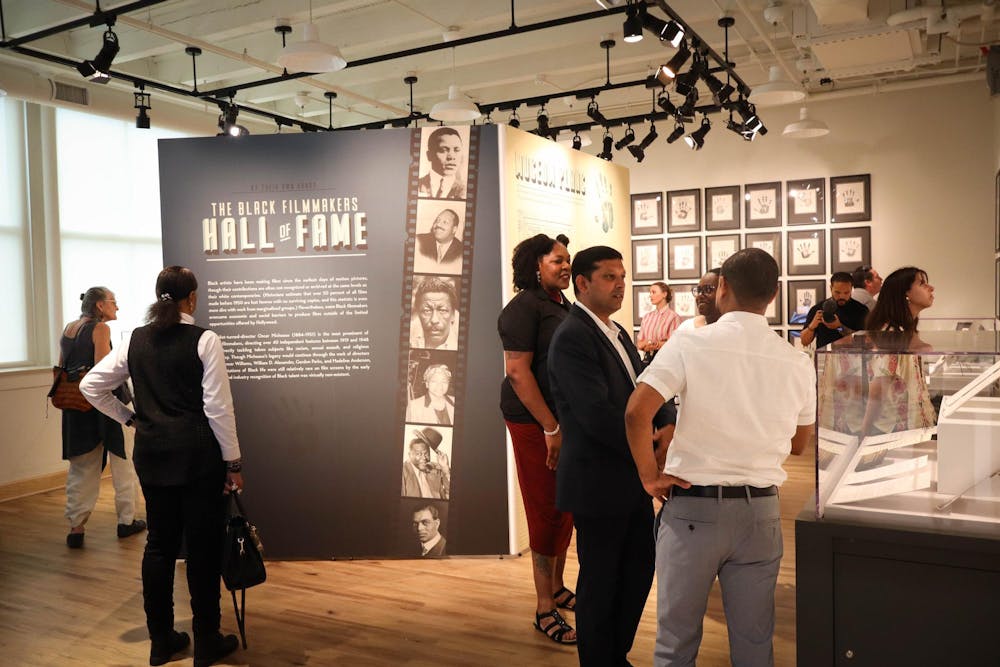
A wall of graphite handprints honoring Black film legends now lines the inside of the McCalla Building. The markings, reading names from Eartha Kitt to Richard Pryor, are a central feature of “By Their Own Hands: The Black Filmmakers Hall of Fame,” which opened to the public last fall.
Presented by the Black Film Center & Archive and University Collections at McCalla, the exhibit opened on Sept. 5. It highlights the legacy of the Black Filmmakers Hall of Fame Foundation, which was founded in 1974. Curated by the two organizations and supported by the IU Foundation’s Black Philanthropy Circle, the exhibit explores the foundation’s mission to honor Black voices in film and the arts.
Dan Hassoun, archivist at the BFCA, and Sarah Petras, assistant archivist, co-curated “By Their Own Hands.”
“Too often, Black filmmakers and Black film as a whole are pushed down, pushed away or put to the sidelines,” Petras said. “Our goal is to make that as forward-facing and front-facing as possible and to make sure that people are aware that Black film history is film history in the same way that Black American history is American history. It is a huge part of that story, and we want to make sure that it is told.”
Petras said Brian Woodman, associate director of University Collections at IU, approached the BFCA to help curate the exhibit, which includes scripts, letters, costume designs and other materials. She said while the BFCA is a film archive, it also collects other materials related to film and the filmmaking process, which made the organization well-suited to curate the exhibit.
Hassoun said the exhibit is divided into three major sections that chart the history of the Black Filmmakers Hall of Fame from its beginning to its end, with selected material corresponding to each section.
When visitors first enter the exhibit, they encounter a section on the BFHFI’s emergence and the involvement of celebrities. Further along, a second section highlights the ceremonies it held, while the final section showcases materials tied to the filmmaking process.
The exhibit includes items such as the Nicholas Brothers’ tap shoes and a script from “Let’s Do It Again” signed by its director Sidney Poitier . This section’s centerpiece is the wall of handprints. Petras said the BFCA received funding from the Black Philanthropy Circle to frame the handprints.
The exhibit includes a wall of 42 handprints in the back of the gallery, showing both the breadth of the organization’s accomplishments during its existence and the many filmmakers and actors who did not receive recognition elsewhere, Petras said.
The handprints come from the original Black Filmmakers Hall of Fame Foundation and were created by celebrities inducted into the Hall of Fame. Beside the handprint wall are binders with the stars’ photos and a QR code linking to a website with additional headshots, Hassoun said. “We tried to provide as many access points as possible.”
An educational event highlighting the exhibit took place on Feb. 27 and featured Hall of Fame inductee Denise Nicholas, an actress and writer known for “Let’s Do It Again” (1975), “Capricorn One” (1978) and the television series “Room 222” (1969-74). Throughout her career, Nicholas received three Golden Globe nominations and won three NAACP Image Awards. Last year she recently her memoir, “Finding Home.”
Ja Quita Joy Roberts, finance and office administrator at the BFCA and mentor for the Department of African American and African Diaspora Studies, said bringing Nicholas to IU was a sort of coincidence.
“The AAADS graduate students were planning the Herman C. Hudson Symposium, and Denise was on her book tour for ‘Finding Home,’” Roberts said. “Someone reached out to me and asked whether we would be interested in meeting her, hosting her and showing her around. Of course, the answer was an absolute yes.”
During the event, BFCA Director Novotny Lawrence interviewed Nicholas, and she recalled her journey from the University of Michigan to becoming an actor and later focusing on writing while navigating the realities of being a Black woman in the United States.
“I wanted to be involved in civil rights, but I was a student at the University of Michigan,” Nicholas said during the event. “That was my way into the civil rights movement. I wasn’t afraid to go, as many people were, because it was so violent. I went by way of the Free Southern Theater. I learned how to act while I was acting.”
The exhibit offers students and history enthusiasts a chance to reflect on the legacy of Black filmmakers and the lasting impact of their work.
“As far as what it can do and provide for students, the community, the public and the world, it is inspirational in so many ways,” Roberts said. “What people were able to do with little or nothing at times is amazing. So, it provides a different level of motivation and encouragement for today’s students to see what happened then, what came to be, what has still survived and what is still amazing.”
The exhibit will run through May 31. The BFCA, located on the ground floor of the Herman B Wells Library, will also host upcoming events including “You (probably) Haven’t Seen This Before” with the Indiana University Libraries Moving Image Archive on March 26; First Wednesdays featuring Gerald Butters Jr., professor of history at Aurora University, on April 1 and a screening of “When Everyone Swims,” followed by a Q&A with Jerald Harkness, president and CEO of Studio Auteur on April 28.


