
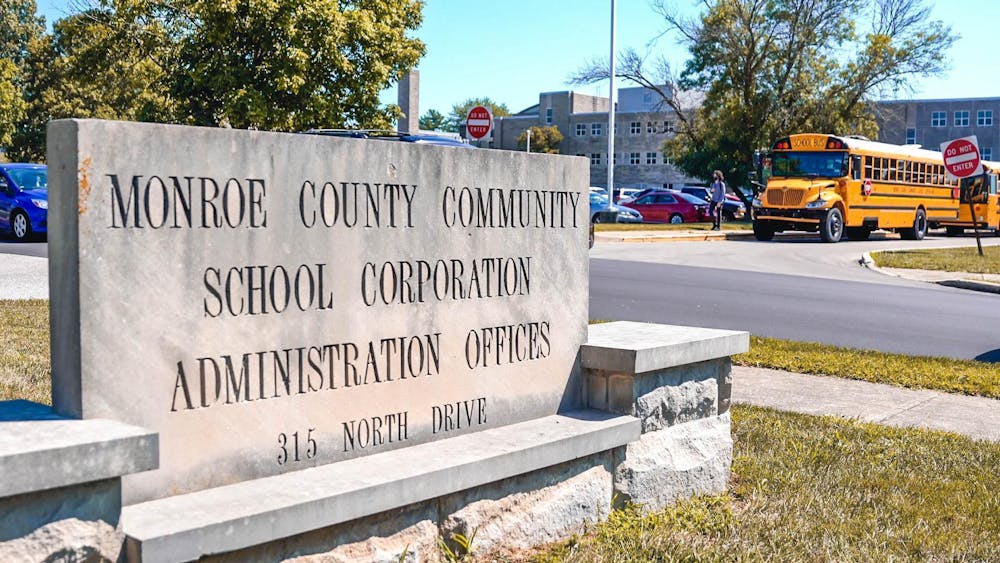
The Monroe County Community School Corporation board weighed options for the old Herald-Times building and renewed early childhood partnerships Tuesday as the corporation continues to navigate the impacts of Senate Enrolled Act 1.
Superintendent Markay Winston provided a quarterly financial update as part of MCCSC’s two-year financial strategy anticipating the aftermath of SEA 1, which cut property tax levies statewide, a key source of public school funding.
“The fact of the matter is that SEA 1 is impacting everyone,” Winston said. “In many ways, MCCSC has been ahead of the curve because we’ve been discussing potential impacts for several months now.”
Winston cited an outlook on Bloomington’s economy conducted by the Indiana University Kelley School of Business. It indicates Bloomington’s real gross domestic product grew 4.4%, less than half the state’s average between 2019-23. Local hourly earnings fell 6.5% between 2024-25.
According to the report, a home in Bloomington costs $451,370 on average, 18.1% more than the state average of $382,180, which Winston said is relevant to MCCSC because of how it affects families.
“When families struggle with low wages and high housing costs, some of them leave,” she said. "And in Indiana, when students leave, funding leaves follows them out the door.”
MCCSC Chief Financial Officer Matthew Irwin said the corporation has experienced an estimated cumulative $30,931,572 loss in state funding due to a decrease in enrollment since the 2019-20 school year. Indiana provides funding based on the number of students enrolled in a public school corporation, creating a challenge for one facing declines in enrollment.
“When our number one source of funding continues to change, we need to change and adapt with it,” Irwin said.
Irwin said MCCSC has made “significant progress” in its fiscal standing. It’s not yet achieved fiscal balance, he said, but the corporation’s Operations Fund is moving in the right direction with continued growth long-term.
The Education Fund, which pays for expenses related to student instruction and learning, has stayed stagnant, Irwin said. This is also the fund that pays teacher salaries. For MCCSC’s Referendum Funds, Irwin said that if the corporation’s spend level trajectory stays the same as SEA 1 continues to unfold in the next few years, it may have to take more from MCCSC’s cash balance.
“It’s important that we are operating in a healthy place because we take care of a lot of students, and we employ a lot of staff,” Irwin said.
MCCSC Assistant Superintendent of Human Resources and Operations Jeffry Henderson also shared community input regarding The Herald-Times building, located at 1900 S. Walnut St.
MCCSC bought the building in 2022 for just under $3 million and is currently using it for storage and bus parking.
MCCSC hosted a community forum Jan. 29 about potential uses for the property. In addition, the corporation released a survey open from Jan. 8-30 that community members could fill out online.
Henderson presented community input collected through both the survey and public forum. Out of 404 survey responses, 40% suggested MCCSC sell the building.
Alternatives included using the property for educational programs, sports facilities, community or social services, administrative or operational usage, career and technical education or other ideas not included in the survey.
Before a public school corporation can sell a property, it must first hold a public hearing and provide notice in accordance with Indiana Code 5-3-1. Then, the board must approve the sale of the property, and the property would then be appraised by two appraisers.
The board may proceed to sell the property at public auction or retain a licensed real estate broker to handle the sale.
Board president Erin Cooperman requested that MCCSC post a notice and hold a hearing to “have all the options on the table” that meet statutory requirements.
Additionally, the board considered Resolution 2026-25, which would renew MCCSC’s relationship with eligible early childhood learning providers for the 2026-27 school year. It also provides that MCCSC may limit the number of new providers consistent with the corporation’s financial planning.
Resolution 2026-05 updates funding for providers of early childhood education or preschool programs. Providers must operate a nonprofit organization providing either early childhood education or preschool programs recognized under Indiana law and meet state licensing and eligibility standards. The provider must also have submitted an application, according to MCCSC’s Early Childhood Education Provider Agreement.
MCCSC will implement a sliding scale of payments from $4,000, $6,000 or $8,000 paid to these providers for eligible students based on age and socio-economic status under the federal poverty guideline. Payments for pre-K students for each school year are adjusted proportionally based on the number of days enrolled and eligibility.
For the 3-year-old preschool program, MCCSC will contribute up to $1,000 per month for up to a year to its partnered childcare providers on behalf of students from households that make less than 225% of the federal poverty guideline. Students must be 3 years old by Aug. 1, 2026, to qualify. However, such funding does not apply to those qualified for Indiana’s On My Way Pre-K program or Childcare and Development Fund.
According to the U.S. Department of Health and Human Services, an income 225% of the 2025 federal poverty guideline for a household of four in the lower 48 U.S. states is $72,337.50 a year.
The board adopted the resolution unanimously.
CLARIFICATION: This story has been updated to clarify MCCSC will contribute to partnered childcare providers for its 3-year-old preschool program.


