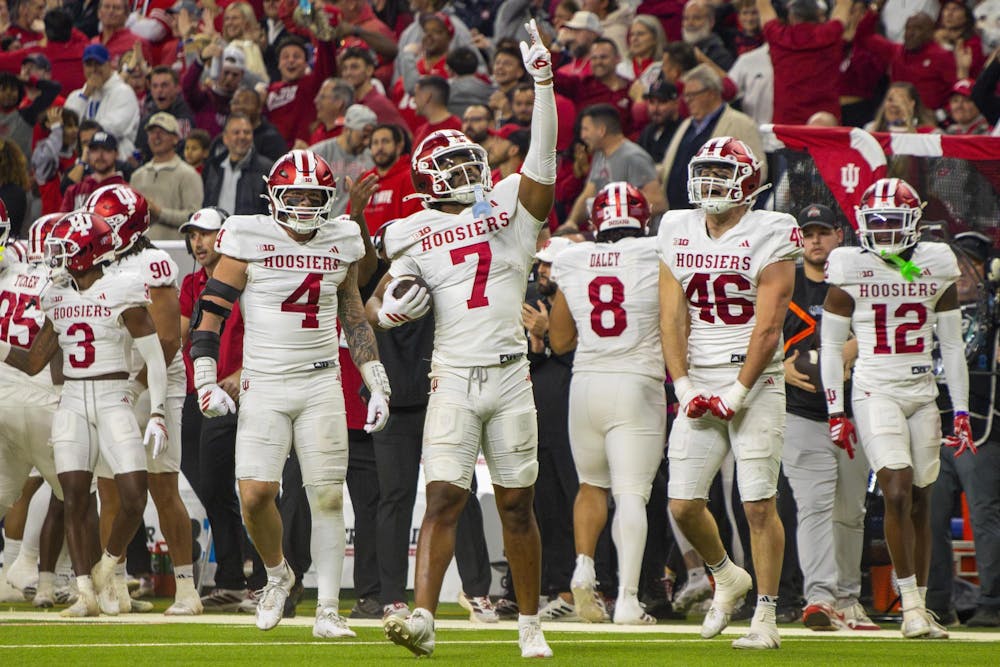
The NCAA has threatened to invoke the “rule of restitution” against Indiana University and former Indiana safety Louis Moore in his ongoing eligibility lawsuit.
According to a response filed in Texas’ Fifth Court of Appeals, the NCAA believes its Division I Board of Directors is entitled to seek restitution, “if they so choose.” Listed possible actions include vacating Moore’s individual performances and repealing team victories, “including the national championship.”
Bylaw 12.9.4.2 of the 2025-26 NCAA Division I Manual states if a player ruled ineligible by the NCAA is allowed to participate by a court order that is later “voluntarily vacated, stayed, or reversed,” the Board of Directors is permitted to take action against the institution “in the interest of restitution and fairness.” Possible actions include:
- Vacating individual and team records and performances
- Declaring the institution ineligible for NCAA Championships in the sport and season that the ineligible student-athlete played in
“It is draconian,” Boise State University assistant professor Sam Ehrlich said. “It really kind of disincentivize(s) athletes from being able to seek judicial intervention.”
After suing for his eligibility, Moore played the entire 2025 season on a series of court rulings that culminated in a temporary injunction being ordered Sept. 24 that kept him eligible for the rest of the season.
An Indiana Athletics spokesperson said Moore was “cleared to play pursuant to a decision made by the courts.”
Ehrlich, an expert in sports and antitrust law, noted that judges have identified “the rule goes far beyond what it’s intended to do” and encourages schools to “go against court orders.”
A non-jury trial in the district court was originally scheduled for Jan. 29, but court records indicate the trial was canceled. A notice of nonsuit was filed by Moore’s attorneys Jan. 20, the day after Indiana football won the national championship.
The nonsuit was granted eight days later, ordering that all of Moore’s claims against the NCAA are “dismissed without prejudice.” The decree officially closed Moore’s case at the district level, but recent developments in the appellate court have reignited concerns over its fallout.
The NCAA has argued that the injunction — which granted Moore eligibility and enjoins the NCAA from invoking the “rule of restitution” — was voluntarily vacated by the nonsuit, freeing the NCAA Board of Directors to invoke the rule.
While it remains unclear if the NCAA intends to penalize Indiana and other schools involved in similar cases, the argument represents the next step toward reaching an appellate ruling.
Former University of Memphis wide receiver Cortez Braham Jr. and former San Diego State University defensive lineman Tatuo Martinson also sued for their eligibility and played the 2025 season under an injunction. However, Braham and Martinson did not file a notice of nonsuit in the district court.
“What’s going on in these three cases isn’t even necessarily about the rule of restitution,” Ehrlich said. “I think it’s just the NCAA really wants an appellate ruling.”
The NCAA seeks an appellate ruling that says its eligibility rules are legal and can’t be challenged under antitrust law. Similar cases have struggled to reach an appellate ruling because of the nature of the timing of the lawsuits with regard to when the player seeks eligibility.
As players initiate lawsuits the same yearthey seek to play, injunctions are frequently granted for those seasons because the courts determine that withholding eligibility would constitute irreparable harm — one of the factors in determining whether an injunction is necessary.
Moore transferred to Indiana following the 2024 season with the intention to play his final year with the Hoosiers. However, prior to the beginning of the year, the NCAA denied his eligibility waiver.
Moore began his collegiate career at Navarro Community College from 2019-21, and the NCAA attempted to count his junior college years against his NCAA eligibility. In the wake of a federal judge in Tennessee granting former Vanderbilt University quarterback Diego Pavia an injunction to play the 2025 season, the NCAA issued a blanket eligibility waiver to players in similar situations, which Moore believed included him.
In each case, the injunctions enjoined the NCAA from enforcing the “rule of restitution” for complying with the order.
The NCAA argued Braham’s case was not moot, and specifically that being prevented from enforcing the “rule of restitution” was reason to keep it going. In a Feb. 9 filing, the NCAA’s attorneys stated they could vacate or strike individual records or performances, vacate team victories, force Braham to return any awards he won during the season or assess a financial penalty to the University of Memphis.
In all three cases, the NCAA contends the injunctions should never have been issued, but the presence of the nonsuit makes Moore’s case unique.
As the Braham and Martinson cases move closer to rulings on their motions to dismiss, college athletics seeks clarity, and Indiana football’s historic 2025 season could hang in the balance.
“The appellate courts are going to have to rule on the merits,” Ehrlich said. “And I think that’ll say a lot about the enforceability of these rules moving forward.”
Nathan Shriberg covers Indiana men’s basketball and sports business/legal matters for the Indiana Daily Student. You can follow him at @NShriberg and contact him via email at naashri@iu.edu.