
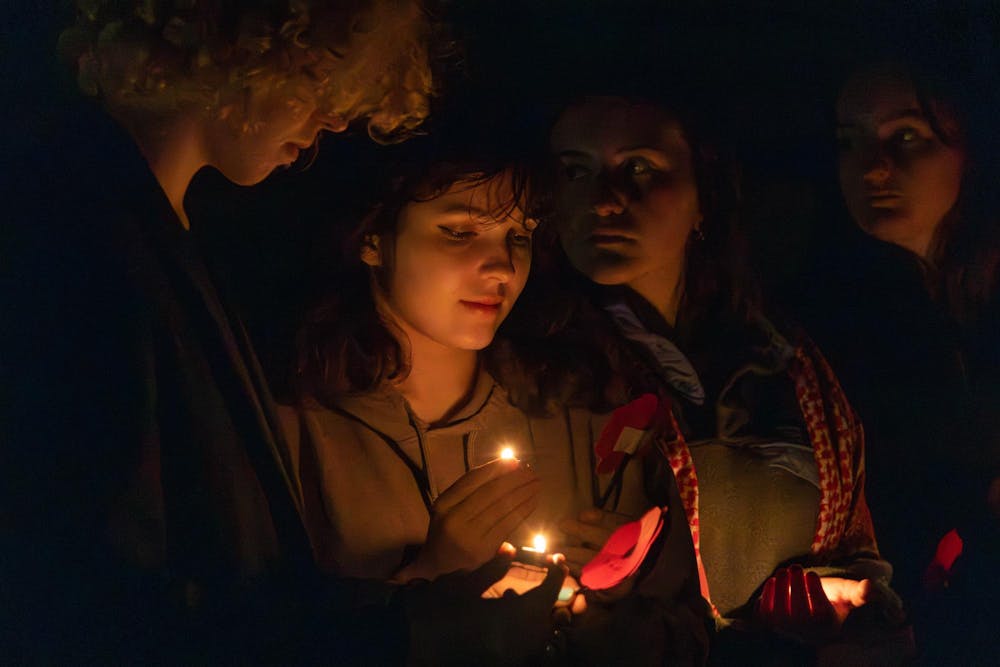
The soft glow of candlelight cut through the dark night at the Conrad Prebys Amphitheater as community members filled the first four rows of limestone benches.
After two years of the Israel-Hamas war, two years of campus vigils, two years of protests and remembrances, many of the same students and professors who began mobilizing after the onset of the war continue to organize for Palestine. Over 60 people gathered for a vigil Wednesday night to commemorate those killed in Gaza since the start of the conflict.
Seven speakers shared poems and stories from Palestinian writers, journalists and victims of the war. Organizers posted signs around the amphitheater reading “IU FUNDS GENOCIDE,” “Israel is starving Gaza” and paintings of victims of the war. They also encouraged donations for families in Gaza.
Since the beginning of the war, protests, vigils and organizers have grown across campus, as has tension. It began on Oct. 9, 2023. Two groups of students, one in support of Israel and one supporting Palestine, met at Sample Gates and confronted each other through a line of police.
Jewish and Palestinian students have both shared stories of harassment and fear on campus as the war continued. Starting April 25, 2024, students held a 100-day encampment in Dunn Meadow. Police forcefully arrested more than 30 protesters on the first day of the encampment. Another 23 were arrested on the third day.
Afterward, the university closed Dunn Meadow for nearly the entire fall semester last year, but protests continued against the war and IU’s response to protests. They continued throughout last school year. IU placed the Palestine Solidarity Committee on cease and desist Aug. 15 for “disorderly conduct.” They have since renamed themselves and their social media to PSC of Bloomington.
The Israel-Hamas war began on Oct. 7, 2023, after a Hamas-led attack killed 1,195 people in Israel. Militants took 251 hostages, with 48 still in captivity. At least 20 hostages are believed to still be alive.
Israel’s subsequent invasion of the Gaza Strip has killed more than 67,000 people and leveled entire towns and cities, according to the Gazan Health Ministry, which does not differentiate between civilians and combatants. The war has brought accusations of genocide against Israel, with a United Nations commission of inquiry concluding Sept. 7 that Israel is committing genocide against Palestinians in Gaza. The International Association of Genocide Scholars and a number of other human rights groups have also said Israel’s actions constitute a genocide. Israel denies the claim.
On Wednesday, Hamas agreed to release the remaining 20 hostages in the coming days, with the Israeli military set to withdraw from a majority of Gaza, according to the AP. Israel will also release nearly 2,000 Palestinian prisoners, according to Hamas officials.
The ceasefire and hostage exchange deal were not mentioned at Wednesday night’s vigil.
One sign at the vigil read, “If I must die you must live to tell my story,” a quote from Refaat Alareer’s 2011 poem, “If I Must Die.” Alareer was a Palestinian writer and professor at the Islamic University of Gaza killed in an Israeli airstrike Dec. 7, 2023, according to CNN.
IU sophomore Malak Samara called on attendees to remember the resilience of the Palestinian people amidst the war. She also brought attention to alleged fatigue she’s seen from her peers about the war.
“We have the audacity to start looking away, to scroll past their videos all because we’re bored or mentally exhausted, or tired of hearing about the same genocide from two years ago,” she said through a megaphone in front of the crowd. “Don’t you think that they’re tired? Don’t you think that they’re mentally, physically, emotionally exhausted on a level you won’t even begin to understand?”
IU student Lilia Wolf read the will of Palestinian journalist Anas Al-Sharif for Al Jazeera Arabic who was killed in August after an Israeli airstrike hit his tent, also killing five other journalists. Israel alleged Al-Sharif had ties to Hamas, an accusation he and the Committee to Protect Journalists denied.
“I urge you not to let chains silence you, nor borders restrain you,” she read from the will. “Be bridges toward the liberation of the land and its people, until the sun of dignity and freedom rises over our stolen homeland.”
After the speeches, attendees lit candles and shared a moment of silence. Organizers shared red paper poppies inscribed with the names of victims to each attendee. Attendees laid them at the front of the amphitheater and laid their still-lit candle beside each flower.
The audience was quiet and focused, loudly applauding each speaker once they finished. They remained silent through the laying of the candles, as the organizers read the names of the victims as they handed each guest a poppy.
IU student and event organizer Sarah Alhaddad helped make the poppies and explained the significance of the flower.
“The red of the poppies is meant to symbolize the spilled blood of our martyrs and Palestinians that goes back into the ground and comes back up as poppies,” she said. “They’re very significant to us culturally so we thought that would be a nice vehicle to honor the martyrs.”


