
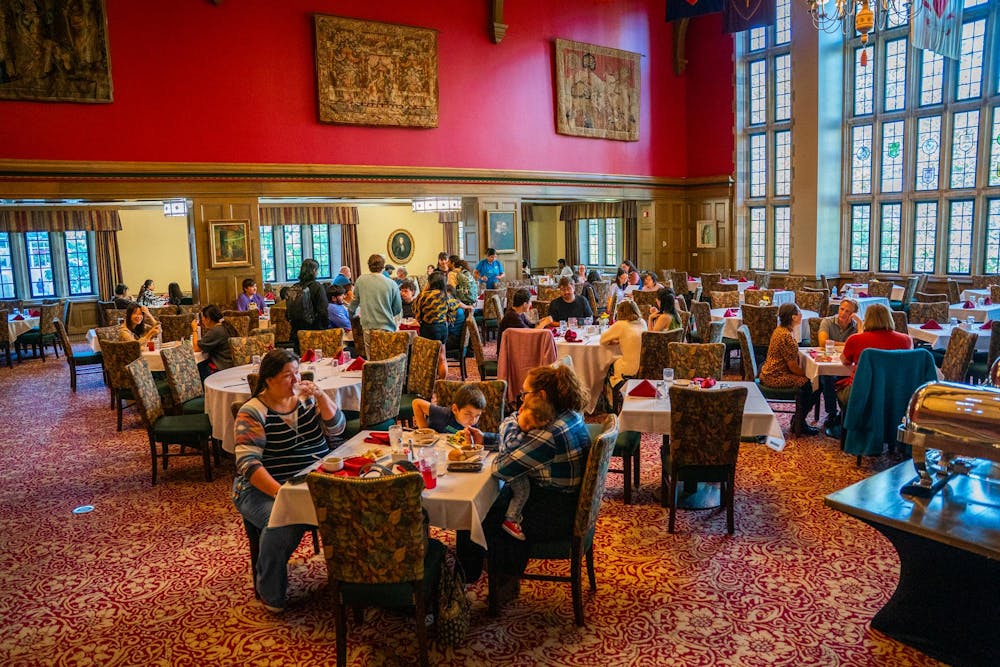
Students and faculty celebrated Indigenous Peoples Day on Monday at the Indiana Memorial union, despite a recent push by President Donald Trump’s administration to exclusively recognize Columbus Day.
This year’s celebration looked slightly different than years past, given that it came just days after Trump issued a proclamation Oct. 9 declaring the holiday Columbus Day. In an April Truth Social post, he vowed to bring the holiday “back from the ashes.”
Columbus Day has been recognized as a national holiday since 1937, but many have advocated for the alternate recognition of Indigenous Peoples Day to honor those who suffered at the hands of European colonialism.
Former President Joe Biden was the first to officially recognize Indigenous Peoples Day alongside Columbus Day via proclamations during all four years of his presidency.
“I think the first step to healing is just atonement and reconciliation and just not ignoring the uncomfortable history,” sophomore Zack Yazzie, a member of the Navajo tribe, said. “It’s like, we can't change it, but we can move forward in a positive way.”
The First Nations Education and Cultural Center and the Union Board hosted Monday’s event, which included an Indigenous-inspired meal in the Tudor Room, with dishes such as bison stew and “Three Sisters” salad, which refers to the Indigenous method of planting beans, squash and corn together so that they support each other’s growth. The event also included vendors and information booths around the IMU.
FNECC Director Sherene Ing, who organized the event, said her goal was to celebrate Indigenous culture on campus, especially given the recognition of the holiday by the city in the past few years.
Bloomington became the first city in Indiana to recognize Indigenous Peoples Day through a proclamation by then-Mayor John Hamilton in 2018. In 2021, the Bloomington City Council passed an ordinance to officially recognize Indigenous Peoples Day on an annual basis.
Students attending the event described the celebration as a way to connect with IU’s Indigenous community and learn more about its history.
Connor Hatch, a sophomore and member of the Lenni-Lenape tribe, said outreach programs like Monday’s help students better understand Indigenous culture on campus beyond land acknowledgements posted on university websites.
Michael Ing, director of IU’s Native American and Indigenous Studies Program, said the celebration was especially meaningful given the small Indigenous population on campus.
“We live in a state named after Native Americans, yet we never see them anywhere, and that's in part because we were so effective at removing them from the area,” Ing said.
State and federal diversity, equity and inclusion cuts have also affected Indigenous students at IU. After executive orders from both Trump and Indiana Gov. Mike Braun dismantling government-funded DEI programs, IU closed the Office of the Vice President for Diversity, Equity and Inclusion and stopped funding several student scholarships.
This included the First Nations Scholarship Program, which Sherene Ing said is “on hold” for all incoming students, but is still being awarded to recipients who received the funding before the legislation.
For sophomore Macy Pugh, the program was one of the reasons she chose to attend IU.
“I'm in the Miami tribe, so I could have gone to Miami University for free because they're on tribal land,” Pugh said. “But I really wanted to come here, and that scholarship was the reason I was able to come here, so it's definitely important.”
One graduate student from the O’Neill School said that, despite political obstacles, celebrating Indigenous Peoples Day is an act of resistance. The student, who is studying Indigenous governance and international development, is on medical leave and asked to remain anonymous to avoid any retribution from IU’s administration.
"They're not going to stop this, no matter how hard they try,” he said. “And that's the people in the state government, that's the people in the federal government, and that's the people in the actual college board.”
Despite Trump's proclamation, attendees and organizers still chose to focus on the community aspect of the celebration.
“With the announcement a few days ago, it made the feeling kind of different,” Sherene Ing said. “But I think overall, we were still able to just enjoy a meal together and to still celebrate culture and heritage.”



