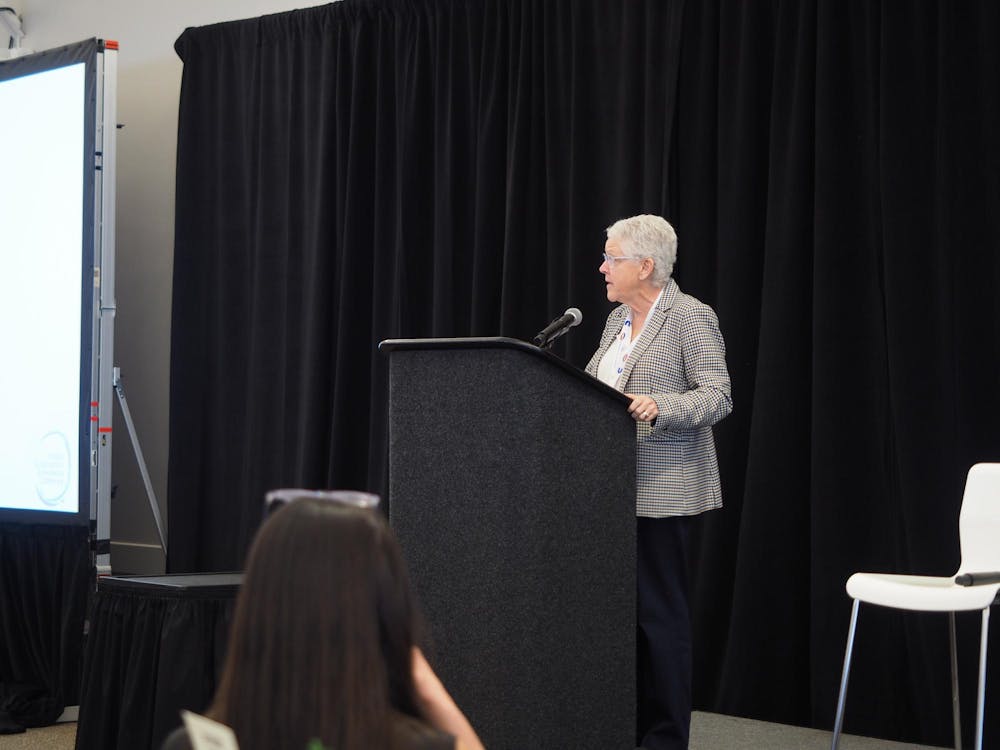
Former Environmental Protection Agency Administrator Gina McCarthy headlined the Indiana Sustainability and Resilience Conference on Friday in Bloomington.
The annual conference brought climate researchers and experts who discussed issues like sustainability on campus, data centers and animal migration during the eight-hour event.
Nearly 500 people attended the conference, many of them students from in-state colleges and universities. The crowd broke last year’s ISRC attendance record of 450, organizer Jonathan Hines said.
IU’s Environmental Resilience Institute has hosted the ISRC for four years, with each subsequent conference drawing more attention, ERI Engagement Coordinator Marie Renahan said. This marked the third straight year the conference sold out.
“It just goes to show how interested people are in sustainability and resources and how excited they are to be in this space, to talk with other professionals who are doing the work and trying to figure out how we can get to a more healthy climate faster and more economically,” Renahan said.
The ERI brought in McCarthy, former administrator of the EPA and first national climate advisor to former President Joe Biden, as keynote speaker. McCarthy, 71, is a lifelong climate change advocate who began her career in Massachusetts state government before serving in several high-level national environmental roles.
Today, McCarthy co-chairs of national climate activist coalition America Is All In, a group that claims to represent more than two-thirds of the U.S. population and GDP among its ranks.
On Friday, she brought the ISRC an abundance of passion and optimism — the latter a theme among speakers throughout the day.
“We are powerful if we act together, and it's fun to see the excitement and opportunity that young people have today to craft a world that's different than the one we see today,” she said in an interview with the Indiana Daily Student.
McCarthy was joined on stage by two IU alumni: former Deputy EPA Administrator Janet McCabe from Bloomington’s campus and City of Lafayette Climate and Resilience Manager Halee Griffey.
“Especially as young professionals and as students maybe soon to graduate, it's important to take that confidence with us as we move forward because we'll need the next Gina,” Griffey said in an interview with the IDS.
More than 70 professors, graduate students and environmental professionals presented over the course of 20 lectures, panels and discussions. Additionally, at least 10 groups of university students from across the state presented research projects over the course of an hour during the conference.
Presentation topics varied. In one session, several presenters discussed the logistics of creating a sustainable campus. Brian Mast, associate vice president of facilities management at Goshen College, detailed the campus’s ongoing evolution from climate-neutral to climate-friendly.
The small liberal arts college and its namesake town just southeast of South Bend implemented its first climate plan in 2009 and has consistently run ahead of the pack in climate consciousness. Mast attributed that to their Mennonite grounding.
“Some of you might think horse-and-buggies when you hear Mennonite. There are no horse-and-buggies on campus,” he said. “But it is the same tradition, the Anabaptist tradition. And one of our core values is stewardship. That was baked in when we were established in the early 1900s. And that stewardship of our resources connects directly with sustainability.”
Their climate overhaul included replacing an outdated steam heat from a central boiler plant, utilizing only LED lightbulbs and implementing geothermal power sources across campus. If the school follows the plan to completion, it would cost Goshen College $60 million in the moment but ultimately save $835,000 per year.
IU formed a committee in 2022 to help become a carbon-neutral campus by the year 2040. IU’s plan includes some similar initiatives, such as controlling heat in buildings and using renewable energy sources. It’s unclear how much the plan would cost in total.
In another presentation, program director Ben Inskeep at environmental lobbyist group Citizens Action Coalition said there was “no such thing as a sustainable data center.”
Inskeep cited more than 30 active data center proposals in Indiana, which he said would far exceed the electricity needs even of Indianapolis and Marion County. The over 10,000 megawatts of electricity required for the proposed data centers would require such a massive amount of energy infrastructure that it would outpace the state’s ability to create clean energy, Inskeep said.
The new fossil fuel plants required to maintain such numbers would also be built to last at least 30 years, Inskeep said.
Several IU students also hosted presentations at the ISRC.
IU sophomore Andrew Good presented an investigation into the mating and migration habits of dark-eyed junco and how they might be affected by climate change.
IU freshman Simone Brown introduced onlookers to Bokashi, a process similar to composting which uses a broader range of food waste.
Purdue University graduate student Priyadarshan presented his research into the potential consequences of electrifying an entire grid — that is, abandoning gas and coal power. His research showed total electrification would put a city like Indianapolis at risk of major blackouts if not moderated.
He said watching other researchers talk at the ISRC inspired him to problem solve.
“When they talk about data centers, we highlighted problems. But I think of it as like, as a researcher, what would be the solution for it?” he said.
Despite the somber nature of many of the discussions, faces all shone with smiles as participants filed out of the building. Griffey said every year, the ISRC reminds her how many people like her want to make a difference.
“I personally consider myself a climate optimist — not because the work isn't challenging, but because I think with optimism actually brings the motivation to take action,” she said. “So I think without hope, really, we wouldn't have this gathering like we do today.”