Editor's note: All opinions, columns and letters reflect the views of the individual writer and not necessarily those of the IDS or its staffers.
Tucked inside Campus View Apartments on Union Street sits a food pantry most IU students don’t even know exists. Open three days a week, it quietly serves graduate students, undergrads and neighbors from the Bloomington community. Recently, Julia Levy, a student worker at Crimson Cupboard told me that she sees about 20-30 people in just three hours. The people coming through the door don’t fall into a single demographic — it’s a mix of students, families and working adults.
On the other side of Bloomington is Pantry 279, run by a group of tightly-knit volunteers and employees.
“We don’t really get rushes,” Stephanee Stephens, a staff member at Pantry 279 said. “It’s just the people who know about it and need it.”
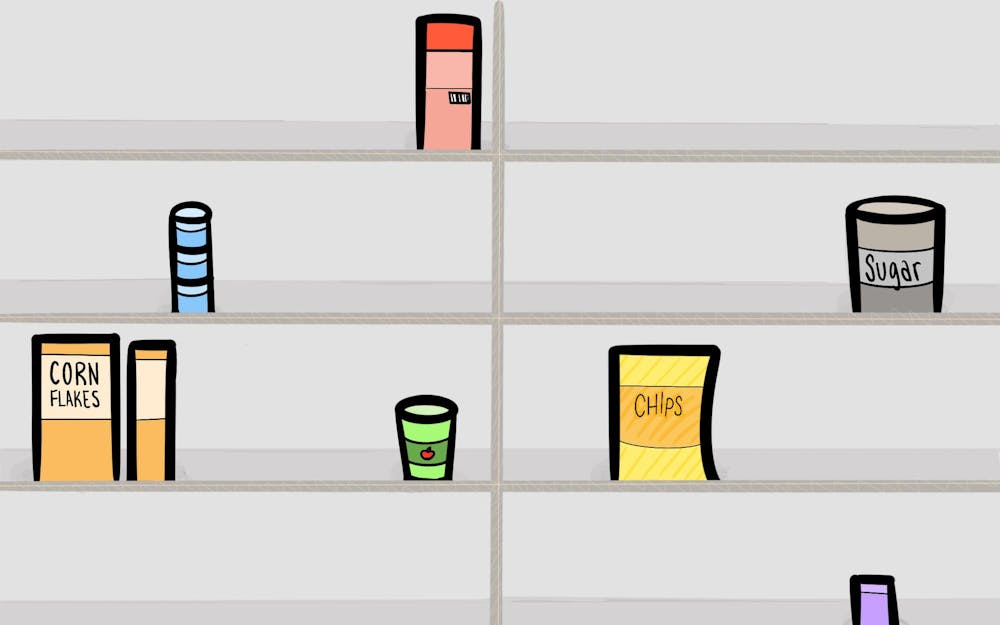
The fact that IU needs multiple food pantries at all — there are over 10 in Bloomington alone — should raise eyebrows. Yet Campus View and the Indiana Memorial Union’s satellite pantry aren’t anomalies. They’re part of a statewide safety net diminishing under federal Supplemental Nutritional Assistance Program pressures and rising food insecurity.
Bloomington and the ‘working poor’
Pantry 279 in Ellettsville, Indiana, a larger local pantry — about a 10-minute drive from campus — has felt the strain more sharply than others. Cindy Chavez, director of the pantry, said 80% of their clients have jobs — often more than one. She calls them the “working poor.”
“The pantry has seen funding stagnate while demand keeps rising,” she said. “These aren’t people who are lazy or freeloading.”
They are seniors whose Social Security doesn’t stretch to the end of the month, doctoral students scraping by without parental support and even children who sometimes show up after school to bring food home for their families.
And the demand is rising. The lines are getting longer. In July last year, Pantry 279 served 9,526 people. This July, the number jumped to 11,117, Chavez said. Without an increase in donations or federal aid, the resource-strained pantry needed to feed nearly 1,600 more mouths in a single month.
SNAP cuts hit home
The spike isn’t a coincidence. This year, federal changes slashed SNAP benefits nationwide. At the same time, the U.S. Department of Agriculture cut nearly half of The Emergency Food Assistance Program, which used to provide about a quarter of Pantry 279’s food, from eggs to meat and other staples. The result: more families showing up at pantries with fewer resources to go around.
SNAP restrictions have also gotten more personal, reaching into the details of everyday life. Desserts and candy are now off-limits. Multiple staff at Pantry 279, including Chavez and Stephens said clients have come in asking specifically for sweets because they can’t purchase them at the store.
“If your child has a birthday and you can’t afford a cake, where else would you get it?" Chavez said. “Our clients are already stressed. Comfort food shouldn’t be a privilege reserved for the wealthy.”
The irony is obvious: in a state where lawmakers preach about personal freedom, low-income families are now told not only how much they can eat, but what kind of food is morally acceptable for them to enjoy.
Food deserts and false choices
The federal policymakers — and the states that administer SNAP — frame these restrictions as a push toward healthier eating. But healthy food is often out of reach. In Indiana, produce and protein prices are high while processed food remains relatively cheap. For example, Purdue Agricultural Economics reports show egg prices surged by 32.6%, beef rose by 4.3% and global chocolate prices nearly doubled to 93% in 2024.
“If the government lowered the prices of healthy foods instead of raising the prices of the ‘icky foods,’ people would eat better,” Chavez said.
Bloomington itself is relatively fortunate. With farmers markets, co-ops and groceries within reach of campus, it doesn’t feel like a food desert. But a few miles outside city limits, the options vanish until you reach Indianapolis. Even parts of Indianapolis are considered food deserts. To tell families to “just eat beans” when meat runs out, as Chavez puts it, sounds like a modern version of “let them eat cake.”
At IU, the divide is stark. Some students swipe meal points without a second thought, while others quietly line up at Campus View or Pantry 279. Chavez said graduate students, especially international students, are among the most frequent visitors. Many don’t receive the same financial support as their peers, and their stipends barely stretch to cover rent, let alone groceries.
The numbers may be invisible, but the hunger is real — it exists on our campus, and it looks like the student in your discussion section or the professor you just turned in an assignment to.
What’s next
Food pantries like Pantry 279, Chavez said, operate almost entirely on private donations — churches, schools, monthly donors. Federal and state funding makes up a small and diminishing portion, including from the shrinking TEFAP program.
It’s an unstable climate, Chavez said. But Pantry 279 “will keep going until we can’t.”
That’s the part that should worry all of us. These aren’t optional programs. They’re lifelines, filling holes where government aid has failed. As SNAP benefits are cut and food deserts spread, pantries are asked to shoulder the burden without additional support.
Bloomington may feel insulated, but hunger lives here. It’s in the graduate student skipping meals, the child showing up alone after school, the senior stretching their Social Security checks. Cuts to SNAP aren’t just numbers in a budget. They are smaller bags of groceries at Campus View, less protein on shelves at Pantry 279 and more families wondering how to make it through the week.
The least we can do is stop pretending hunger is somewhere else. It’s right here in Bloomington and right here on our campus.
Sudharshini “Sue” Muthukarunakaran (she/her) is a senior studying neuroscience.