
Editor's note: All opinions, columns and letters reflect the views of the individual writer and not necessarily those of the IDS or its staffers.
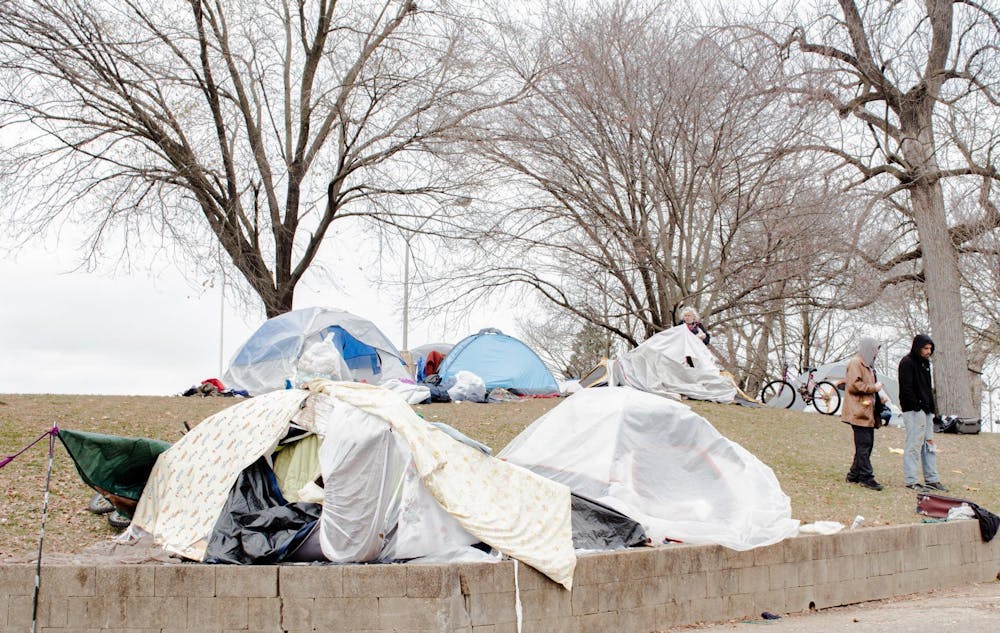
“We feel that there is a bias when the police show up; we feel that we are already the problem in any cases dealing with homeless people,” Carlos, a 37-year-old resident experiencing homelessness in Bloomington, told me in a conversation about police presence in the unhoused community at the Monroe County Public Library.
His words echo a larger moral question: what does it mean for a city to deny people not only shelter, but also the dignity that comes with being treated as a human being?
This summer, Bloomington Mayor Kerry Thomson confirmed arrests after an operation targeting drug dealing at Seminary Park in a press release.
“I will remain focused on ensuring that our most vulnerable are treated with dignity and respect, while also affirming our commitment to a better, safer Bloomington,” the statement said.
Police activity to stop predation on the most vulnerable in society is a justified and welcome action. Still, we cannot ignore that unhoused people are often stuck in a policy gap, which, circumstantially, may lead to issues like drug use.
I observe a general trend throughout the city of Bloomington; we have municipal policies and non-profits working toward offering on-demand, immediate help to people experiencing homelessness, but the pathway to stable and affordable housing seems to be left to the individual to pave.
Last weekend, in my conversations with people experiencing homelessness, I sought to gain insights into the human aspect of the problem. The people of the city and the state have democratically elected their trusted policymakers to address this issue from a socio-economic standpoint. However, the human aspect of this issue is often overlooked in discussions about providing spaces for encampments and building public projects to encourage investment in affordable housing.
Philosopher Martha Nussbaum and Nobel-winning economist Amartya Sen offer an interesting perspective on the concept of human dignity in public policy. They propose a novel way of understanding economic development through the capabilities approach. The core principle of this idea is that the final goal of policy must be to expand the capabilities of people to pursue a life they value, instead of maximizing income or enriching people’s greed for commodities.
The dignity of people is secured by not just keeping them alive, but by ensuring they have the freedom to pursue a worthy human life. This reminds us that homelessness is not a simple question of shelter beds and housing stock; they are a part of the conversation, but not the end of the conversation. Homelessness is about individuals lacking the basic capabilities of making life livable, including a safe environment, bodily integrity, health, access to employment and agency over one’s final choices.
I believe there are two primary ways of expanding capabilities without seeking a policy change at the administrative level. One way of realizing an individual’s dignity is the classic way of pulling oneself up by the bootstraps. During my visit to the Monroe County Public Library, I met John Trout, a Bloomington resident and military veteran, who had experienced homelessness for about seven years and was able to overcome this challenge through gaining employment at the Shalom Community Center. He went from being a client of Shalom to volunteering there while homeless and eventually working there. His job offered him an apartment to live in, which he cherishes to this day.
However, individual stories of resilience, while powerful, cannot be the only answer. They remind us of what is possible, but also how narrow the path out of homelessness can be when the burden of survival is placed entirely on those who are most vulnerable. If we are to take the capabilities approach seriously, the conversation cannot stop at individuals or government policies; it must include us, the Bloomington community.
The agency to bring change does not solely rest with the individual experiencing homelessness or the policymakers. We, as community members and Indiana University students, must ask ourselves how we can help expand the freedoms of people experiencing homelessness. Not through charity alone, but by rethinking our relationship with each other and the unhoused community, with our institutions and our civic responsibilities as residents.
Eamonn Keane, a junior studying microbiology at IU, plans to start a student organization dedicated to this cause. A planned goal of this organization would include building a student network of volunteers who help with the volunteer shortages at community centers across the city. Through his volunteering experience at the Shalom Community Center, Keane recognized the importance of community organizing in helping Bloomington’s unhoused community.
He believes the dignity of homeless individuals must include “living a life where you don’t have to feel that you are inferior to others.” This idea of inferiority more deeply means seeing unhoused individuals not as passive recipients of aid, but as people with voices, skills and an agency of their own.
Students and community members can build forums, including organizations that drive people into volunteer work or building mutual aid. They can also advocate for the university to employ its immense resources to center the cause of alleviating homelessness through research projects and student internships that not only provide a policy perspective but also recognize unhoused individuals as fully human and a part of the community.
In addition to volunteering and public advocacy, non-material help through student-led programs such as art projects and reading groups can also help alleviate the fear of inferiority that may plague the unhoused community. Programs like this affirm dignity and expand capabilities in practice.
Homelessness, when reframed through the capabilities lens, transforms from being a question of shelter to a question of collective justice. As a community, we must work toward building a city where everyone has the substantive freedom to pursue a life that they value. This end will not come from policy alone, but from everyday choices that we make as a community.
Advait Save (he/him) is a junior studying economics and sociology.



