Editor's note: All opinions, columns and letters reflect the views of the individual writer and not necessarily those of the IDS or its staffers.
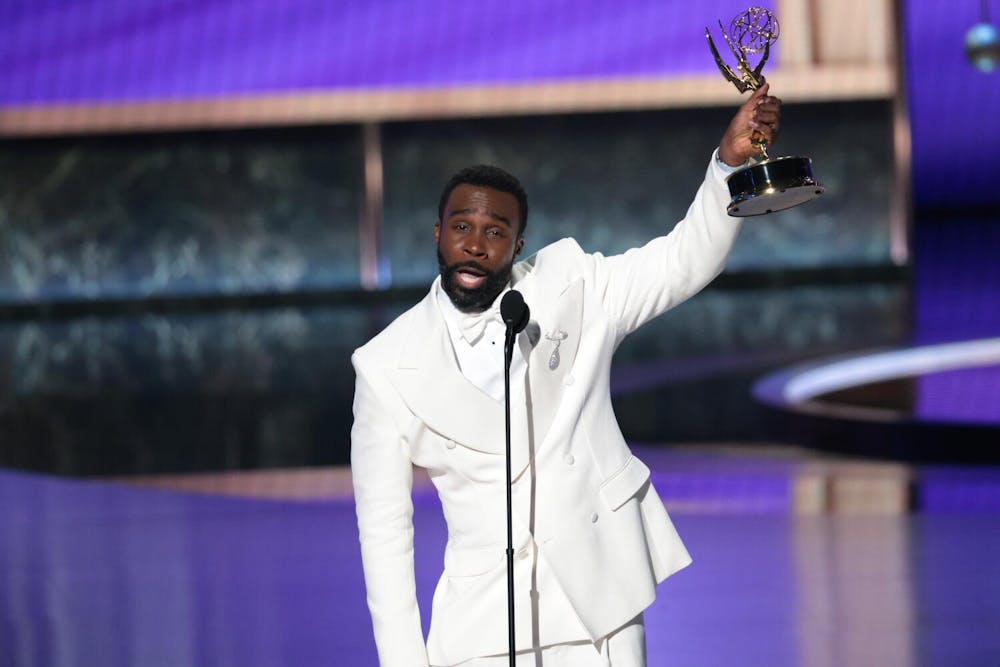
Tramell Tillman is the first Black man to win an Emmy on Sept. 14 for outstanding supporting actor in a drama series. His win feels emblematic, since his “Severance” role mirrors the very inequalities Hollywood reproduces.
The category was the only one that had yet to honor a Black performer in the Emmy’s’ 77-year history. During the show’s first season in 2022, Tillman was overlooked among the series’ s 14 nominations.
Only 13 Black actors have been nominated in the supporting drama actor category since 1970, when it was formally established. The last Black actor nominations came in 2021, when Giancarlo Esposito, O-T Fagbenle, and Michael K. Williams were recognized for “The Mandalorian,” “The Handmaid’s Tale” and “Lovecraft Country,” respectively.
In the 2025 Emmys, actors of color accounted for 24 of 94 leading acting nominees or 25.5%. This is the lowest share in five years, and it’s a sharp drop from the 2022 peak, when they made up 39%.
These facts suggest a trend of racial inequality in the Emmys, but this issue extends beyond the award ceremony and its nominees. The film and TV industries as a whole are plagued by inequality.
Black actors account for 11% of leading film roles, which is lower than their overall presence in casts (13.4%). In 2024, 36.4% of all speaking characters in top-grossing films were from underrepresented racial/ethnic groups, even though they represent 41.6% of the U.S. population.
Tramell Tillman’s Emmy win feels paradoxical, when you consider how award institutions mirror the systems of exclusion his “Severance” role critiques.
His character in the show, Mr. Milchick, embodies the contradictions of race and power in the workplace, acting as both a gatekeeper and a marginalized figure at Lumon Industries. He oversees the microdata refinement team, keeping them ignorant about their work and the outside world. However, while in a position of authority, he’s still a Black man navigating a predominantly white corporation.
The only other Black person we see interacting with him at Lumon is Natalie (Sydney Cole Alexander), who primarily serves as the “Board Liaison for the Severed Floor.” In the show, the severed floor is where Lumon workers enter a different state of consciousness. Their memories of the outside world are erased.
The mysterious board is a governing body of faceless, nameless voices. As the liaison between them and other employees, Natalie is also seemingly in a position of power. Both she and Milchick are unsevered, retaining outside memories and greater privileges.
Milchick and Natalie share a scene where she presents him with gifts on the board’s behalf: several “inclusively re-canonized paintings” to help him see himself in Keir, Lumon’s white, deity-like founder.
Milchick’s visible concern upon seeing the paintings contrasts Natalie’s strained smile, underscoring Lumon’s diversity initiatives as hollow and performative. Rather than celebrating him, the company belittles Milchick, pressuring him to erase difference and feel honored to “see himself” in a white man.
This mirrors his Emmy win; both gestures are framed as victories for representation, but they raise questions about whether larger institutions are really moving forward or simply offering symbolic gestures.
We see a similar tension here in Bloomington. Indiana University closed its Office of the Vice President for Diversity, Equity and Inclusion in May, while the city proposed budget cuts to funds previously allocated to DEI training. These decisions suggest weak institutional commitments to diversity that can be treated as expendable.
Tillman’s Emmy celebrates progress, but it’s a reminder that inequities exist. These local withdrawals of support show the fragility of commitments to equity.
Another important part of Milchick’s character arc in season two is the friction between him and Mr. Drummond, a high-ranking enforcer for Lumon Industries. Milchick’s vocabulary is eloquent, and Drummond polices it.
There’s a specific scene where Drummond conducts a performance review for Milchick, reprimanding him for using “too many big words.” Tillman himself theorizes that the problem has to do with his character’s race.
“Maybe they feel that this Black man should not have access to these words, and he shouldn’t speak this way,” he said.
Toward the end of season two, Milchick defies Drummond by using longer words instead of following his order to simplify. This might feel like a small win, but it’s still a crack in the hierarchy, where a Black character asserts agency in a white-dominated space.
While it could be taken simply as a symbolic gesture, Tillman’s Emmy win represents a similar crack within Hollywood’s award system; his recognition doesn’t dismantle the system overnight, but it proves that barriers can be broken. Unless these cracks widen into structural shifts, awards risk looking like Hollywood’s version of Lumon’s hollow diversity rituals.
Joaquin Baerga (he/him) is a junior studying journalism.