
Indiana University’s Common App admissions portal now tells incoming students “no new admissions will be offered” for dozens of suspended majors being reconfigured under state law.
This includes degrees in gender studies, Earth science and more. Some faculty say the notice misleads students and hinders humanities and language enrollments.
The portal displays a “Program Suspension Notice” for major programs affected by language in the state budget bill requiring universities to eliminate programs that don’t meet minimal enrollment quotas. Bachelor’s programs must have had an average of 15 graduates annually over the past three years to not be counted as a low-enrollment program or ask for an exemption from the Indiana Commission for Higher Education.
Instead of seeking exemptions, IU voluntarily eliminated, suspended or merged 249 low enrollment programs from IU campuses on July 1, 2025. At IU Bloomington, 116 degree programs faced changes.
Out of these 116 degrees, 22 were eliminated and 31 will be suspended after currently-enrolled students complete their programs.
Another 63 were suspended with the goal to either consolidate or merge with other departments, only after being approved by the ICHE.
The notice on IU’s admissions portal warns applicants that majors marked with an asterisk are suspended for spring 2026 admissions and that no new admissions will be accepted.
Students interested in these marked majors can indicate their “major interest(s)” by selecting them as a first or second intended major. The university can then share information about “related courses and available alternatives” and “potential future academic options (subject to necessary approvals).”
An earlier version of the Common Application allowed students to select suspended programs as their “intended major,” but this was updated to the “major interests” option after Feb. 11. Both versions state no new admissions will be offered for suspended programs.
Some high school seniors and parents in the application process could interpret the notice as suggesting all their interests are not available at IU, Deborah Cohn, a Spanish and Portuguese professor at IU, said.
Cohn said the notice should state more clearly that IU still offers these fields of study, even if they may be consolidated or merged as part of the ongoing restructuring process.
“They could have said something more user-friendly, such as, ‘We are currently in the process of applying to offer these, and here’s a contact person,’” Cohn said.
IU spokesperson Mark Bode wrote in an email that the application form allows students to show interest in suspended programs and that the admissions team will reach out to students with alternatives and updates.
“At the launch of this year’s admissions cycle, the IU Admissions team worked to make sure prospective students could indicate areas of interest on their applications, including areas corresponding to suspended programs,” Bode wrote. “The site noted that registering interest in these programs would enable IU to share information on relevant future academic options.”
In February, the ICHE approved new reconfigured programs, IUB Chancellor David Reingold said during a Bloomington Faculty Council meeting Feb. 10. In the meeting, Reingold said that confusing language in the university’s Common App application would be updated that day or the next.
“The enrollment management staff is working to communicate with currently admitted students in coordination with the College and changes in the application are underway,” Reingold said.
At the Feb. 10 BFC meeting, Reingold addressed faculty worries that enrollment for affected programs is and will continue to go down, telling attendees that applications, admissions and deposits for affected programs are all higher than last year.
Bode clarified Reingold’s statement in an email to the Indiana Daily Student on Feb. 19, confirming that overall applications, admits and deposits for the affected degree programs have increased from previous cycles.
“A definitive assessment of major-specific enrollment trends will be available once the updates to academic structure and assignment of the appropriate program/plan codes to the student records have been completed,” Bode wrote.
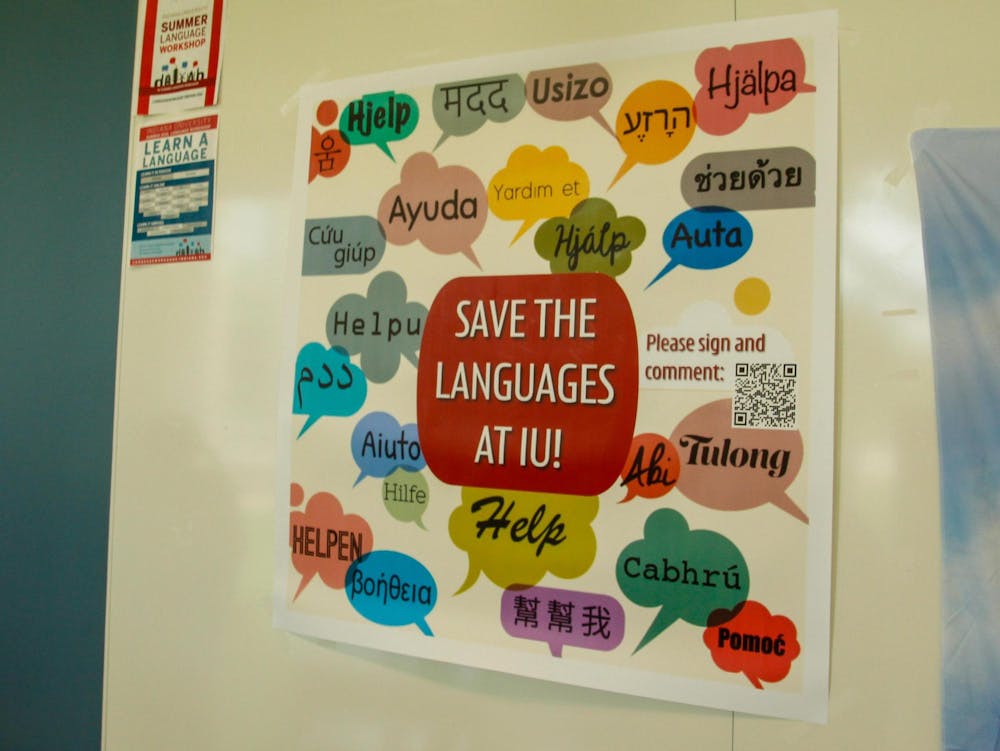
Nicolas Valazza, the interim director of undergraduate studies at IU, helped organize the Save the Languages at IU initiative, a faculty-led group formed to oppose cuts to language programs. He said he received a message from a parent of a prospective student confused about the application a couple weeks ago.
“The admission application was basically saying that they were suspended and no new student would be admitted,” Valazza said. “So we found this very concerning.”
Valazza said students planning to major in suspended studies might see the portal message and choose to attend elsewhere. But since those potential applicants never contacted the departments, faculty have no way to track how many students were deterred.
Cohn said departments have been fielding confused calls from incoming students and their parents since the summer.
"The lack of clarification is going to have caused damage to the number of students who were interested in these programs,” Cohn said. “That were given the sense that they don’t even exist anymore.”
For Valazza, the issue is urgent. He said clear communication needs to be sent to all incoming students rectifying the information. Beyond enrollment concerns, Valazza said the issue threatens IU’s core identity and reputation.
“The reputation of IU Bloomington is based, on (a) largest extent, on its liberal arts tradition, its humanities, foreign languages, those are our strength,” Valazza said. “I’m still optimistic that the administration has IU in its heart.”
Both Valazza and Cohn said students and parents shouldn’t give up on IU because of the portal language alone.
“Don’t stop with that information,” Cohn said. “Go and reach out to the departments that you and your children are interested in. Get the information, because the information is out there.”
CLARIFICATION: This story has been updated to clarify an IU spokesperson's confirmation of an increase in overall applications, admits and deposits for affected programs.


