
Katie Mysliwiec Slavin’s love of coffee began when she was a young girl growing up in Bloomington. She’d go with her dad to a coffee shop and order a hot chocolate, but not too hot. They’d sit, read The Ryder Magazine and catch up with acquaintances who happened to wander in. Mysliwiec Slavin loved spending time with her dad and the feeling of community she got in coffee shops.
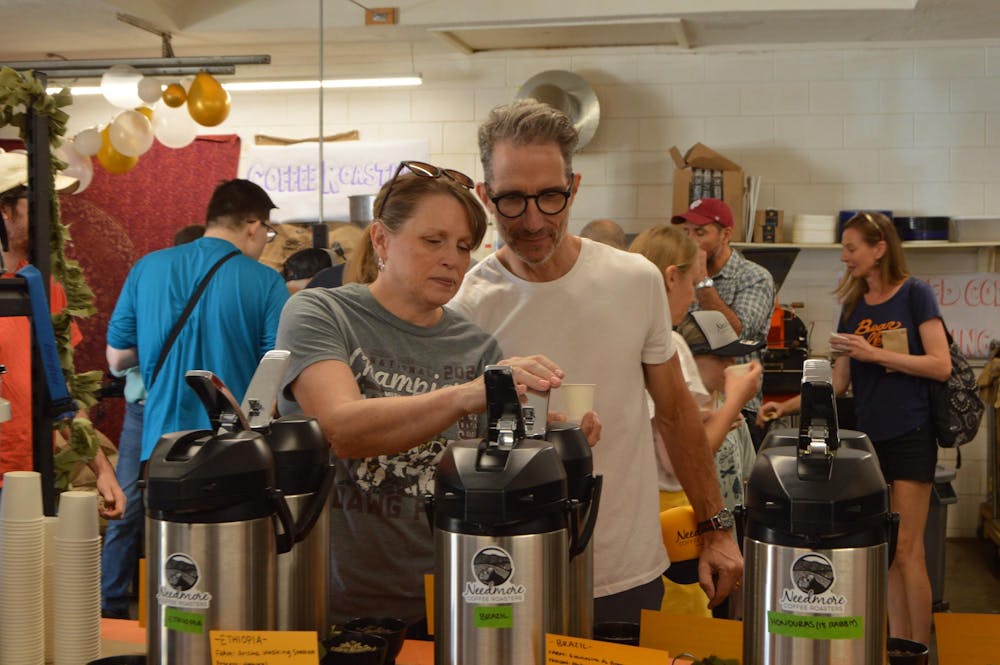
Now, years later, Mysliwiec Slavin hopes to grow that same sense of community as owner of Needmore Coffee Roasters. The shop hosted an open house Saturday at its new roastery at 1310 S. Monon Drive in Bloomington.
The Needmore team moved their coffee roasting machine from the cafe to the garage-like space in January. The nine months since have been filled with setting up the roastery workflow, but once that was taken care of, Mysliwiec Slavin wanted to celebrate.
“Once we got into the good flow, I said, ‘Let's have a party,’” she said. “I want everybody who wants to come check it out.”
Flora Arthur, a cafe manager at Needmore, said the team wants to have more events like Saturday’s, where the public can come and learn about what goes on behind the scenes.
“What sets Needmore apart is roasting specialty coffee from farms that are vetted for economic and environmental stewardship and taking care of their communities,” Arthur said.
These extra steps in sourcing mean that Needmore pays a premium on the beans they buy, Arthur said. In a time of rising prices, transparency is important.
“We want to make sure that people understand the value of what they have,” Arthur said. “And so, by having events like this and opening up to the public, we're hoping to educate people on all of the work that goes behind coffee and the huge supply chain that is the backbone of all of it.”
Having the new space for the roastery was a needed change, Mysliwiec Slavin and Arthur said. Before this year, the coffee roaster was located inside Needmore’s cafe on North Pete Ellis Drive, vying for space with bakers and baristas.
“The roasting happening while the cafe was open at first was cool because people could ask questions, but then it got to where it was too much of a distraction and the roaster couldn't focus,” Mysliwiec Slavin said.
Moving the bean roasting machine means that the staff have a dedicated space to work on producing great coffee without getting sidetracked, Mysliwiec Slavin said.
Visitors to the open house, like Nick Edwards and Brittany Penzer, came out to support Needmore and celebrate the new space. Penzer said she hopes it will give baristas at the cafe more room to move around. Edwards agreed.
“Yeah, when the roasting machine was in the shop, it smelled very nice, but it was very clearly taking up a big portion of the space,” Edwards said. He said he tries to go to the cafe every other week.
Arthur said the new space is already driving innovation in Needmore’s offerings, providing room for roaster Brandon Thorne to try new beans and blends.
“[The roastery] gives him a lot more opportunity to concentrate and to experiment and to have kind of his own zone,” Arthur said. “More room for him to grow our business in terms of just the size that we're able to produce.”
One such innovation is a “zombie desert bean,” Arthur said. She isn’t sure what the bean is going to be like, but that’s something Thorne will discover during the process of cupping, when he makes a small batch of coffee out of roasted beans. The practice also serves as a quality check.
“That is essentially where you pay very close attention to the color of the roast, the smell of it,” Arthur said. “You pour hot water over and let it bloom, and you waft it and make sure that it smells like it's supposed to: either fruity or roasty or nutty. And then you sip on it, and there's a whole, like, giant wheel of tasting notes, like, hundreds of combinations.”
As Needmore’s roaster for the past 18 months, Thorne selects beans to keep its offerings well-rounded. He has to strike a balance between natural-process coffees, which have fruity, floral notes, and washed coffees, which taste more of cocoa and nuts.
Thorne’s role during the roasting process is to manage the temperature of the beans and decide when to take them out of the machine. The “first crack” of a coffee bean, Thorne said, is when it explodes. A second crack occurs for dark roast coffee.
"We'll drop 15 pounds of beans in at 450 degrees,” he said. “The temperature drops rapidly. And then my job is to bring the coffee beans’ temperature up in a smooth rate.”
Thorne loves roasting coffee and enjoys working with the machine.
“This is a really, really very nice roaster,” he said. “It's like the Cadillac of roasters.”


