Actress Gwyneth Paltrow made a controversial move April 9 that seemed to quickly set the Internet world ablaze.
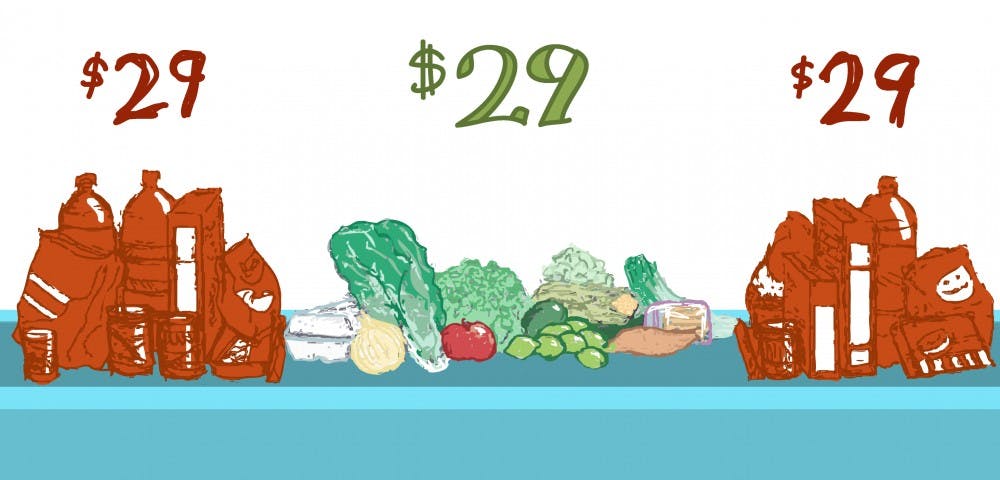
Paltrow graciously accepted chef and restaurateur Mario Batali’s #FoodBankNYCChallenge, meaning she agreed to survive on $29 worth of food for one week.
According to the Food Bank for New York City, this is the amount of money the average SNAP assistance recipient must eat with.
Paltrow, a self-proclaimed cultural icon of healthy living, would seem to be a solid choice for a public display of the challenge.
However, while her efforts are not without their positive consequences, Paltrow’s attempts at food insecurity activism largely misses the mark, to put it nicely.
Paltrow announced the start of her “challenge week” by tweeting a beautiful picture of vegetables, whole grains, eggs and limes atop her Carrera marble counter top.
While it is a striking and attractive photograph, it serves to make Paltrow’s disconnect from the reality of poverty even more obvious than her Goop luxury lifestyle website.
It’s also a little discerning.
The Editorial Board is most concerned with the extreme inaccuracy of Paltrow’s selections.
We ask you, dearest Paltrow, how do you plan on sustaining yourself for a week when you purchase rabbit food?
Buying seven limes isn’t exactly what we would call sustainability, or smart shopping for that matter.
Unless you get to eat one lime for breakfast, one for lunch and the third for dinner, we don’t really know what else you plan on using them for.
New York City is an excellent example of a city plagued by “food deserts,” or geographic areas where residents’ access to affordable, fresh and nutrient-dense food options is restricted at best, or they are simply nonexistent.
Instead of hosting grocery stores and produce markets, low-income neighbors are typically seen as a sales opportunity for convenience marts and gas stations.
Due to various transportation barriers such as the lack of a vehicle, the availability of public transit and the time it takes to travel to and from a distant grocery, many individuals and families that reside within food deserts are left with extremely ?limited options.
Gwyneth Paltrow most certainly did not purchase her kale, sweet potato and limes at a Village Pantry or Speedway.
And it is highly unlikely she traveled to an impoverished neighborhood to stock up for the week.
Additionally, Paltrow based her choices around her very specific lifestyle — meaning, her need to remain a waif with glowing skin.
Paltrow’s choices go a bit beyond “healthy,” as they would likely only cover about 1,000 calories per day.
Her work as an actress and ?fashion icon in a culture that obsessively makes thinness synonymous with attractiveness begs for her to limit her food intake — but how much is ?too much?
For those who truly need the food stamps, they likely spend their time working all day long.
And 1,000 calories or less couldn’t begin to be enough to effectively ?sustain someone throughout the day.
Instead of buying cilantro, Paltrow might have been wiser to purchase a 5 lb. bag of rice instead.
That might actually last someone for the week.
Paltrow enjoys a variety of protective factors that the majority of SNAP recipients do not, including but not limited to: affluence, access to preventative health care, nutritional education, a full-service kitchen, a refrigerator and easy transportation for her foodstuffs.
Many SNAP recipients would struggle to transport a large load of produce to their home and then keep it fresh for several days, and all of Paltrow’s main recipe options would call for the use of some collection of ?appliances.
Overall, Paltrow’s statement is filled with good intentions; through it, she hoped to use her fame and status to draw mass attention to the reality many low-income individuals and families face.
However, perhaps she could have done a bit more homework before she claimed to be “recreating” life on food stamps.