
All opinions, columns and letters reflect the views of the individual writer and not necessarily those of the IDS or its staffers.
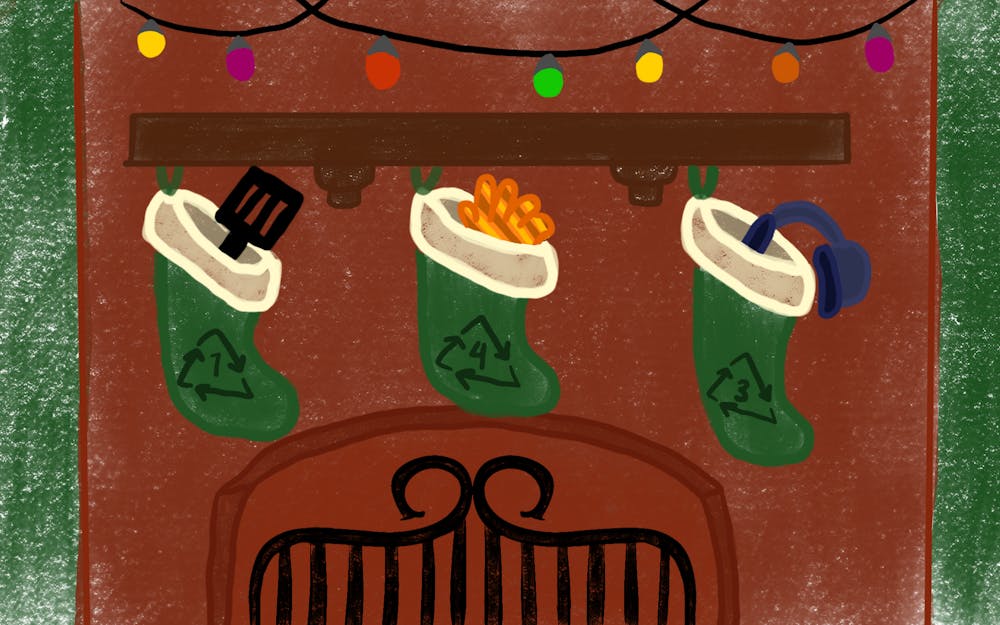
What’s worse than coal in your stocking on Christmas morning? More microplastics. Giving better gifts concerns more than whether the recipient prefers tartan or plaid; the right gift shouldn’t end up in the landfill or poison your loved ones. So, put down that silicone spoon and spatula set, printed with a festive AI-rendered Santa smiling up at you from the shelves of TJ Maxx. It will only shed harmful chemicals and microplastics for the rest of its non-biodegradable life.
Instead, stop and think: If microplastics are already in our food, water and bodies, why would we want more items that release them gifted to us? Here’s what to know about microplastics.
Because microplastics are simply plastics broken down into small particles, it’s important to define what plastics are: a group of materials called polymers, composed of repeating monomers, or a repeating chain of the molecules linked together to make one, larger molecule. Polymers are strong and durable because of these numerous links. Think, chainmail armor!
The first modern, mass-produced, synthetic plastic was Bakelite, which constructed purses in 1907. As commercial production of new plastics developed, we got nylon toothbrush tufts in 1938, polyethylene tupperware in 1949 and cellulose acetate Lego blocks in 1958. By 1976, plastics became the world’s most used materials.
Now, consumers buy plastic products en masse, often without a second thought. However, plastics are pervasive in more parts of life than acknowledged. They’ve been instrumental in medical advances — like artificial organs and prosthetics — due to their moldability and durability. But single-use plastics are excessive in health care and plastics unnecessarily present in homes.
The fashion industry depends on these synthetic materials for its textiles, threads, buttons and zippers, padding, tags, linings, pockets, sequins and even vegan leather and faux fur. Kitchen accessories — non-stick pans, silicone baking sheets, melamine dishware and flame-retardant utensils — are also overwhelming plastic. More than ever, we live in a Barbie world, but life in plastic isn’t as fantastic as Aqua made it seem.
Plastic materials’ dominance is dangerous first for their environmental impact. Plastic pollution threatens both marine and terrestrial life and the planet, contributing to 3.4% of global greenhouse gas emissions — mostly due to converting fossil fuels into new products — and creating tens of millions of metric tons of plastic waste in the United States. In 2019, 86% of plastic waste in the U.S. ended up in landfills. Although recycling initiatives exist, only 5% of plastics actually get recycled.
Second, the small particles plastics release directly impact human health. While microplastics can be as big as a pencil eraser at 5 millimeters, the subset of nanoplastics includes anything less than 1 micrometer and as small as 1 nanometer, which is 1/80,000th the diameter of a human hair shaft — too small to see with the naked eye. Their size allows the particles to enter the human body through our skin, diet and air.
One 2022 Environment International paper was the first to find microplastics in human blood. Researchers studied healthy adult blood samples, finding plastic particles in 17 of 22.
“Half the samples contained PET plastic, which is commonly used in drinks bottles, while a third contained polystyrene, used for packaging food and other products,” Damian Carrington, environment editor for The Guardian, wrote about the study. “A quarter of the blood samples contained polyethylene, from which plastic carrier bags are made.”
Since then, researchers found evidence of microplastics in human hair, bone, bone marrow, skin and other organs, bodily fluids, throat and airways and veins. While more research is required, studies have shown microplastics’ ubiquitous presence is detrimental to human and animal respiratory and cardiovascular health. Additionally, we’ve seen plastic particles’ ability to absorb and then leach out toxic chemical pollutants into plants, animals, humans and Earth’s ecosystems.
Yet, when you use that damaged plastic cutting board, steep that teabag or wash that polyester sweater, you’re spreading microplastics to yourself and your environment.
The solution to the problem of microplastics is reducing exposure, as elimination is impossible at this point. The best way to work toward this ideal is to limit your plastics consumption. In general, the simple approach is to reduce and thus reduce waste: less is more.
But there are gifts to be given, no? This holiday season, think twice about what you’re gifting your loved ones. Pay attention to the materials; Pick up the wood cutting board instead of the plastic, loose-leaf tea instead of bagged, a festive cotton sweater, instead of synthetic. Read the care labels and if the words are gibberish, give it a quick search. But, if seeking out higher quality materials isn’t possible, avoiding plastic packaging, especially for food, is still a boon to the planet and everything that lives on it.
Odessa Lyon (she/her) is a senior studying biology and English, pursuing a minor in European studies.



