
Ryan White's dream was to attend Indiana University. Former IU men’s basketball coach Bob Knight even said he'd get Ryan a full-ride scholarship. But a month before his high school graduation, Ryan died from AIDS-related complications.
After 36 years, he will finally be memorialized in bronze at IU Bloomington.
In the spring of 2026, a memorial sculpture of Ryan, who died at 18, is set to be installed in the Indiana Memorial Union.
Born in 1971 with severe hemophilia, a disorder causing blood not to clot properly, Ryan required regular factor VIII infusions, a blood product containing the clotting agent found in blood, since childhood. He contracted HIV from a contaminated supply in 1984 when he was 13 years old. The Kokomo, Indiana, resident was given six months to live.
AIDS, a condition that can develop because of an HIV infection, damages the body’s immune system, making it more difficult to fight against infection and disease. AIDS is transmitted through blood and unprotected sexual contact with someone who has the virus. Between 1981 and 1990, the AIDS epidemic killed over 100,000 Americans, eventually becoming one of the leading causes of death among men and women aged 25 to 44.
At the time, many people incorrectly believed AIDS could spread through casual contact. Schools didn’t want students with AIDS in their classrooms, including Ryan. When Ryan’s diagnosis became known, school superintendent James O. Smith announced Ryan would not be allowed to attend Western Middle School.
Ryan’s family filed suit to challenged the ban. While the legal battle played out, Ryan attended class through a telephone-computer hookup. After state health officials determined he was not a threat to other students, Clinton County Circuit Judge Jack O’Neill lifted the restraining order on April 10, 1986.
After the legal battle, Ryan became one of the first public faces of the AIDS crisis, with celebrities like Elton John and Michael Jackson befriending him, helping to publicly destigmatize socializing with people with AIDS. Ryan refused to be defined by his diagnosis.
“He never talked about dying; he always just talked about living,” Jeanne White-Ginder, Ryan’s mother, said. “He was never sad to be around.”
Even after Ryan won the right to return to school, the harassment continued. The school forced him to eat with disposable utensils and use separate bathrooms. Restaurants threw away his dishes and his locker was vandalized with homophobic slurs, reflecting the misconception that AIDS only affected gay men.
When someone fired a bullet through the family’s living room window, the family knew it was time to leave Kokomo. The Whites moved to Cicero, Indiana, in 1987, where Ryan was welcomed at Hamilton Heights High School.
He often attended IU basketball games with tickets from singer John Mellencamp, a fellow Hoosier who publicly supported Ryan, sitting three rows behind Bob Knight. Knight promised Ryan a full scholarship to IU.
When Ryan asked what he would do at IU, Knight told him, “‘We’ll find a place for you on the team,’” White-Ginder said.
Ryan held on to that promise, telling his mother he would make it to IU, no matter what doctors predicted.
“And he said, ‘I’m going to live long enough, I’m going to go,” White-Ginder said. “‘People don’t think so, but I will.’”
Ryan died April 8, 1990, about a year before he would have started at Indiana University.
Four months later, in August 1990, Congress passed the Ryan White Comprehensive AIDS Resources Emergency Act, which helps people with HIV/AIDS and their families through funding for medical treatment, mental health counseling and other support services. Today, it serves about half a million people annually.
Today, Ryan’s legacy lives through the act that bears his name, and soon, through a bronze sculpture at IU.
The idea came from William Yarber, a provost professor and senior director of the Rural Center for AIDS/STD Prevention, during one of the annual Ryan White Distinguished Leadership Award ceremonies he organizes.
“He wanted to go to school here,” Yarber said. “He should be here, period.”
Yarber knew exactly who to call.
Melanie Pennington, a senior lecturer in IU’s Eskenazi School of Art, Architecture and Design, had already created one statue on IU’s campus of sex researcher Alfred Kinsey in 2022. But when she got the recommendation to make another statue, Pennington was nervous.
“This is a very big deal to do Ryan White,” she said. She said yes anyway.
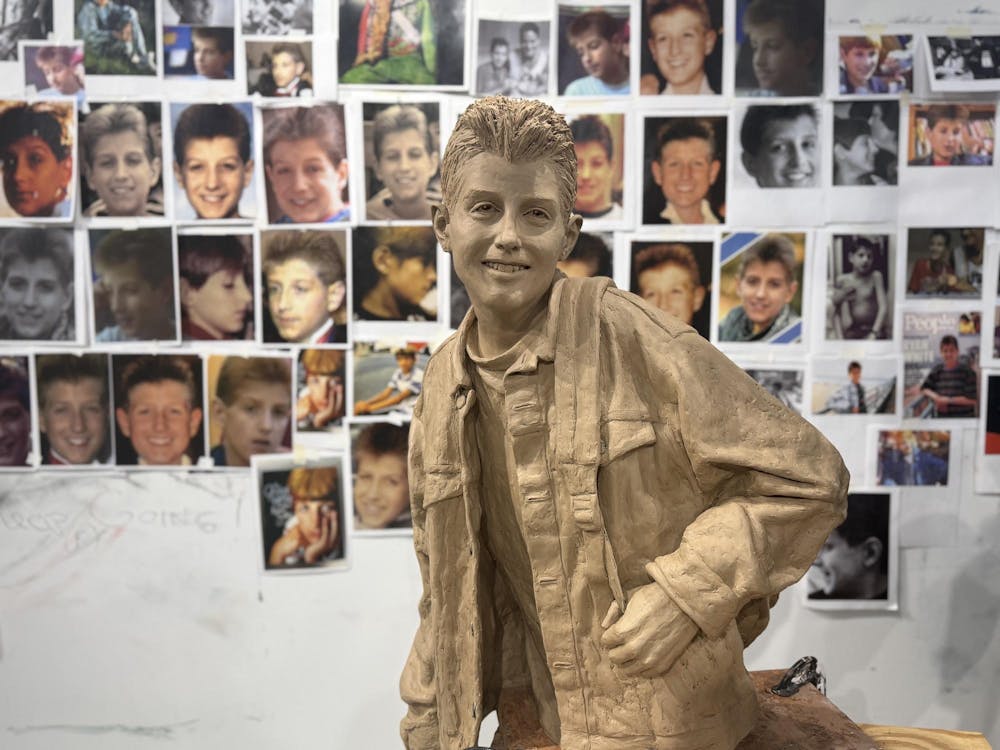
Pennington spent nearly 250 hours on the sculpture, working since August in the Studio Arts Annex on campus. She studied photographs and videos of Ryan found online, noting how he was always in motion, always smiling.
She worked with three body models to create body casts, pouring foam into the molds to make mannequins. She dressed them in clothing, stiffened the fabric with Mod Podge and covered everything with oil-based clay so they wouldn’t dry and began sculpting.
“I wanted him to look really kind,” Pennington said.
She focused especially on the eyes — capturing “that spark” — and Ryan’s signature smile. She studied his clothing, dressing the figure in an acid-washed jean jacket, which Ryan wore throughout the 1980s.
Midway through, Pennington felt she wasn’t quite capturing Ryan. She called her mentor and former college professor, Jeff Thompson. He sat down, looked at the sculpture and delivered hard news: she needed to add more clay.
“All the work I had done was just, like, gone,” she said. “And it didn’t bother me because I had asked for it.”
Thompson reminded her of the fundamentals. “Start with the bones,” he told her.
After he left, Pennington started working on the bone structure, from the cheekbones, the nasal bridge and jawbone to the frontal lobe. She overlaid photographs to check proportions, studying the slope of Ryan’s cheeks and the way his features fell.
Pennington’s students visited once in a while to offer feedback, pointing out small details she might have missed.
“After you’re looking at a sculpture for so long, you get blind to it,” she said.
The sculpture, which shows Ryan from the hips up, is life sized, accurate to Ryan’s frame before he died. Pennington titled the sculpture “Keep Going.” Ryan stands mid-stride with an IU backpack slung over one shoulder — its open pocket inviting students to leave encouraging notes.
The idea stemmed from the The Power of Children: Making a Difference exhibit at the Children’s Museum of Indianapolis, where visitors leave notes at the showcases about Ryan, Malala Yousafzai, Anne Frank and Ruby Bridges.
Pennington has lost students near Ryan’s age, making the message deeply personal.
“It’s hard, but we can help each other,” she said. “Things will get better, especially if you just keep going.”
On Dec. 5, White-Ginder came to see the finished sculpture. When she walked into Pennington’s studio, she broke down in tears. Her reaction was what Pennington had been working toward all those hours.
“That is memorial sculpture at its best,” Pennington said. “If it can represent the person enough that it carries their spirit, especially to the people that knew them.”
The sculpture will be installed in the IMU in the spring, likely in the south lounge near Starbucks. Yarber, who made the initial contribution to fund the project, believes the sculpture will draw attention differently than other campus memorials.
“He wanted to go to school here, he can be with us, with what would have been his friends,” Yarber said.
Ryan’s mom hopes her son’s presence on campus will offer the same support he gave others during his life.
“I think they’ve got a friend,” she said. “Students are going to be able to just go by the statue and say, ‘Hi, Ryan.’ I hope they do.”
CLARIFICATION: This story was updated to clarify the type of transfusions Ryan White was given.


