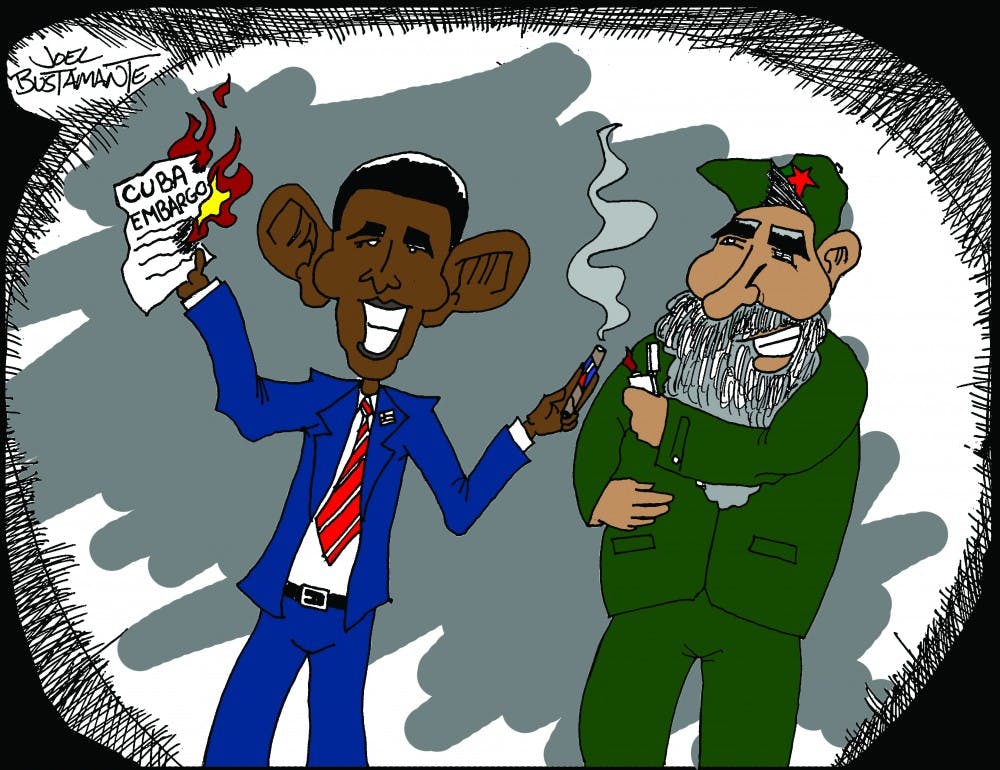
This week, President Obama did something that hasn’t been done by an American president for decades — he met with the leader of Cuba, a country just a few miles off our Southern coast.
The administration announced on Tuesday that it would remove Cuba from the archaic and infamous list of state sponsors of terrorism, leaving only North Korea and Syria. The move is the latest and most significant in a series of decisions by the Obama administration to instigate a drastic policy shift in ?regards to Cuba.
For a little bit of history, United States-Cuba relations have been strained since Fidel Castro led a socialist revolution at the height of the Cold War and took power in 1959.
Tensions grew tighter during the Kennedy Administration with the failed Bay of Pigs Invasion. Then, the biggest turn was the implementation of the Cuban Embargo on Feb. 7, 1962. Later in the year, the Cuban Missile Crisis started, which clearly showed the world Cuba’s alliance with the Soviet Union.
Since then, the U.S. relationship with Cuba could be considered hostile at best. A string of tighter economic sanctions, political arrests and refugee crises helped sustain a hostility that was initially created by ideological and political differences.
Then, this past December, Obama announced there would be a change, and so far, he has lived up to that claim.
After months of back channeling and secret negotiations, the U.S. and Cuba reached a basic agreement to open up the door for restored relations after more than 50 years of policies that not only isolated the nations from each other but failed to change the Cuban government.
Cuba has just been one of a litany of nations the president has reached out to in order to show diplomacy can work. His efforts have led to increasingly positive results with Afghanistan, Burma, Iraq and Iran, in addition to Cuba ?this week.
The commitment to diplomacy, even with states we view as hostile to our interests, combined with the president’s commitment to building regional coalitions to combat manifested threats such as Nigeria and Libya, marks a shift in American foreign policy the Editorial Board strongly supports.
Rather than create international boogeymen like the Bush administration, or “reassert” American power against lesser nations like the Reagan administration, the Obama administration has showed the world a diplomacy-first policy that values international ?engagement and can lead to progress.
And when diplomacy fails, rather than taking the role of the “world’s police,” we simply help facilitate a ?multilateral effort to combat the threat.
This policy, like any policy shift, might experience hiccups, but it gives us the flexibility to explore options for peace that previous administrations were unable, or more likely, unwilling ?to pursue.
It is a policy worthy of a responsible international superpower, it’s a policy worthy of a nation claiming to be the “greatest nation in the world,” and it’s a policy we urge all future administrations to embrace.