As we approach yet another Electronic Entertainment Expo, colloquially known in the gaming circles as E3, now might be a good time to take stock of current trends in video games.
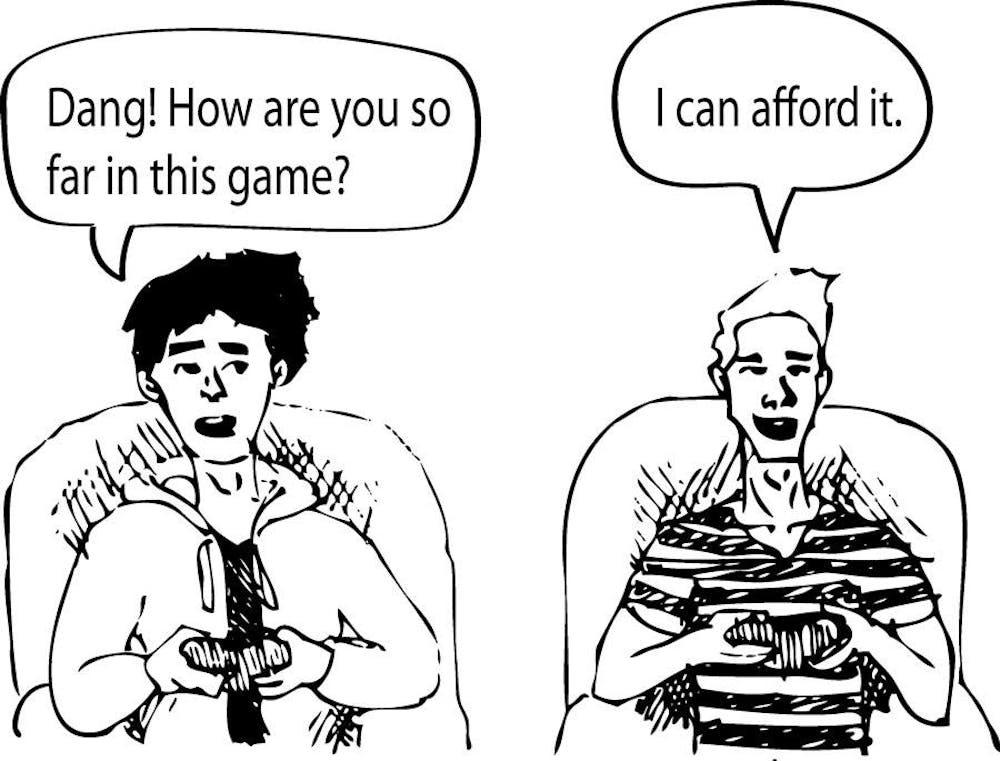
One of the most disturbing and irritating is the newfound prevalence of microtransactions.
A microtransaction is simply a small payment.
In the context of gaming, it refers to a small sum of money that is paid in order to unlock additional content or, in some cases, make it easier to win.
Some believe microtransactions are perfectly OK, others believe they should be cautiously used, and some believe they are not acceptable under any circumstances.
Some of the most visible examples of this practice can be found on games such as “Candy Crush Saga” and “Clash of Clans,” where players can pay money in order to speed up timers or give extra lives that allow them to keep playing.
However, such games are widely given a pass, as they are free to play.
The rage starts when $60 games are included with microtransactions on the basis that users should not have to pay money to use content they already bought.
Alternatively, when microtransactions enable progress faster than usual, such as in “Forza 5” or “Gran Turismo 6,” the result is a product that seems to suck more money out of customers.
Even more infuriating are games seemingly designed around such tactics.
Tactics such as progression at a snail’s pace without paying extra money, mechanics and gameplay “features” shoehorned to facilitate users coughing up more money, and, perhaps most offensively, “downloadable” content locked on the disc that users already paid for.
In context, this is very much a first-world problem.
The political instability in Ukraine, a battered global economy counterintuitively crawling out of recession, and the ephemeral poltergeist of climate change are all threatening to immolate us.
But video game players are still consumers, and they do not generally enjoy being asked to pay for things that used to be free or being asked to pay more than once for certain content.
In short, while the microtransaction still exists as a temptation for game developers — already hamstrung between declining sales and persistently increasing costs for making the big-budget video games we crave — it might not pay off in the long run.
But in conjunction with a litany of other practices, such as season passes and timed exclusive deals that seem anti-consumer at best and greedy at worst, some have said it is only a matter of time before the whole structure collapses on itself.
Game developers and publishers, like every other enterprise, must make a profit in order to survive.
With the incredible growth during the past few years, the video game industry shall continue to remain strong for the foreseeable future.
Still, there is always the concern that overzealous profiting, currently led by the microtransaction, could frustrate rather than innovate the industry.
And that is not a situation gamers want to see.
mjsu@indiana.edu
Microtransaction Mania
Get stories like this in your inbox
Subscribe