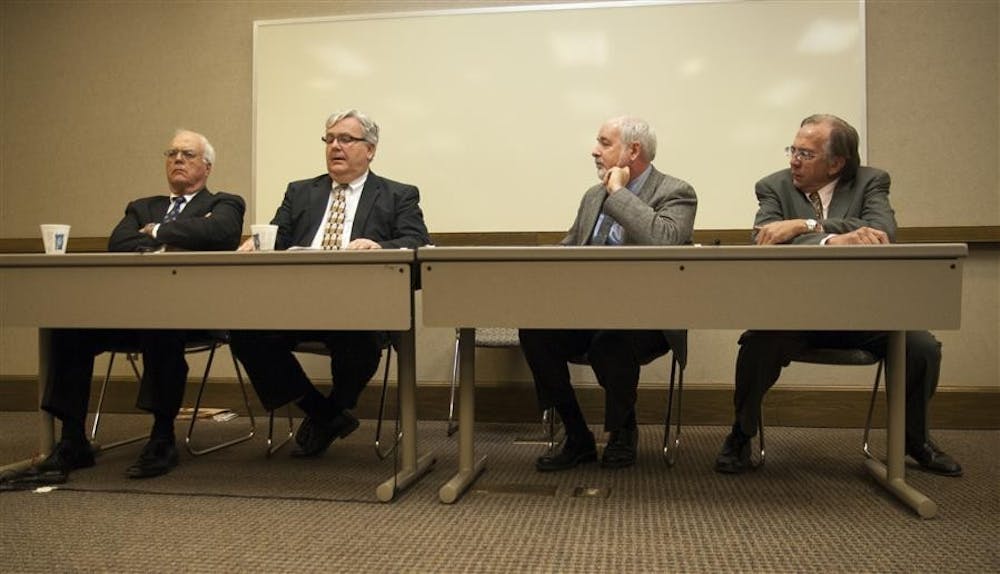
IU professors and other Bloomington faculty led a panel discussion and forum Monday about the potential effects of Indiana Senate Bill 182 and Indiana House Bill 1384 on Indiana colleges.
The panel, led by the Bloomington Faculty Council and the Bloomington Chapter of the American Association for University Professors, discussed the bills’ effect on the academic relations between IU Bloomington, IU’s regional campuses and Indiana’s community colleges.
SB 182 establishes Statewide Transferable General Education Court requirements, promoting a “one size fits all” model for students transferring from community colleges to four-year institutions, panel member and Interim Vice Provost for Undergraduate Education Dennis Groth said.
HB 1384 will require universities to provide “degree maps” for beginning undergraduate students of all majors, Groth said. This will begin in fall 2014.
Although both bills have passed, they could be subject to change per the efforts of an organized University response, AAUP-Bloomington President Lynn Jamieson said.
“This is a national concern,” Jamieson said. “We as a faculty need to get involved more.”
Panel member and BFC President Herb Terry shared his perspective as a former paid lobbyist.
“We understand the problem, higher education needs reform,” Terry said. “With luck, yeah, the degree maps will improve the performance of some students. I fear that some of them will follow them right into the river.”
Terry urged University Trustees, faculty and administrators to join together in reaching out to other state institutions to address perceived problems.
“If we’re not really doing a great job of educating students, one size fits all models just won’t work,” he said.
As the business model for higher education is changing, Board of Trustees Chair Tom Reilly said he has concerns about the political leaders and lobbyists operating in Indianapolis.
“I would like to see the academic model drive the business model,” Reilly said. “How are we going to deal with that? Leadership. We are the only people in the state capable of coming up with a model.”
The forum discussion included how the University will weigh competing interests of efficiency and degree value.
Provost Robel’s Strategic Plan will address these concerns, Terry said.
“Unless all hell breaks loose, things are not likely to change this year,” Terry said. “The faculty needs to work together progressively. We want to build a sense of community among faculty that will help us achieve objectives talked about here.”
Follow reporter Hannah Alani on Twitter @hannahalani.
Faculty discuss state control of curriculum
Get stories like this in your inbox
Subscribe