
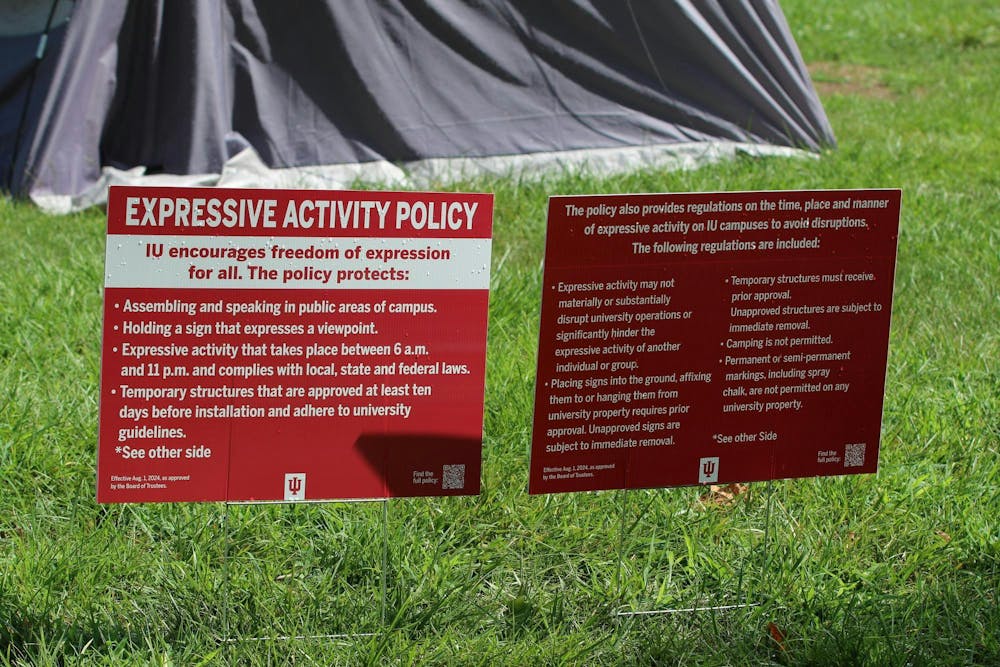
Indiana University’s August 2024 expressive activity policy violated the First Amendment, federal judge Richard Young ruled Thursday in the American Civil Liberties Union of Indiana’s lawsuit against the university.
The judge also directed IU to expunge any record of disciplinary action resulting from this policy from plaintiffs’ records. But the judge said plaintiffs were not entitled to receive damages from IU President Pamela Whitten and Superintendent for Public Safety Benjamin Hunter.
The university’s expressive activity took effect Aug. 1, 2024, and limited expressive activity to between 6 a.m. to 11 p.m., required approval at least 10 days in advance of putting up temporary structures and prohibited camping and impeding traffic. The IU Board of Trustees amended the policy in November 2024 to allow approved expressive activity outside of 6 a.m. to 11 p.m.
The ACLU represented 10 plaintiffs in the lawsuit. Among the plaintiffs were four professors, three graduate students, two alumni and one IU employee.
The 10 plaintiffs, along with 47 others, were arrested during the pro-Palestinian encampment in Dunn Meadow in April 2024. Following their arrests, the plaintiffs received trespass warnings from the university.
The university banned five of the plaintiffs — who were arrested April 25 — from all IU properties until April 26, 2025. Four other plaintiffs who were arrested April 27 received a ban from the Bloomington campus until April 28, 2025. The last plaintiff received a similar ban until April 28, 2029.
Though IU rescinded all trespass warnings by July 2024, the plaintiffs argued the rescission was not sufficient, and that the university should expunge the warnings from the records entirely. After the August 2024 expressive activity policy went into effect, five of the plaintiffs received letters of reprimand from the university for expressive activity after 11 p.m., though these letters were ultimately rescinded.
On Thursday, Young ordered IU to officially expunge these warnings from their disciplinary records. Young's Thursday ruling criticized the university’s August 2024 expressive activity policy for being overly broad, describing it as creating a “virtual ‘First Amendment Free Zone’ on IU property.”
“Clearly, IU cannot justify such a sweeping ban on First Amendment-protected activities with a governmental interest, let alone a compelling or significant one,” Young wrote in the judgement.
The plaintiffs argued the warnings were a form of prior restraint in a public forum. The court ultimately sided with IU that because the trespass warnings were not based on the content of the speech, but the logistics that surrounded when it occurred, they cannot be described as prior restraint.
The court also found that while IU has an interest in protecting the public safety of campus, the trespass warnings were not narrowly focused enough to promote public safety.
However, the court said IU had the right to issue trespass warnings.
In the lawsuit, the plaintiffs sought damages from Hunter and Whitten for the period the warnings prevented them from entering IU property.
The court ruled that although the university violated the First Amendment, Hunter and Whitten were immune from legal action because it’s not clear “a reasonable official in Superintendent Hunter’s or President Whitten’s shoes would have know that the directive to IUPD to issue trespass warnings to Plaintiffs violated their First Amendment rights.”
“We are still reviewing the matter internally and with our clients,” Ken Fulk, the ACLU of Indiana’s legal director, said in an email to the Indiana Daily Student.
IU did not respond to request for comment.


