
Researchers from the School of Informatics and Computing are participating in a contest inspired by the “Fukushima 50,” the men who stayed back to work at the nuclear plant in Japan to thwart a nuclear meltdown after an earthquake and tsunami
devastated the area in 2011.
The contest, Defense Advanced Research Projects Agency Robotics Challenge, is a $2 million project funded by the U.S. DARPA.
The purpose of the contest is to create functioning robots that can complete complicated tasks in dangerous environments.
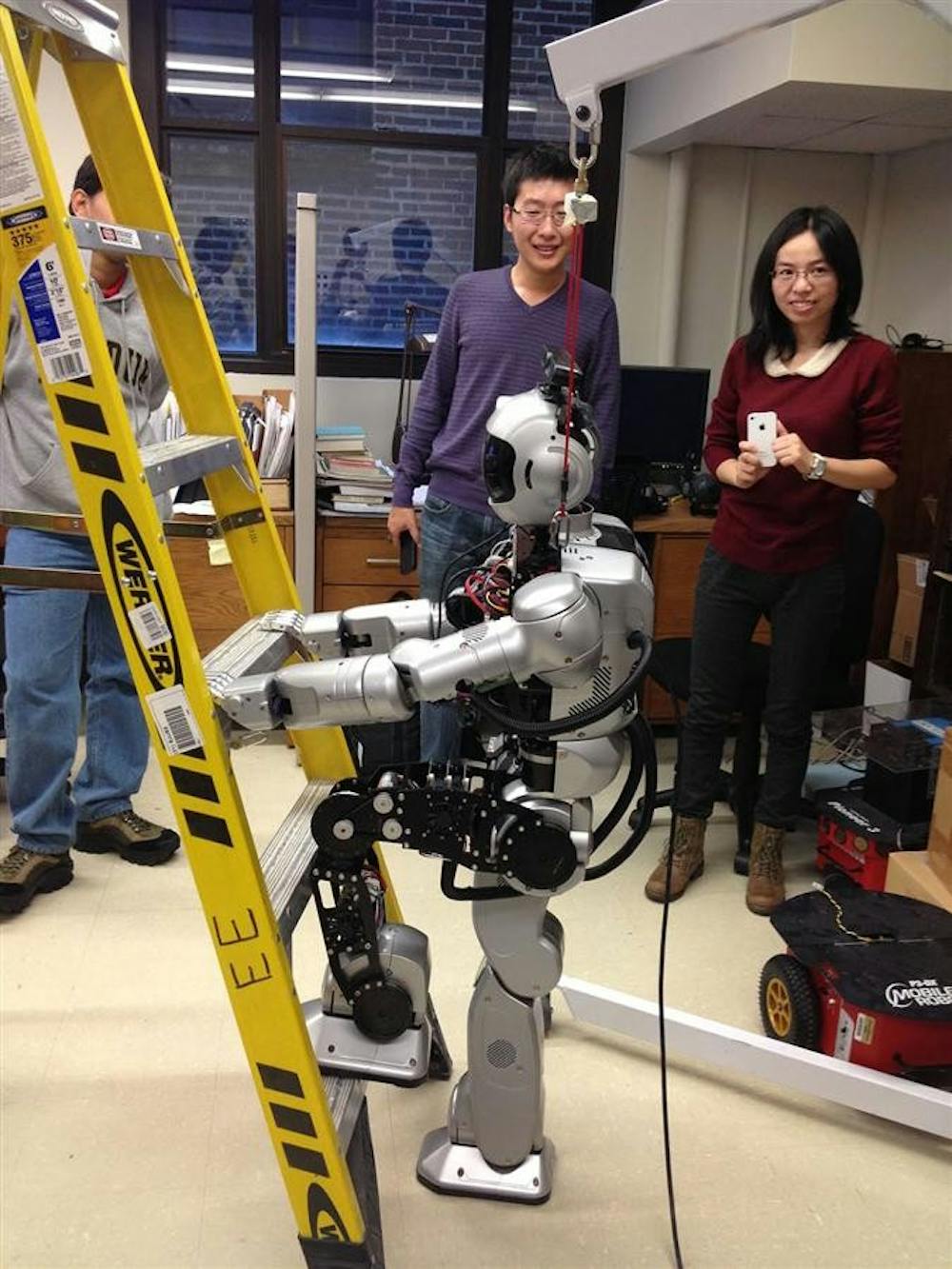
Assistant Professor of Computer Science Kris Hauser and graduate students Yajia Zhang and Jingru Luo will join with a professor and three students from Purdue University as well as eight other universities on their 10-school team.
Other members of the team include Columbia University and Georgia
Institute of Technology.
The team is one of seven that have been instructed to create robots that can conduct difficult tasks such as climbing a stairway or connecting a fire hose, according to a press release.
“At one level our software figures out how to coordinate the robot’s stepping and reaching motions so it remains balanced and energetically efficient, but at another level it makes strategic decisions about how to climb, like whether to step up one rung or two, or whether to grip the rungs or the rails,” Hauser said in a press release.
Simulated tests of virtual robots will allow the software to be used to design new arms and hands.
The tests will determine how design choices can affect the robot’s performance.
The portion of the competition that just began will last 15 months and end with a challenge that will test the robot’s ability to complete tasks in the wake of disaster.
The robots will have to do tasks such as removing debris and opening doors.
IU will receive $130,000 in funding for the first phase, and a possible total of $251,152 if the team progresses to the second phase.
After the challenge, teams may be selected to continue to a second phase, which leads to another competition next year.
— Matt Stefanski
Researchers compete in robotics competition
Get stories like this in your inbox
Subscribe



