
Paint.
That’s what senior Michael Park saw on his face when he looked in the mirror after rolling out of bed to brush his teeth.
He tried to recall why there could possibly be paint on his face, but he was
unsuccessful.
It was 10 a.m. on a Wednesday, and Park had gone out with his friends the night before to “$2 Tuesday” at Kilroy’s on Kirkwood. He felt hungover and groaned at the thought of his 11:15 a.m. class but forced himself to get ready anyway.
Meanwhile, junior Margaret Bentzel was sipping a coffee and getting ready for her 11:15 a.m. class, feeling well-rested. She had finished her homework and hung out with her roommate before going to sleep the night before.
It was the middle of the second week of the spring semester, and both Park and Bentzel were beginning to feel the oncoming stress of studying. The first week of the semester, “syllabus week,” during which students have been known to party, had come to an end, and the workload from classes was starting to grow.
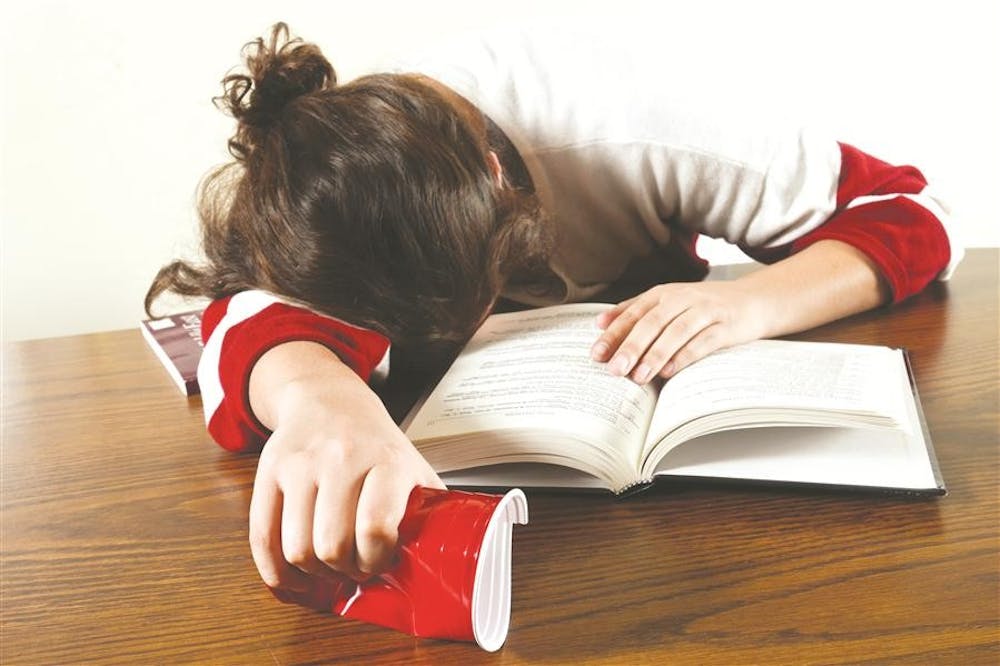
Some students say they cope with the stress by going out less, but others cope by going out more.
Carolyn Lee, chief psychologist at the IU Health Center, explained it this way.
“Many people use stress as an excuse for engaging in excessive party behavior,” Lee said. “However, most college-aged people can recognize the downsides of excessive partying, alcohol or drug use.”
Park, a mathematics major, said he drinks about 20 drinks in an average
night out.
“When I want to rage, I start off pregaming with about five to seven beers, take about five shots in between the beers, then go to the bars and probably have around eight drinks at the bar, so around 20 drinks total,” Park said.
Lee said students might realize this extreme partying can be harmful but try to rationalize the behavior.
“Even if they say their use is similar to their friends’ use pattern, they can still admit that it is excessive and harmful to them, or at least not helpful,” she said.
“The danger is that it is easier to become psychologically or physically addicted to alcohol and drugs than people want to admit.”
In addition to the possibility of dependence, high alcohol consumption can have other side effects.
“Overall, it is a detriment,” Lee said. “Since alcohol is a depressant, students often feel more depressed while and after drinking than when not drinking. Plus, the aftereffects — hangovers — further reduce their ability to perform effectively academically and socially, thus adding to their stress level. Chronic dependence on alcohol for academic or social ‘coping’ leads to long-term deficits in developing other, more adaptive coping strategies.”
Park said he does not think this behavior is negatively affecting him.
“Maybe in the long run, but I’m fine right now,” Park said.
Even with all the partying, Park said he still manages to complete all of his homework during the week and maintain a 3.4 grade-point average. He said how much he goes out depends on his amount of stress.
“If there’s a test that I absolutely know I need to study for, I won’t go out, obviously, because I need to study,” he said. “I’ll probably just go to the library and try to do whatever I can at the library, but if it’s for something that’s in the future, I would rather go out and have a good time and just forget about it.”
Bentzel, a marketing major in the Kelley School of Business, said she tends to stay in more as her stress level grows.
“When I get stressed out from school, I tend to go out less and focus on the work that I need to get done in order to make me less stressed,” Bentzel said. “Monday through Thursday, I work as hard as I can and don’t go out so that I can enjoy myself and relax and have fun on weekends.”
Both Bentzel and Park said they go out most Thursday, Friday and Saturday nights, and Park also frequently goes out Tuesday nights.
Sophomore Kaitlyn Dalton, however, reacts differently when she’s stressed.
“For me, when my stress level is building due to school, I am more likely to go out,” she said. “I know for me, I need to do my work in shifts. I cannot just sit down and do all of my work at once. If I am busy, I tend to go out with friends more often so I can relax some in-between times of business.”
Bentzel uses socializing as a stress management technique frequently to relieve personal anxieties.
“If I’m with my girlfriends and we want to relieve stress, we’ll do manicures and pedicures or a workout video or go out to dinner or something like that,” she said.
“If I’m with my boyfriend, we’ll watch sporting events on TV, rent a movie or hang out with our roommates in a group setting at somebody’s house.”
Lee said socializing is a necessary part of stress relief.
“There is a lot of research supporting the value of a good support network for stress management, as well as physical health,” she said.
Park said that, aside from going out and drinking, working out is among the activities that help him relieve stress.
“I also go to the gym, watch TV, hang out and talk to friends, and chill with friends to relax,” he said.
Christine Von Der Haar, a senior lecturer in the Department of Sociology, said Americans experience a great deal of stress on a daily basis, college students being no different.
“However, the critical thinking skills that they are developing in college are designed to help them solve problems and make good decisions,” she said. “They would be wise to use these skills in their own personal lives and figure out good ways to reduce stress.”
Long live the stressed
Sociology faculty point to possible correlation between stress levels, partying based on students’ experiences
Get stories like this in your inbox
Subscribe



