
A piercing shot rings out in the quiet southern Indiana morning. A doe drops. Another thunderous blast echoes off the steep hills on either side of the valley. A buck drops. Chelsea has executed her lethal job to perfection yet again.
It is 8 a.m. on a warmer-than-usual day for mid-November in Nashville, Ind. Mechanical contractors Richard Hartman of Franklin, Ind., and Glenn Masonia of Greenwood, Ind., have their work cut out for them if they want to enjoy their earnings. Isolated deep in the woods, the hunting pair has hundreds of yards of tough terrain between them and their truck; and in this 70-degree weather, with no refrigeration, deer meat can go bad in about three hours. Without help, Chelsea’s masterful work will spoil.
Chelsea, a beautifully camouflaged 12-gauge 187 Remington shotgun, is named after Hartman’s niece. “She is a pretty little girl, but if you mess with her, she will lay the smack down,” Hartman said with a smirk and an air of confidence.
Though he and Masonia have been avid recreational hunters for years, this time they hunt to eat the lean venison. Last year, due to obesity, Hartman was told he had six months to live, but gastric bypass and a stomach staple were able to save his life.
“See that man over there?” Hartman asked, pointing to Masonia, who is possibly twice his size in weight. “This time last year I weighed more than he did.”
Being selected to participate in this year’s hunt not only helps him in his health battle, but also allows him to help control a growing problem.
Indiana’s Brown County State Park has been selected to have deer reduction hunts almost every other year since the event’s inception in 1993. On Nov. 14, and Nov. 15, the park closed its gates to the public as 600 licensed hunters showed up with their shotguns to help reduce the deer population and restore ecological order. Some hunters attended the event purely for sport. Others said they believed they were doing a public service for their community and local ecosystem. In this economy, however, most show up above all else for the chance to provide their families with a bounty of venison.
Brown County State Park was the first state park to have the now annual and statewide deer reduction hunt after a decade of studies from Department of Natural Resources biologists that found a monumental deer overpopulation in Indiana, causing severe ecological repercussions. The situation was causing unhealthy deer, crop damage, danger to humans on the road and habitat destruction. Three herbaceous species — sweet cicely, white baneberry and jack-in-the-pulpit — were nearly extinct due to excessive deer consumption. The only solution — though it was a controversial one at the time, since one of the main attractions of Indiana state parks is deer watching — seemed to be to unleash the inner predator in humans.
“This is not a recreational affair,” said park naturalist Jim Eagleman. “We do not promote trophy hunting. We’ve always promoted any deer that runs in front of you, take it. We’re biologists. We want data. After these hunts, we’ll have hunter data coming out of our ears.”
Every year Brown County has been selected by DNR biologists as one of the state parks to have the hunts, standby drawings are held to determine who the 600 hunters will be. To be eligible for selection, hunters must be Indiana residents who possess a valid license to take deer and are at least 18 years old. Those who show up to the hunt every year belong to one of two schools of hunters: recreational or sustenance hunters. The park rangers can usually figure out which category hunters fall into upon arrival by the type of pickup trucks they drive.
“Of course, you always see the rinky-dink old trucks sputter in here with a bunch of guys that are just hungry,” biologist Jeff Riegel said, who does not work at Brown County but comes in to help out at every deer hunt because of his ability to determine the age of the deer. “Then there are those detailed, shiny big ones with overweight retirees with all the customized guns and latest hunting gear. But I haven’t been seeing as much of those this year.”
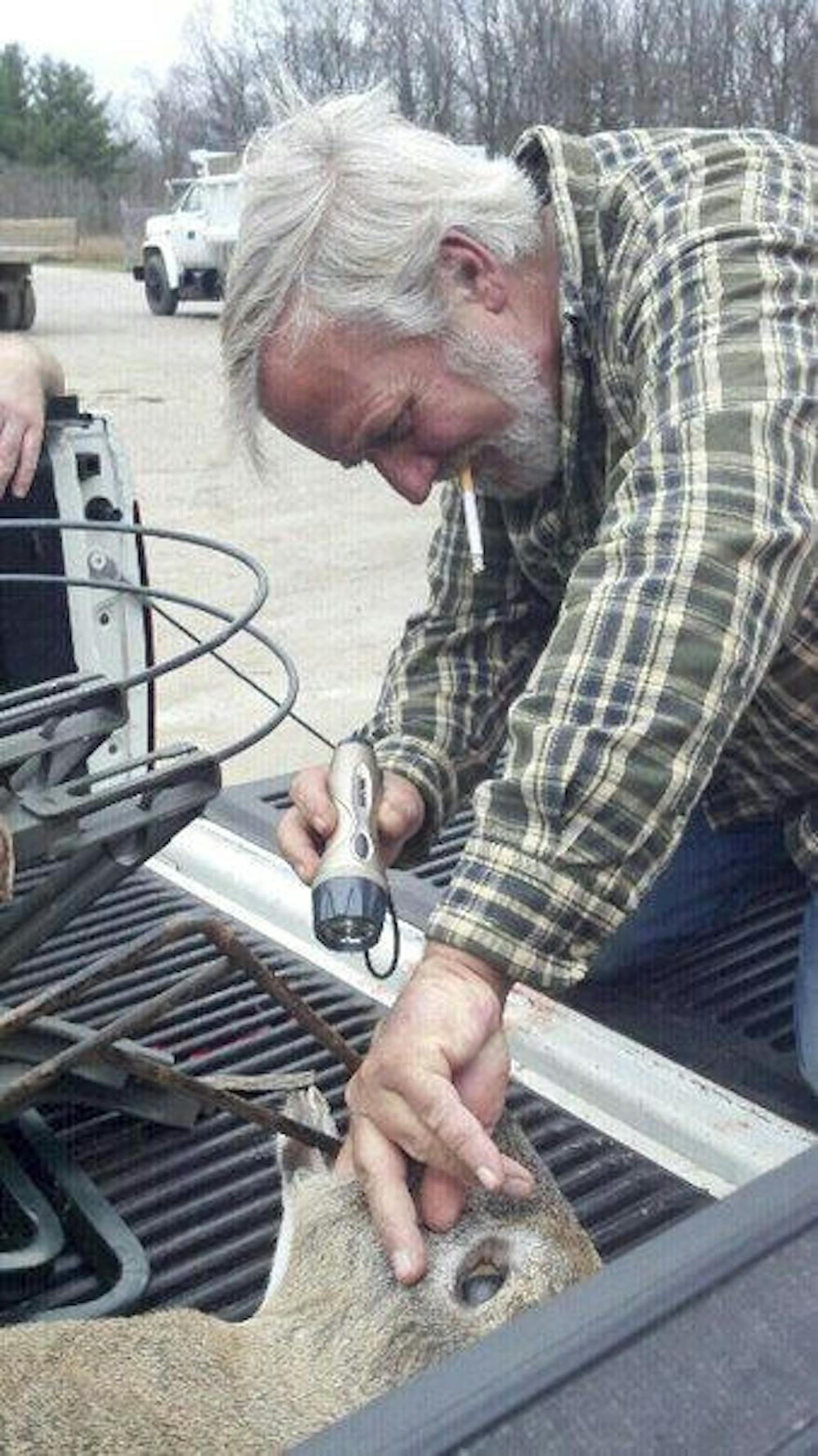
Riegel is an older man with weathered skin, thinning white hair and a full beard. His plaid, long-sleeved shirt and dirt-stained jeans give him the look of a true outdoorsman. Riegel has been hunting for so long he could probably make a kill with his eyes closed, a common trait amongst those who run the hunt.
Assistant Property Manager Kevin Snyder is such an avid hunter that he joked, “Making me work the deer reductions is like putting a fat kid to watch the cake.” But Riegel has been in this business longer than just about everyone else, and he notices when there is a shift in hunting focus.
Due to its rocky terrain, Brown County is a tougher gig for recreational hunters, since a large portion of that group consists of elderly, and sometimes overweight, individuals enjoying their retirement. “I saw two old farts sitting around at a picnic table. I guess they were waiting for a deer to walk by,” joked Riegel. That was an uncommon sight this year, however, as the number of sustenance hunters was staggeringly larger than that of the recreational hunters.
At the main check-in station, where hunters bring their kills for proper documentation, equipment mechanic and long-time park veteran Newton Hendrick noticed the hunters were not bringing by “big fancy bucks like usual.” Most of the hunters this year, it seemed, were skipping the notion of waiting for the trophy buck and taking what they could get for food. The deer were arriving at the check-in station a lot faster than before as well. It was not even 11 a.m. and 10 hunters had brought in kills. In most years, almost all of the check-ins occur after noon.
The first deer checked in of the 2011 season was a juvenile, weighing no more than 60 pounds. The deer was shot by a young man from Jennings County named William Gates, whose ear-to-ear smile while pondering how to best cook it alluded to just how excited he was for the meat.
“I’m probably going to make most of this into deer jerky. When you make it right, that stuff tastes real good,” Gates said.
The big winner on day one of the hunts was John Byerly of Carthage, Ind. He killed the sole legitimate trophy buck of the day — a fully grown, 200-plus pound eight-pointer, meaning the antlers were so large they had eight different points — but even he could only focus on the year’s supply of free meat he had just won.
“Oh, I’m going to eat this deer. I make a mean summer sausage. This should last my family at least nine months, maybe even a year and a half,” he said.
Father and son pair Dwayne and Ethan Martin took off work and high school, respectively, for both Monday and Tuesday in their pursuit of deer steaks. Fireman Chris Connell was willing to trade in his fire truck for a pick-up truck for the day so he could take a shot at getting a deer that “is all going into summer sausage.”
Charles Nally of Taylorsville, Ind., was once mostly a trophy hunter, but “that was a while ago. I’ve been trying to get drawn (for the reduction hunts) for many years. This was my first time. I’m getting some back strips and hamburgers out of this one.”
Riegel noticed the hunter’s focus this year was further away from reducing the deer population than in previous years.
“I guess it’s the economy,” said Riegel. “Everyone seems a lot more desperate to kill a deer and bring it home. I think one guy wanted to eat it right now. He asked me what’s the name of the guys that come in and draw out the blood. So, I told him vampires, but I don’t think we have any professional vampires here today.”
Back in the forest, Hartman and Masonia’s boots are flooded from sweat. They have been slowly dragging Chelsea’s kills in a wheelbarrow up and down hills, leaving a bright red blood trail behind them. Their location was great for finding deer but not for transporting them. Hartman picked that spot Nov. 2. That day he got married in the park, and following the ceremony, he went around scouting locations.
The two friends called in for help and it arrives in the form of Kevin Snyder, who is well aware of the number of overweight men who have fallen victim to heart attacks while hunting. After tugging the deer carcasses to the main road, Snyder hopped back in his truck on his way to help out the next group of hunters who got too aggressive with their hunting locations. Hartman interrupted his conversation with Masonia about filleting deer tenderloins and turns to Snyder, in his truck with the windows rolled down: “My heart can’t thank you enough.”
The buck stops here: Hunters in Brown County State Park take advantage of deer overpopulation in tough economic times to put food on table
Get stories like this in your inbox
Subscribe



