
If you’re scared, you’re dangerous.
So Super Stock driver Dewayne Gross says he replaces his fears with strategy.
It’s a little after 8 p.m. Friday at the Bloomington Speedway. As the white race car, which he spent two years assembling, sits idly at the entrance to the dirt track, he releases all thoughts.
“You just go,” he said earlier in the night. “Just chill out before the race.”
The Super Stock track entrance is on the far left of the pit area, past the bleachers and trailers where audience members in racing sweatshirts and jeans fold their arms against the cold.
Gross’ car waits there with six others, his right hand holding his racing helmet over the metal siding where a passenger seat would normally be.
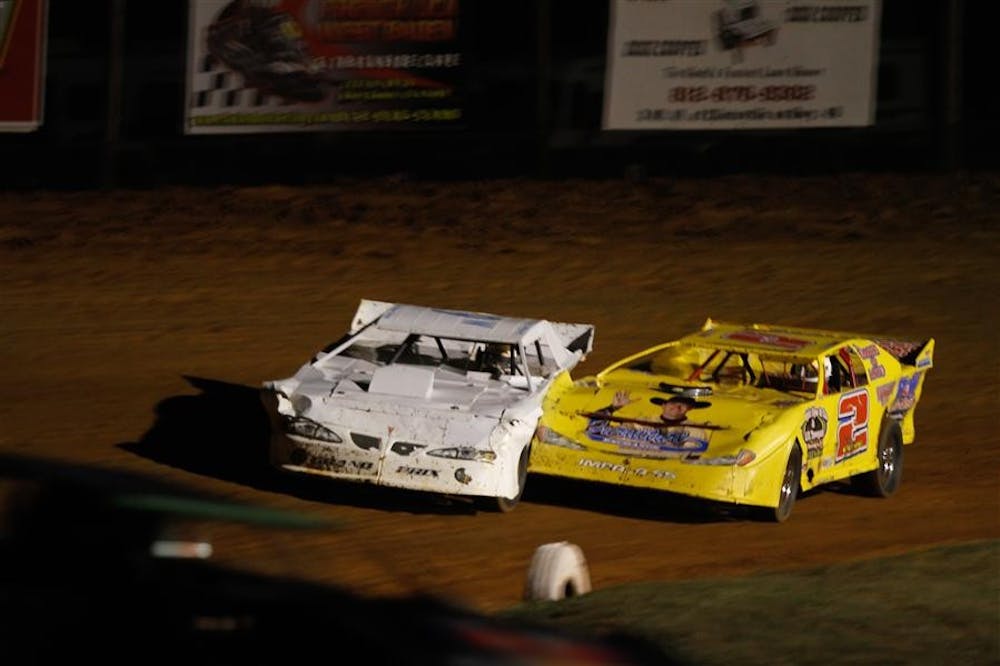
There’s a red car idling in front of him and a yellow car behind. He studies them as the first heat of the Super Stock division finishes.
He knows most of the drivers from previous races, so he says he knows what to expect once he gets on the track.
A diesel mechanic during the week, Gross has raced in three different classes on weekends for the last 16 years. He spent seven years in Bomber class before moving up to Super Stock.
This year is his first in the higher-level class, and though he has competed in eight races so far this season, he has yet to win.
“The day I stop getting butterflies in my stomach is the day I’ll win,” Gross said.
For the Bloomington Speedway’s season finale this particular Friday, Gross has arrived three hours prior to his first race.
He waits for his heat wearing a partially unzipped purple jumpsuit over a dirt-covered T-shirt.
He is alone in his hobby, unlike many of the other drivers at the track.
“I have friends who help sometimes, but they’re all at other races,” he said, standing next to his car.
Unloading equipment, fueling the car, checking tire pressure — Gross does it all himself and pays weekly costs.
“To start, it’s about $10,000 to $15,000 for a car, then $150 a week if you don’t break anything,” he said.
When the 15 minutes are up, Gross starts his heat third from the front. He knows the other drivers are faster and more experienced in this class. He knows the yellow car behind him will be the first to try and pass. He falls in line with the rest of the cars, matching their speed.
The stoplight in front of him flashes yellow.
Yellow again.
Then green.
He lets go of his thoughts and drives.
Super Stock driver prepares for Bloomington Speedway season finale
Get stories like this in your inbox
Subscribe



