The word “dummy” can evoke laughter, smiles and sarcasm, but for filmmakers and spouses Lindsay and Mark Goffman, “dummy” is a word of inspiration.
When Lindsay, a 2002 graduate of the Kelley School of Business, was sitting in K201, filming a documentary was the furthest thing from her mind.
After graduating, Lindsay moved to Los Angeles, where she went knocking on people’s doors and started working for various production companies. There she met her husband, who became a writer for NBC’s “The West Wing” and currently a writer and executive producer for USA Network’s “White Collar.”
“There was a writers’ strike, and Lindsay and I wanted to do a project together,” Goffman said.
The couple decided to make “Dumbstruck,” a documentary on the world of ventriloquism. The documentary was directed by Mark and produced by Lindsay.
Lindsay said her mother inspired them to make a documentary on ventriloquism.
“My mom is a second-grade teacher. Whenever her students would start to get rambunctious she would bring out a dummy and use it to calm them down,” Lindsay said. “She didn’t do a lot of hobbies, but my dad encouraged her to go to a ventriloquist convention.”
Lindsay and Mark went with her mother to the convention, and Lindsay said they were fascinated by what they saw there.
“There are 510 ventriloquists in one room talking to each other and their dummies,” Mark said. “We really wanted to know more about the world.”
After speaking to the editor of the documentary “Wordplay,” the couple went on to do some fundraising and put a budget together to make their documentary.
The Goffmans found five ventriloquists, or “vents,” that blew them away, Mark said. The Goffmans decided to follow them for their documentary.
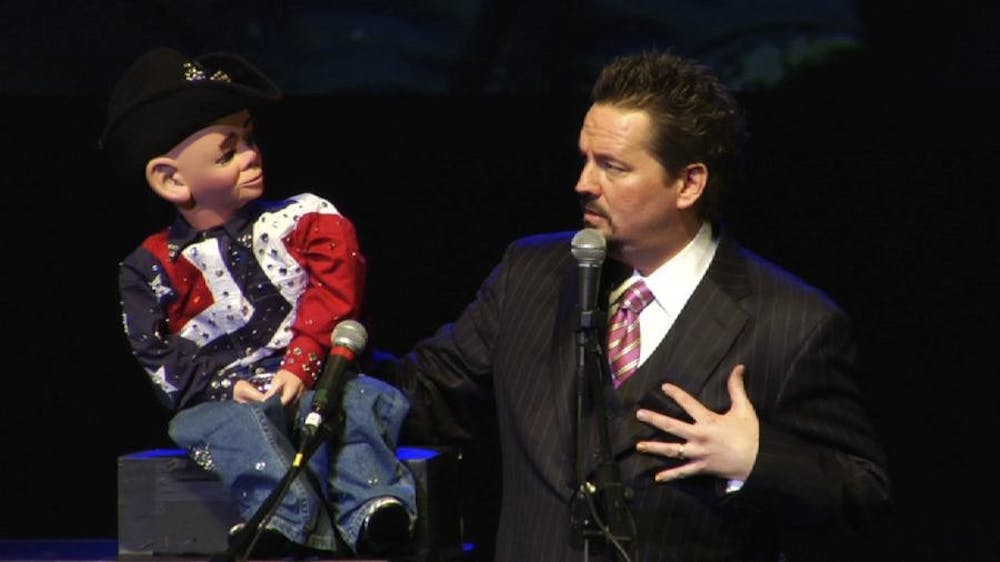
The vents are: 6-foot-5 Wilma Swartz; Dan Horn, who has been a guest on “The Late Show with David Letterman”; 13-year-old Dylan Burdette; former beauty queen Kim Yeager; and Terry Fator, winner of “America’s Got Talent.”
“We love the community aspect and wanted to have information on how their family and friends reacted. That is where we got the best comedy,” Mark said.
Many of the people who decide to pursue ventriloquism as a career don’t get the support of their friends and family, Mark said. The film shows the community of ventriloquists as they bond and help each other.
The film focuses on personal challenges, like those of Yeager, who is trying to become a professional ventriloquist while her family struggles to understand and support her.
Or 13-year-old Burdette, whose father wishes his son would play football rather than play with puppets.
“The film started being about finding out more about this obscure art form of ventriloquism,” Mark said, “but instead what the film ended up being about is the American dream, to be who you want to be and be successful at it.”
The film not only looks at people’s lives, but also the art of ventriloquism.
Ventriloquists are comedians, Horn said.
“A comedian uses the same devices as a ventriloquist; you need a good story and timing,” Horn said. “The only difference is that we have a prop.”
A ventriloquist is a masked personality. A puppet can get away with things a regular person can’t, Horn said.
“There is something indefinable about seeing a good ventriloquist with good technique,” Horn said. “Nothing can match the magic of watching that happen.”
Thus far, the documentary has been well-received, Lindsay said. The film was voted “Best of Fest” at the 2010 Palm Springs International Film Festival.
The film will be distributed by Magnolia Pictures and Truly Indie and is set for limited theatrical release March 26.
“When we screen, the reception has been good. We have gotten standing ovations,” Lindsay said. “We wanted to make a film about these people. By the end, (viewers) are taken in by them and go through the journey with these people.”
Film explores ventriloquist life
Get stories like this in your inbox
Subscribe