Dunn Meadow is cold and white.
The first snow of the season is beginning to cover the grass.
In the fall, dead pine needles spread across sections of sidewalk and collect on the surface of the Jordan River, forming a layer of foliage so thick that squirrels readying for winter can safely walk on the water without sinking.
In warmer months, the meadow is filled with sun bathers and students reading and studying in the shade of trees.
It often plays host to games of Frisbee or intramural Gaelic hurling matches. Even now, pet owners brave the weather to walk their dogs.
Rain or shine, IU students and Bloomington residents enjoy Dunn Meadow for what it is — a meadow.
But, throughout the past century, it has been many other things.
A Runway
In 1911, an airplane drove across Dunn Meadow and took off into the sky.
Well, almost.
IU-Bloomington Chancellor Ken Gross Louis said it was the first airplane flight in Monroe County.
“It crashed into an apple tree,” Louis said.
A Circus
In the 1970s, ‘campus clown’ Leon Varjian ran for student government vice president on the “Birthday Party” ticket.
Varjian didn’t win, but he led a march through Dunn Meadow anyway.
He and his supporters danced through the meadow in clown attire, costumes and band uniforms, singing the party’s official song, “Happy Birthday.”
Today, Varjian is a high school math teacher in New Jersey.
A Music Festival
Small concerts and music festivals are a common occurrence in Dunn Meadow.
In 1998, a concrete stage was built to better facilitate musical performances and speakers, replacing the old wooden stage that had to be repaired or rebuilt every year.
Since then, events such as WIUX’s Culture Shock have taken full advantage of the space, featuring performances by local musicians and national acts.
In October 2009, Victoria’s Secret erected a massive steel stage in Dunn Meadow as part of the lingerie company’s B-Town Bash — a festival-style celebration that IU won through an online contest.
The concert featured performances by artists Girl Talk and Cobra Starship and raised $5,000 dollars for the local Middle Way House.
The wet, fall weather did little to curb the turnout — which turned Dunn Meadow into a muddy, grassless mess. Victoria’s Secret picked up the tab for its repairs.
A Soapbox
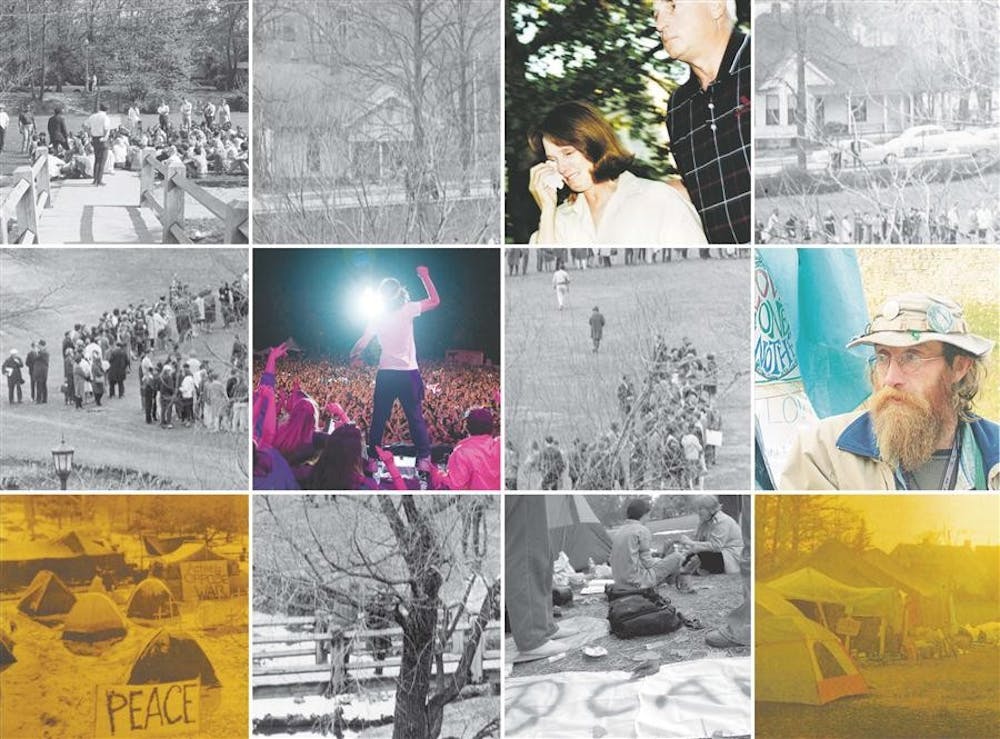
Protests, speeches and vigils — there are few causes Dunn Meadow hasn’t given a space to during the years.
Even fewer, however, have resulted in as great a turnout as a former IU basketball coach’s farewell speech.
On Sept. 13, 2000, about 6,000 people crowded into the meadow, its surrounding sidewalks and roofs of nearby buildings to hear Bob Knight’s address. The coach had been fired earlier that week, after he grabbed and shouted at then-freshman Kent Harvey.
The quiet and peaceful crowd was a stark contrast to the riot-like atmosphere that swept across the University only days earlier.
A fish from the Showalter Fountain was stolen and paraded around campus, while effigies of Harvey and then-IU President Myles Brand were burned. Police allegedly sprayed several students with chemical deterrent.
During his speech, Knight took a few subtle jabs at the administration, but mostly thanked his supporters and urged students to leave Harvey alone.
“Let that kid be a student,” he said. “Let that kid get on with his life. This thing — believe me — it happened a long time before that situation took place. Believe me.”
A Tent City
Since the ’80s, Dunn Meadow has been home to numerous tent cities, peace camps and shanty towns.
Sometimes lasting weeks or even months, these encampments were created by students and local demonstrators in reaction to world issues.
In 1986, a shanty town was assembled to send a message to University officials about segregation in South Africa. At the time, students believed IU was investing in companies that supported the apartheid.
Another shanty town was organized in 1988, this time as an anti-rape center.
However, at the time the University started enforcing stricter rules regarding using Dunn Meadow for protests. The Assembly Grounds Committee, created after the apartheid shanty town, decided that the tents could not remain up 24 hours a day and had to be taken down at night.
“If they are going to have a permanent demonstration, they need to have it permanently inhabited,” committee chair Craig Nelson said in a 1988 Indiana Daily Student article.
“I don’t think it’s a good idea to permit demonstrations to become billboards.”
When America became involved in the Persian Gulf War in the early ’90s, a tent city was erected that lasted two months. The protest was led by IU student Phoenix Myers, who sometimes clashed with University officials about whether the campers should be allowed to stay in the “city” overnight.
Sleeping was not a form of protest, the University argued.
A year later, 10 campers rebuilt the city for a one night remembrance of the two-month protest.
In October 2001, the bombing of Afghanistan and rising concern about the treatment of Muslims led to the erection of another camp. This tent city was started by Bloomington local Sean Bagley.
Bagley is also known as Steps, the nickname for his full spiritual name Steps for Freedom.
As the winter cold and holiday breaks came and interest waned, many students gradually abandoned the camp. However, Steps stayed for eight months.
There hasn’t been a peace camp in Dunn Meadow since.
Dunn Meadow: home to a circus, a runway, a farewell speech
Get stories like this in your inbox
Subscribe