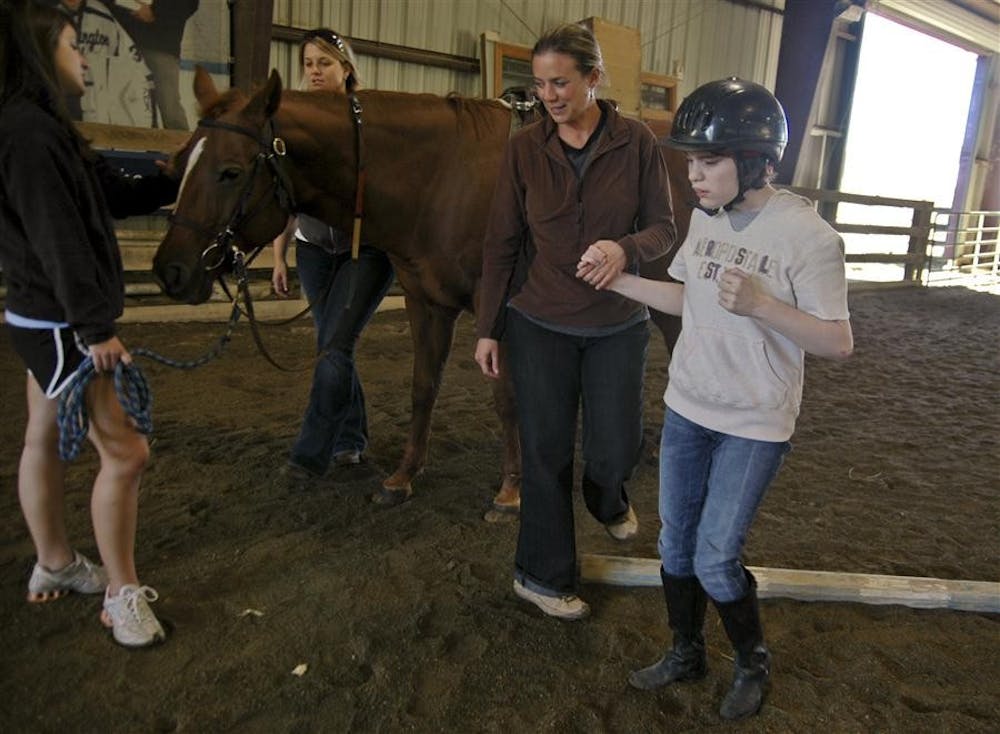
When Jennifer Lung began teaching Libbie Holmes, a 13-year-old with spina bifida in 2006, Libbie would get frightened even when a horse just sneezed behind a fence. But not anymore.
At the end of her lesson, Libbie hugs Cody the horse and says, “I wish I could take him with me.”
She then pets him on the nose and says, “I love you Cody.”
Libbie goes to kiss him, but he moves his head. “I’m sorry Cody,” she says with a laugh.
Lung is the head riding instructor at People and Animals Learning Services, Inc. in Bloomington.
When Libbie began riding, her mom Carrie Holmes was almost as nervous as her daughter was. But once Lung told her she would be fine, Carrie Holmes felt more comfortable and so did Libbie.
Lung has been there when Libbie needed her and Libbie knows Lung will protect her if she falls off, Carrie Holmes says.
Libbie is one of Lung’s “girls” and “favorites.”
“She started out as a little girl who was scared, needy and clingy,” Lung says. “Now, she is Ms. Boss Thing.”
Libbie has become stronger and her walking has improved.
She is hesitant to ride Cody without anybody supporting her on her sides. But Lung forces her to become more independent in her riding.
“Good, your booty is up,” Lung says.
“I can’t stay here for ever, you know,” Libbie says.
Lung instructs her to pull on the reigns instead of just saying “no” in order to gain control.
Cody is Lung’s favorite horse at the barn. He’s a troublemaker who acts likes a dog.
“You know your horse,” Lung says. “He is just difficult. He’s a dork. Push through the dorkiness.”
Holmes has physical control over Cody. Lung wants her riders to feel a sense of independence while they are at the barn. It is at the barn where they can be safe from judgment. The horses give them a chance to be at ease.
Lung said she wants to help her students become more confident.
“The world in itself is a challenge for them,” Lung says. “They have little control over decisions. People tell them what to do all day long.”
At noon, she arrives at the barn and teaches horseback riding lessons until 5:30 p.m.
This is the part she enjoys — interacting with people and the horses. She says she likes making a positive impact on her students by helping them connect with their horses.
Between Lung, the horse and her rider, they are sure to be able to find a skill that the student can flourish in: whether it be trotting, seating, dressage or horsemanship.
No matter what anyone’s skill set is, everyone can learn life lessons at the barn.
***
Lung, with her blond hair in a loose braid, smiles with her pearly whites even as she gets scratched and pinched.
Lung signs into the palm of Karen’s hands, a 37-year-old woman who is deaf and blind.
Signing into the palm of Karen’s hands is how she gives her directions and communicates with her.
Since Karen doesn’t want to cooperate with Lung, she has to repeat each of her instructions two to three times.
When Lung is providing details on what she wants Karen’s next movement to be, she traces her fingertips into the palm of her hands. If she wants Karen to hold the reigns, she taps two fingers into her palms.
The main struggle of their lesson is that Karen refuses to remove her blue winter coat even though it is about 70 degrees outside.
Lung tells her to take off her jacket. Karen doesn’t like that.
“Her brain is a steel trap,” Lung says.
Karen scratches and pinches Lung. She has to be firm with her. She first taps the top of one of her hands and says, “stop.”
“Behave or you are not going to ride,” Lung says sternly.
But Lung does not become frazzled. She separates herself from Karen’s frustrations. Karen wants to have control over anything she can even if that means hurting herself in the long run.
She is the one that has to suffer the consequences — not Lung. Karen has to learn from the choices she makes.
“OK, you’re your own person,” Lung says with defeat.
The pinching and scratching is not over until Karen is done with her lesson.
But for Lung, pinching and scratching are easy to handle — for Karen, this is cooperative. Karen has scratched Lung badly on both her sides and her breasts before. Karen will touch Lung all over her body to find out what will hurt her most.
But she refuses to react because that shows weakness.
Lung understands Karen and has worked with her for seven years. She has no close relationships and no tangible control.
***
It’s the moments of success that keep Lung at the barn. It’s not the money.
She once calculated her hourly rate and she only makes $6.10.
She only makes a $26,000 salary — a 50 percent pay cut from her previous job at an agency that serves people with disabilities in Monroe County.
Lung works 40 to 70-hour weeks even though she is only supposed to put in 40 hours
per week.
Every morning, she schedules the 65 riders and 100 volunteers that inhabit the barn. It helps that at the same time, she can drink coffee and lounge in her pajamas while sitting on her couch.
Lung usually stays up past midnight to check and answer her e-mails. Usually, her inbox is full with at least 35 new e-mails that she needs to answer. She detests the administrative aspect of her job.
But she would rather live paycheck to paycheck than work full-time at her previous employer. For that job, she was on call 24 hours every day and essentially, was responsible for people’s lives. She would get paged at the wee hours of the morning all of the time if there was an emergency.
She landed her previous job because she needed the money and had experience working with people with disabilities.
Lung was unsatisfied with her previous job. It drained her in every aspect of her life. At least at the barn she looks forward to the environment and the people.
“It’s never been about the money,” Lung says. “I’d rather be with horses and kids all day than be in a stuffy office job. I like being on the move. I like the change of it, too. It never gets boring.”
Money is her main source of stress, but her family assists her.
“It sucks that I’m 35 years old, and my dad is supporting me,” Lung says. “At my age, I wish I could be more self-supporting.”
***
A school bus pulls up by the barn. A student steps off the bus and runs aimlessly. Lung notices this immediately and chases after the child.
She grabs the child and her backpack and returns her to one of the volunteers.
After Lung returns the child, she walks back to her office.
While catching her breath she laughs and says, “It’s like herdin’ chickens.”
It’s instances like this that tire Lung and make her enjoy her childfree personal life. Lung loves working with children, but said she likes returning to a house with just her two dogs, Mesa and Azul.
As a woman in her mid-thirties, she isn’t opposed to having a family, but she says she has never had a maternal instinct.
***
Once work is over for the day, Lung travels to the other side of town to take care of her horse Chico and her friends’ two horses at what she refers to as a community barn.
After working with people throughout the day and giving directions and positive feedback with that well-known smile on her face, Lung can be at peace with the horses.
Lung can always be herself around the horses – she never feels judged by them. She can communicate with them through verbal commands and body
language.
She always knows what to expect from them. Horses are predictable and are not as complicated as people.
With them there is no judgment – just unrelenting love and predictable behavior. It is with the horses that she feels most at home.
Horseback riding instructor helps disabled riders gain independence
Get stories like this in your inbox
Subscribe