Two male penguins raise a baby penguin together, an 11-year-old orphan realizes he is a wizard and a young Jewish girl hides in an attic during the Nazi occupation of the Netherlands.
All three stories wildly vary in plot and genre, but they share one common characteristic — all have been banned or challenged in U.S libraries.
The Gay, Lesbian, Bisexual and Transgender Student Support Services office is honoring the American Library Association’s Banned Books Week by sponsoring an open house in the office’s library to showcase several challenged books.
The banned books open house is available for viewing from 9 a.m. to 5 p.m. through Friday at the GLBT office.
“Freedom of information is an American tradition,” said junior Eric Gonzaba, GLBT office outreach coordinator. “There’s a right for these books to be in libraries.”
Gonzaba said the library association maintains a list of banned and challenged books, which the GLBT office used as a reference.
Most of the books picked for the display were already in the GLBT office library, said Carolyn Caffrey, a School of Library and Information Science graduate
student.
“A lot of the books on the list are GLBT related,” Caffrey said. “The bannings begin under the guise of sexual content, but the books usually are actually dealing with homosexuality and queer issues.”
Many of the books in the showcase were written for children and were banned or challenged because of homosexual themes.
Book banning is not a thing of the past, with many of the books displayed challenged in the past 10 years, Caffrey said.
The 2005 book written by Peter Parnell and Justin Richardson, titled “And Tango Makes Three,” tells an illustrated, true account of two male penguins who are in a relationship, are given an egg and care for it.
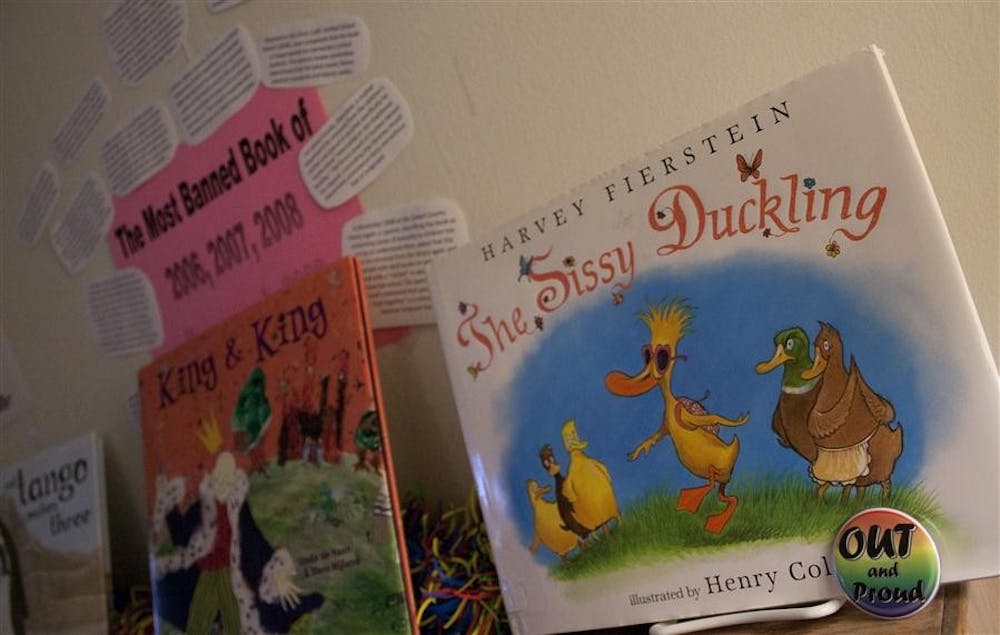
Another book, the 2002 “King and King” by Linda De Haan and Stern Nijland is a modern Dutch fairy tale about a prince whose mother insists he marry
a princess.
Suitor after suitor is marched in front of him until he falls in love with one of their escorts — another prince.
“The Sissy Duckling,” another 2002 book by actor Harvey Fierstein follows a duck named Elmer, who is called a sissy because of the clothes he wears until he proves his bravery after his father is wounded by a hunter. The book never states Elmer’s sexual preference, but parents in Texas moved to also have it banned in schools and libraries.
“Revolutionary Voices: A Multicultural Queer Youth Anthology,” which is a collection of essays about young people coming out of the closet, was recently banned this year in Burlington County, N.J., after some of its illustrations were branded as “child pornography,” Caffrey said.
One of the images in question supposedly illustrates two men having sex. The book’s editor, Amy Sonnie, said the illustration is actually a stock photograph of one man hiking a football to another.
In addition to the books on display, including David Sedaris’ essay collection “Naked” and Annie Proulx’s short story “Brokeback Mountain,” is information about banned books not available in the library
GLBT office assistant Carol Fischer said all books the GLBT references range in genre and type.
“Banned books are not just a GLBT issue,” Fischer said. “Everybody can be affected.”
GLBT showcases contended books
Get stories like this in your inbox
Subscribe