“Make it beautiful.”
That simple instruction from stage director Vincent Liotta began the long design and production process leading to the sets and costumes of the latest IU opera.
Even those far removed from the opera world have heard the name “Puccini,” and they now have the chance to experience the composer’s 1917 “La Rondine,” or “The Swallow.”
The performance opens 8 p.m. Friday at the Musical Arts Center.
“It’s a story about the fact that you can’t ever really go back,” Liotta said.
While many of the program’s operas — like the recent “Lucia di Lammermoor” — use sets and costumes from previous productions of that show, “La Rondine” will feature all-new costumes and sets from two designers: Bill Forrester, a scenic designer who has worked all over the country, and Linda Pisano, head of IU’s Costume Design program.
The title character and proverbial swallow, Magda, is the mistress of the wealthy Rambaldo around 1910 in Paris. Inspired by a poet, she goes off in search of the true love of her youth, rather than remaining in the gilded world without him.
“It’s a story about trying to go back in time and romanticizing youth,” Pisano said, describing it as “bittersweet.”
Disguised as a shop girl, she finds passion with the young Ruggero, who eventually proposes to her. In the end, she turns him down and returns to Rambaldo because she has been lying to Ruggero and knows that her past would destroy his reputation.
“She realizes that she can’t do this to him because she’s living a lie,” Liotta said. “She has to make the decision that is best for everyone ... This is a very strong woman. She’s got a very good sense of who she is and what is right and wrong.”
Liotta said the difficulty of Magda’s decision is one of the clearest signs of her strength.
“Strong is somebody who realizes what has to be done and makes the right decisions,” he said. “That’s maturity to me. That’s being an adult.”
Both designers have worked with Liotta several times before — including for last year’s production of “Most Happy Fella” — because Liotta said they “click.”
“We’re both on the same wavelength, and that’s what you’re looking for in any good collaboration,” Liotta said of Forrester. “When I was asked who I wanted for a costume designer, I said ‘Linda.’”
And for their parts, the designers said they enjoy working with him as a director.
“It’s great to be working with them again,” Forrester said of Pisano and Liotta. “He’s a great director to work with. He generally knows what he wants and then leaves you alone to do your part.”
Forrester said the second act is his favorite set because the first and third don’t have a chorus.
“There’s a lot going on; it’s very colorful,” he said, adding it wasn’t an easy choice. “It’s sort of like ‘which of your children do you like the best?’”
Unlike the Wells-Metz or Ruth N. Halls theaters, the sheer size of the MAC stage can make designing the shows more difficult.
“IU’s School of Music is blessed with a very good facility, which is also very large,” Forrester said. “You have no choice but to make it big.”
Pisano said her designs compensate for the distance of the audience members in the back rows and balconies who cannot make out patterns or colors that, though saturated, can be lost from far away.
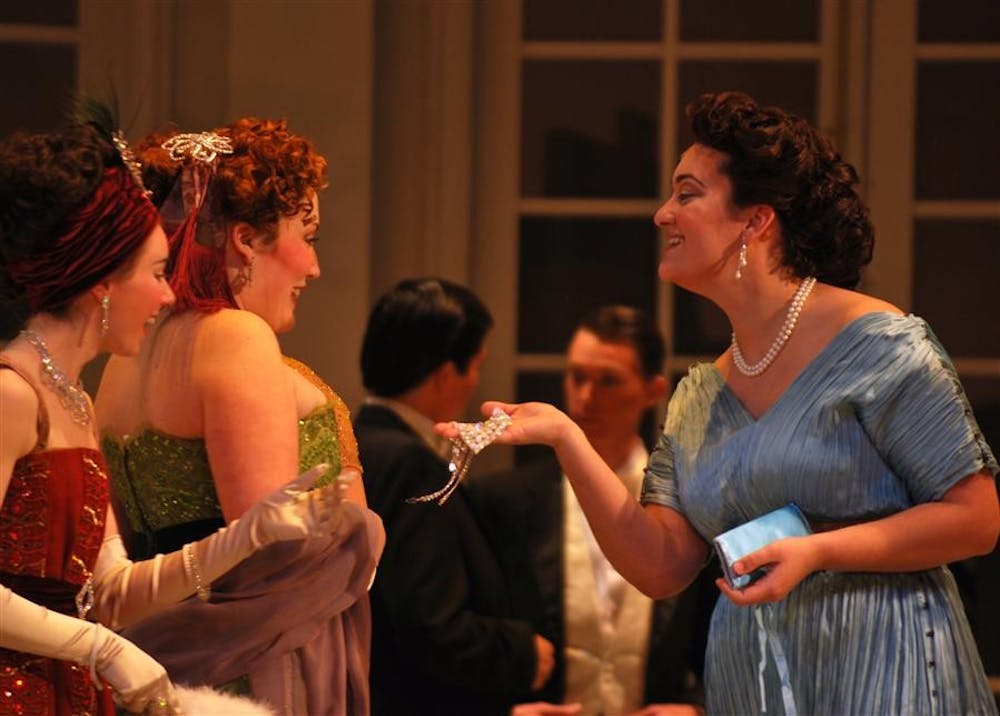
To represent elegance and romanticism, Pisano dressed the lead character in Fortuny dresses, which were very progressive at the time, very expensive and known for showing a woman’s natural curves.
The simplicity of Magda’s gowns is also clear in contrast to the ornamentation on other women.
“This is the beginning of the end of the corset,” Pisano said. “She is so naturally honest. She’s not corseted or contrived in any way. She’s just out there.”
Jacobs School's 'La Rondine' to open Friday
Get stories like this in your inbox
Subscribe