There are more than 43 quintillion ways to solve it.
It has inspired magazines, instruction manuals, books and countless variations.
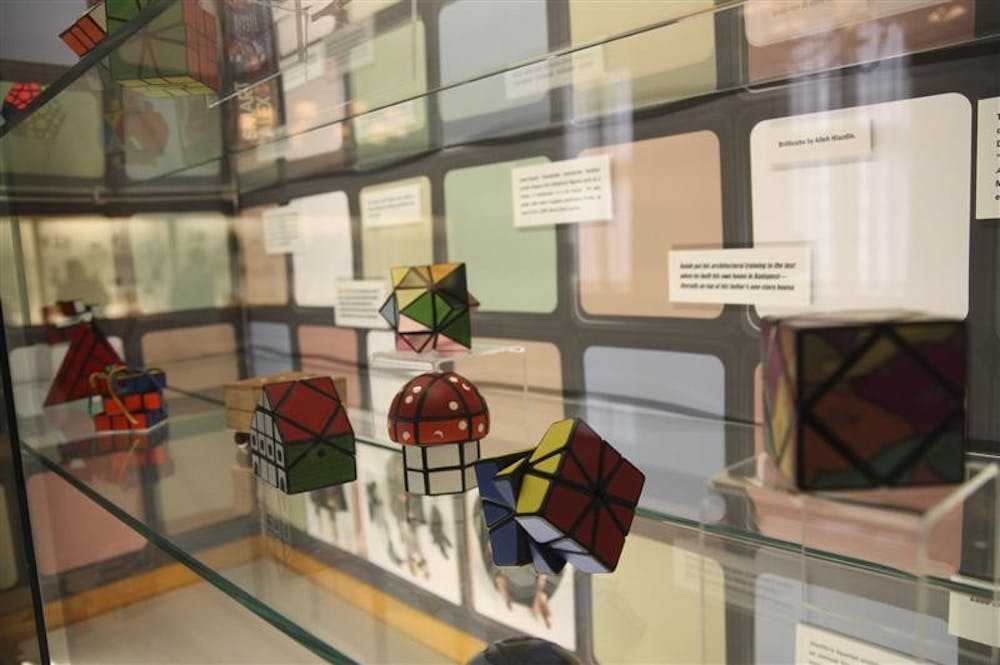
Lilly Library’s new exhibit “Revolutions and Solutions: A Celebration of the World’s Most Iconic Puzzle” celebrates the history and pop-culture status of the Rubik’s Cube.
“The Rubik’s Cube actually means many different things to many different people,” said Curator of Puzzles Jillian Hinchliffe.
The exhibit features 120 pieces from the puzzle collection of Jerry Slocum, who donated more than 32,000 items to the Lilly Library in 2006.
“The challenge was deciding what not to show,” Hinchliffe said.
Hinchliffe put together the exhibit to celebrate the release of Slocum’s newest book and to capitalize on the Rubik’s Cube’s resurgence in popularity. She said the exhibit is aimed at a diverse audience, including puzzle fans from the 1980s, kids, mathematicians and designers.
Hinchliffe takes care of the collection, coordinates public programming and organizes exhibits like this one.
She said it took three to four months to put the display together, with help from the Lilly Library’s conservation team.
The collection depicts the history of the Rubik’s Cube and how the puzzle has evolved throughout the years.
The cube was originally called the 15 Puzzle. Hungarian architect Erno Rubik invented the puzzle in 1974 not as a toy, but as a tool for visualizing three dimensions for art students.
Hinchliffe said through her research, she discovered Rubik wasn’t the first to invent a twisting dice puzzle. She said Larry Nichols invented a similar puzzle in 1957 but didn’t have luck marketing it.
A 1981 article displayed in the exhibit says the toy company made $30,000 per month in royalties from Rubik’s Cube sales when it first entered the international market.
The exhibit also shows how the Rubik’s Cube has made the transition through the years from puzzles shaped like pyramids and stars to puzzles inspired by pop culture.
Examples sit on pedestals in front of the display cases so visitors can try them.
“It’s not just a regular kind of exhibit where you’re looking at things behind glass,” Hinchliffe said. “It’s very hands-on. People can try the toys out themselves.”
Hinchliffe said the exhibit has been open only a week, but the response so far has been positive. More than 135 people attended the opening reception and talked about Slocum’s book on April 8 at the Lilly Library.
Eric Bartheld, director of communications for IU Libraries, attended the exhibit’s opening. He said the collection was extraordinary and informative about the roots of such a famous toy.
“Everyone knows what the Rubik’s Cube is,” Bartheld said. “But not everyone knows what it is about.”
Solving the puzzle
Lilly Library celebrates invention of the Rubik’s Cube
Get stories like this in your inbox
Subscribe