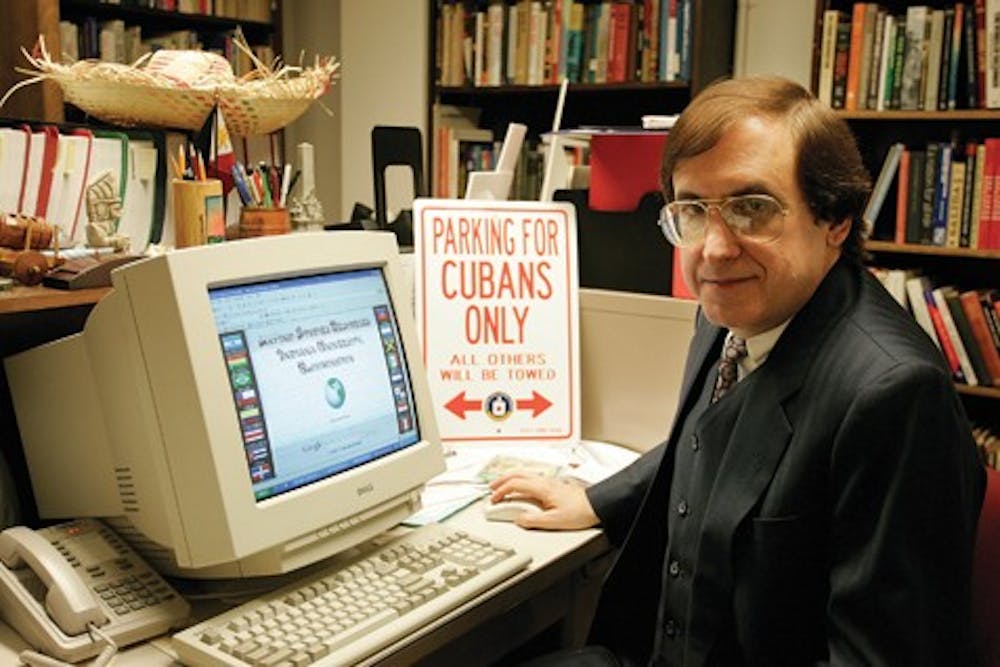
When his mother woke him up at 5:30 a.m. to tell him Fidel Castro had taken over the government, assistant professor of Latino Studies Antonio de la Cova remembered rolling over in bed. As a child living in Cuba at the time, de la Cova said he hadn’t thought much about the news.\nThe year was 1959, and after a period of violence Cubans thought would lead to democracy, Castro began his dictatorship that lasted more than 40 years.\nDe la Cova gave a presentation on the history and present state of Cuba Monday in the La Casa Latino Cultural Center. Theta Nu Xi and Lambda Upsilon Lambda sponsored the event.\nHe started out by providing information about Castro’s childhood that may lead to explanations of who Castro is today. \nOne item he presented was a letter written by a young Castro to Franklin D. Roosevelt in 1940. In the letter, Castro said he was 12 years old and asked Roosevelt to send him $10. Castro was actually 14 years old, so de la Cova said this showed Castro began lying at an early age.\nDe la Cova then explained the Cuban Revolution. During the revolution, Castro told Cubans he would run a democratic government after the revolution was won.\nStill, de la Cova said, during the revolution Castro and members of his political party practiced guerilla combat tactics and executed people for offences such as treason. \n“Revolutions are about violence and death,” he said. “It is not what Rage Against the Machine sings about.”\nOnce Castro’s party took over, many things in Cuba changed and have been incorrectly portrayed since then, de la Cova said. He gave examples of today’s Cuba through stories of people he knows and through a few of his own personal stories. \nOne example he cited is the misconception of Cuban education. In his presentation, he showed slides of files that are kept on children from the first grade until 12th grade. How much support for the revolution each child has is noted in the file.\nThe files are the determining factors for whether a student can go to college or not, he said. \nToday, it is not unusual for a seventh grader to teach a fifth grade classroom, de la Cova said. \nSenior and Theta Nu Xi member Miriam Musco found facts about Cuba informative.\n“I think a lot of people don’t talk about Cuba,” Musco said. “We all know it’s bad, but we don’t know why it’s bad.”\nIn Cuba, many facilities, such as hospitals and hotels, are segregated between tourists and locals. De la Cova said many times people only see the facilities tourists use, which are generally well-kept. However, the facilities locals have to use are the opposite.\nAlthough it was recently announced that locals will now be able to use tourist hotels and beaches, de la Cova said people living on a monthly wage of $17 will not be able to afford this.\n“Every time change comes about, people realize what they were missing out on,” he said.\nThere are no clear indications of what will happen in the upcoming months now that Castro is no longer officially in charge of Cuba. De la Cova said he suspects the youth of Cuba will demand a greater change for a better Cuba. \nAfter the presentation, traditional Cuban food was served. De la Cova ate and shared more stories of when he lived in Cuba with attendees. \nSenior and Lambda Upsilon Lambda member Andrew Cardenas said the program was part of his fraternity’s week of events. He said they wanted to raise awareness about what is going in Cuba today.\n“If we don’t make ourselves aware of it nothing will happen,” Cardenas said.
Professor discusses history, status of Cuba
Get stories like this in your inbox
Subscribe